For 40 years, Anselm House has sought to wholeheartedly serve the University of Minnesota from the center of campus. From the very beginning, Anselm House has endeavored to help the campus community — from freshman to faculty — make meaningful connections. The story of Anselm House is one of gathering, educating, and sending out whole leaders for the whole of life. Anselm House has made it their mission to help students pursue an integrated life—a life of wholeness—in the context of rich, Christian community.
Anselm House staff combine Christian faith with academic training to develop both the moral and intellectual character of the community — and the individuals in it, through connected community, Christian formation, shared learning, and deep inquiry. They host a wide-variety of casual, community gatherings for students, faculty, and staff to connect and engage in meaningful dialogue. They create on-ramps into circles of discovery and intentional, focused study for every stage in the journey of discipleship to Christ. Anselm House convenes speakers and lecturers—thought leaders and scholars across various fields of study—for large public events. And it offers curricular programming and robust academic support to students and faculty seeking deeper engagement. The core values of Anselm House are hospitality, character, faith, and knowledge.
Life was never meant to be a collection of disconnected parts. We’re pursuing wholeness in community.
from the Anselm House website
A Name to Match a Vision
St. Anselm of Canterbury was an 11th century theologian and philosopher. He is remembered, among other things, for the concept of “faith seeking understanding.” He believed that our faith and our knowledge of the world are intertwined. His life of thoughtful faithfulness and engagement with learning provides a model for our presence at the university.
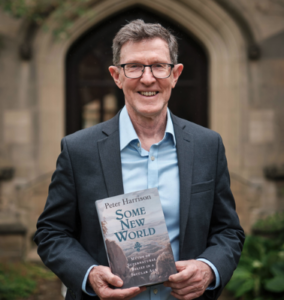
On November 11, from 7:00 to 8:30 p.m., Anselm House (University of Minnesota) will host the 31st Annual Holmer Lecture in Christianity and the Humanities. This year’s lecturer is Dr. Peter Harrison, author of Some New World: Myths of Supernatural Belief in a Secular Age. He will speak about the history of the concept of “the supernatural” . . .
Jennifer Frey explores Thomist elements in Flannery O’Connor’s theology and writing, with a particular emphasis on a Thomist understanding of art. (39 minutes)
In this poetry reading and talk, poet Christian Wiman discusses his own faith journey and how his struggles worked themselves into his poems. (40 minutes)
In this lecture, Karen Swallow Prior examines the power of great literature to shape lives, nourish imaginations, and develop a vision of the good life. (43 minutes)
William Hurlbut explores current neurobiological advancements and the ethics and dangers of biotechnology interventions that go beyond therapy. (62 minutes)
In this 2016 lecture, artist Makoto Fujimura asks what would it look like for Christians to be stewards of beauty and human flourishing in all areas of life and culture. (48 minutes)
Vigen Guroian explains how children’s literature has the capacity to birth the moral imagination in our children, affirming for them the permanent things. (53 minutes)
In this 2022 lecture, Oliver O’Donovan explains the historical background — and present consequences — of the assertion by Jesus of two great commands. (67 minutes)
Every volume of the Journal produced since November 1999 (Volume 40) is now available to members in our catalog, and on the first Friday of each month, we will highlight one of these archived collections of interviews. The entire highlighted volume will be available for one month to members and to anyone who signs up for a free Visitor’s Pass.*
Volume 146 of the Journal, produced in February 2020, is this month’s free sample volume. In this Friday Feature you will hear excerpts from interviews with Mark Mitchell about why the modern denigration of tradition has rendered political life so volatile; with Hans Boersma about how the ultimate end of seeing God should inform how we live now; with Henry Edmondson, III, about political ideas in Flannery O’Connor’s work; with Brian Clayton and Douglas Kries about integrating faith and reason; with Conor Sweeney about wrestling with the ‘death of God’ with the help of hobbit wisdom; and with Carole Vanderhoof about Dorothy L. Sayers.
*Follow the instructions on our “Listen for free” page to sign up for a free Visitor’s Pass. With this Pass, you can download these audio files to our app on your mobile device. NB: We don’t sell or share our listeners’ information with anyone else. No one who signs up for any of our memberships, free or paid, need fear that their contact information will be sold or shared with any other entity.
Antón Barba-Kay on the shape of the virtues in the digital age
What virtues do we need to live well in our digital age, and how might those virtues be best formed, not only individually but as communities? In this March 2026 lecture, Antón Barba-Kay examines the notion of virtue ethics, a concept that has become increasingly alien to many. He then discusses how digital technology actively deforms, disassociates, and disembeds our lives and experiences. Barba-Kay proposes key principles that educational institutions can embody in order to help form virtuous human beings and communities in light of what we are; and he articulates three “interlocking” virtues that relate to those principles. Throughout the lecture, he offers reflections on these issues from his teaching experience at Deep Springs College, a unique school that forms students through academics, self-government, and manual labor.