Established in 1990 and published ten times a year, First Things publishes in-depth, grounded commentary on the pressing issues of the day. Writers and readers of First Things include scholars, engaged citizens, and government, business, and church leaders. The magazine publishes economic analysis, policy proposals, judgment about how to use American power abroad, and clear, realistic thinking about how to bring the fragmenting elements of American conservatism into a workable, coherent coalition. First Things examines the metaphysical and religious foundations necessary for cultural renewal in the West, affirming a commitment to the first principles that are central to a flourishing public life.
The inaugural issue of First Things was published in March 1990. The magazine’s founding editorial, “Putting First Things First,” can be found here. Today, First Things encompasses the print magazine, which is published ten times each year; firstthings.com, which publishes daily “web exclusive” articles; and two regular podcasts: Conversations with Mark Bauerlein and The Editor’s Desk.
The Institute on Religion and Public Life, a 501(c)3 nonprofit organization (EIN: 52-1628303) and the publisher of First Things, was founded in 1989 by Richard John Neuhaus, a Lutheran pastor who later became a Catholic priest. (Incidentally, Ken Myers worked with Neuhaus on a predecessor publication to First Things, a quarterly journal called This World.) The Institute’s mission is to advance a religiously informed public philosophy for the ordering of society. In addition to publishing First Things, the Institute on Religion and Public Life executes core educational programs, including:
Erasmus Lecture, which enters its 35th year and now comprises a poetry reading, a post-Lecture dinner for Editor’s Circle donors and leading scholars, and a next-day scholarly colloquium;
Evangelicals and Catholics Together, which was established in 1994 and continues to convene prominent Protestant and Catholic scholars to publish public statements on critical theological, cultural, and political topics;
Junior Fellows program, which trains two recent graduates each year;
Half-day executive seminars in cities around the country;
Intensive weekend Intellectual Retreats;
First Things Lecture in Washington, D.C.;
Our reading group, which meets monthly from September through May, with both in-person and Zoom options available; and
Other events, including arts events, book signings, and lectures at our Manhattan editorial office and around the country.
In addition to First Things editor R. R. Reno, many of the magazine’s key contributors have been guests on the Mars Hill Audio Journal.
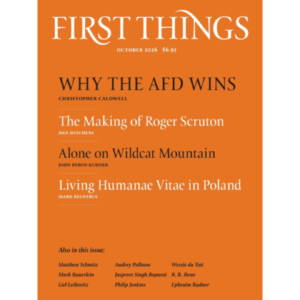
The October 2026 issue of First Things magazine includes articles by John Byron Kuhner (“Seven Years Alone on Wildcat Mountain”),Mark Regnerus (“Living Humanae Vitae in Poland”), Dan Hitchens (“The Making of Roger Scruton”) . . .
Bishop Robert Barron explores the misanthropic and inherently unstable anthropology at the heart of the modern university and offers an alternative for human flourishing. (46 minutes)
In this 2026 lecture, Mary Harrington explores modernity’s “Thomophobic epistemological straitjacket” that bans serious inquiry into the nature of things. (41 minutes)
David Bentley Hart argues that if it rejects Christ, the only remaining option for a post-Christian culture is conscious or “narcotic” nihilism, which takes the form of absolute, meaningless volition. (66 minutes)
In this lecture, N. T. Wright examines the epistemology of love and how it counters the reductionism of Enlightenment and Epicurean ways of knowing. (63 minutes)
In this October 2023 lecture, Carl Trueman explores the concept of “desecration” as a frame for understanding the nature of modernity in our time. (42 minutes)
Edward T. Oakes, S.J. explains why John Henry Newman’s eloquent defense of the nature of university education, The Idea of a University, continues to inspire, challenge, and even frustrate its sympathizers. (24 minutes)
In this essay, Stanley Hauerwas explains the breadth and depth of Alasdair MacIntyre’s thought, the goal of which was to help people to act intelligibly and live morally worthy lives. (40 minutes)
In this essay, Judith Martin (a.k.a. Miss Manners) argues that etiquette is “civilization’s first necessity” and an indispensable societal virtue. (21 minutes)
Following a move from one state to another, Gilbert Meilaender explores the tension between being simultaneously a sojourner and a body located in place and time. (30 minutes)
In this essay, Albert L. Shepherd V explains why George MacDonald’s story “The Light Princess” is meant for “all who are childlike in faith and imagination.” (8 minutes)
In this essay, John Ahern explains the beauty and order of counterpoint, the accumulation of multiple melodies that come together in a harmonious whole. (20 minutes)
In this audio reprint of an article from First Things, Church historian Robert Wilken describes how the lives of virtuous Christians became models for imitation.(46 minutes)
While it is tempting to dismiss transhumanism as a fringe science fiction, Mark Shiffman warns that the Cartesian aspirations of transhumanists are becoming more accepted and more common. (45 minutes)
Ethicist Gilbert Meilaender considers the different ways in which we can think about our death, particularly from the paradoxical “simultaneities” of our finite nature and our transcendent desires. (51 minutes)
In this early article from First Things, historian Christopher Lasch poses the question of whether cultural conservatism is compatible with capitalism. (42 minutes)
Theologian Robert W. Jenson describes how a postmodern world is characterized by the loss of a conviction that we inhabit a “narratable world” that exists coherently outside of ourselves. (40 minutes)
Theologian David Bentley Hart muses on what is arguably America’s greatest contribution to civilization: baseball. Baseball, as Hart would have it, is the Platonic ideal of sports. (27 minutes)
David Lyle Jeffrey observes the sense of consistency in poet Richard Wilbur’s work which emerges from his poetic craftsmanship and his awe of and affection for both Nature and human nature. (25 minutes)
Every volume of the Journal produced since November 1999 (Volume 40) is now available to members in our catalog, and on the first Friday of each month, we will highlight one of these archived collections of interviews. The entire highlighted volume will be available for one month to members and to anyone who signs up for a free Visitor’s Pass.*
Volume 146 of the Journal, produced in February 2020, is this month’s free sample volume. In this Friday Feature you will hear excerpts from interviews with Mark Mitchell about why the modern denigration of tradition has rendered political life so volatile; with Hans Boersma about how the ultimate end of seeing God should inform how we live now; with Henry Edmondson, III, about political ideas in Flannery O’Connor’s work; with Brian Clayton and Douglas Kries about integrating faith and reason; with Conor Sweeney about wrestling with the ‘death of God’ with the help of hobbit wisdom; and with Carole Vanderhoof about Dorothy L. Sayers.
*Follow the instructions on our “Listen for free” page to sign up for a free Visitor’s Pass. With this Pass, you can download these audio files to our app on your mobile device. NB: We don’t sell or share our listeners’ information with anyone else. No one who signs up for any of our memberships, free or paid, need fear that their contact information will be sold or shared with any other entity.
Antón Barba-Kay on the shape of the virtues in the digital age
What virtues do we need to live well in our digital age, and how might those virtues be best formed, not only individually but as communities? In this March 2026 lecture, Antón Barba-Kay examines the notion of virtue ethics, a concept that has become increasingly alien to many. He then discusses how digital technology actively deforms, disassociates, and disembeds our lives and experiences. Barba-Kay proposes key principles that educational institutions can embody in order to help form virtuous human beings and communities in light of what we are; and he articulates three “interlocking” virtues that relate to those principles. Throughout the lecture, he offers reflections on these issues from his teaching experience at Deep Springs College, a unique school that forms students through academics, self-government, and manual labor.