Touchstone is a Christian journal, conservative in doctrine and eclectic in content, with editors and readers from each of the three great divisions of Christendom—Protestant, Catholic, and Orthodox. It provides a place where Christians of various backgrounds can speak on the basis of shared belief in the fundamental doctrines of the faith as revealed in Holy Scripture and summarized in the ancient creeds of the Church. To the confusion of voices in the world on matters of order in religious, social, and cultural life, it speaks with a unified voice of that which, manifest in creation and divine revelation, flows from the life of God himself.
Never evasive and never dull, Touchstone is acclaimed by a wide range of Christian leaders for its honest reporting, thought-provoking analysis, and bold commentary. The magazine features cultural criticism and editorials that tackle tough issues, learned and fresh Bible commentary, interviews, book reviews, news of the Church across denominational lines and around the globe, and more.
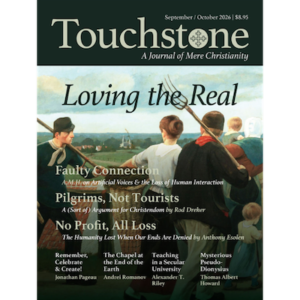
The September/October 2026 issue of Touchstone magazine includes essays by Anthony Esolen (“No Profit, All Loss”), Rod Dreher (“Pilgrims, Not Tourists”), Alexander T. Riley (“Latent Lessons”), Jonathan Pageau . . .
Ken Myers draws on T. S. Eliot to argue that Western civilization has broken down, not into a multiplicity of cultures, but into a “post-culture.” (47 minutes)
Ken Myers introduces various settings of “Ther is no rose of swych vertu,” a medieval carol that uses imagery of a rosebush to describe the Virgin Mary. (29 minutes)
Alan Jacobs examines several literary imaginings of “the last days” and argues that such narration is profoundly inadequate and perhaps even presumptuous. (51 minutes)
In this lecture, R. V. Young examines why people are increasingly unable to discriminate between base and fine art, arguing why this issue is of particular concern to Christians. (41 minutes)
Douglas Farrow examines the relation between “the kings of the earth” and the law of Christ, particularly when governmental law is exercised without reference to natural or divine law. (49 minutes)
Brad Littlejohn builds a case for the idea that authority makes free action possible, illustrating how that occurs within the forms of political and epistemic authority, properly understood and wisely practiced. (45 minutes)
Ken Myers reads an article by Vigen Guroian, “The Fairy Tale Wars: Lewis, Chesterton, at al. against the Frauds, Experts, and Revisionists.” In the article, Guroian critiques the common practice of retelling traditional stories in ways that eliminate the meaning of the originals. (31 minutes)
Today’s Feature presents a reading of a 2007 article by Gilbert Meilaender that explores the significance for bioethics of the mystery of human being as body and soul. (39 minutes)
Peter J. Leithart reviews Lori Branch’s book Rituals of Spontaneity, in which Branch argues that an “ideology of spontaneity” has led to the modern rise of non-liturgical forms of worship. (29 minutes)
Every volume of the Journal produced since November 1999 (Volume 40) is now available to members in our catalog, and on the first Friday of each month, we will highlight one of these archived collections of interviews. The entire highlighted volume will be available for one month to members and to anyone who signs up for a free Visitor’s Pass.*
Volume 146 of the Journal, produced in February 2020, is this month’s free sample volume. In this Friday Feature you will hear excerpts from interviews with Mark Mitchell about why the modern denigration of tradition has rendered political life so volatile; with Hans Boersma about how the ultimate end of seeing God should inform how we live now; with Henry Edmondson, III, about political ideas in Flannery O’Connor’s work; with Brian Clayton and Douglas Kries about integrating faith and reason; with Conor Sweeney about wrestling with the ‘death of God’ with the help of hobbit wisdom; and with Carole Vanderhoof about Dorothy L. Sayers.
*Follow the instructions on our “Listen for free” page to sign up for a free Visitor’s Pass. With this Pass, you can download these audio files to our app on your mobile device. NB: We don’t sell or share our listeners’ information with anyone else. No one who signs up for any of our memberships, free or paid, need fear that their contact information will be sold or shared with any other entity.
Antón Barba-Kay on the shape of the virtues in the digital age
What virtues do we need to live well in our digital age, and how might those virtues be best formed, not only individually but as communities? In this March 2026 lecture, Antón Barba-Kay examines the notion of virtue ethics, a concept that has become increasingly alien to many. He then discusses how digital technology actively deforms, disassociates, and disembeds our lives and experiences. Barba-Kay proposes key principles that educational institutions can embody in order to help form virtuous human beings and communities in light of what we are; and he articulates three “interlocking” virtues that relate to those principles. Throughout the lecture, he offers reflections on these issues from his teaching experience at Deep Springs College, a unique school that forms students through academics, self-government, and manual labor.