
The cost of “killing” God
In this October 2023 lecture, Carl Trueman explores the concept of “desecration” as a frame for understanding the nature of modernity in our time. (42 minutes)

Mystery novels with theological concerns
In these interviews from 1993, mystery author P. D. James speaks about the philosophical and theological issues woven into her novels, and Alan Jacobs discusses James’s novel The Children of Men. (23 minutes)
Mars Hill Audio Journal, Volume 165
FEATURED GUESTS: Jeffrey Bilbro, Daniel McInerny, Joseph Minich, Carl Elliott, Nadya Williams, and Don W. King

Georges Bernanos & the Mystery of the Human Person
Translator J. C. Whitehouse praises French novelist Georges Bernanos’s profundity in exploring the depths of the human soul through the vehicle of fiction. (58 minutes)
“Only a real world can save us”
Oliver O’Donovan explores how the “religion” of modernity lacks a coherent world in which one may participate with full human agency and moral purpose. (Lecture 3 of 3; 61 minutes)
The recovery of an integrated ecology
In this essay, Michael Hanby unpacks the summons of Laudato si’ to an ecological way of life based on a proper understanding of creation in its fullness and integrity. (57 minutes)

The downward spiral of all technocracies
Andrew Willard Jones explains the two paths that exist with the development of new technologies: one which leads to an expansion of the humane world and one which exploits and truncates both Creation and humanity. (65 minutes)
To see people as people
Anthony Bradley argues that a recovery of Christian personalism is needed to counter the dehumanization, polarization, and tribalism of our day. (45 minutes)
Ethical issues in neurobiological interventions
William Hurlbut explores current neurobiological advancements and the ethics and dangers of biotechnology interventions that go beyond therapy. (62 minutes)
Gratitude, vitalism, and the timid rationalist
In this lecture, Matthew Crawford draws a distinction between an orientation toward receiving life as gift and a timid and cramped rationalism that views man as an object to be synthetically remade. (52 minutes)

Humans as biological hardware
In this essay, Brad Littlejohn and Clare Morell decry how modern technology tends to hack the human person in pursuit of profit. (55 minutes)
A richer, deeper view of human dignity
“The system will be first”

Human nature through the eyes of Lucian Freud

Depicting the human form

“Gender” as ultimate separation
In this November 2018 lecture, Margaret McCarthy explains how the predictions of Pope Paul VI’s Humanae vitae regarding the consequences of separating sex from procreation have proven true. (38 minutes)

Personhood, limits, and academic vocation
Christopher Hitchens vs. G. K. Chesterton
Ralph Wood compares Christopher Hitchens's view of the cosmos with that of G. K. Chesterton, arguing that Chesterton succeeded where Hitchens failed. (44 minutes)
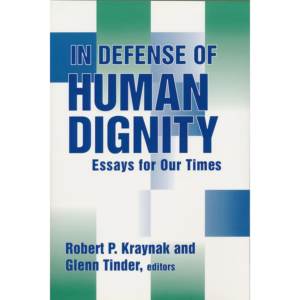
Human dignity, cosmic hierarchies
Political scientist Robert Kraynak on how Christianity opposes worldly hierarchies with hierarchies of its own
Challenging the “gospel of democracy”
Robert Kraynak argues that assumptions many modern Christians hold about liberal democracy are rooted in some false ideas about the nature and purpose of civil government. (46 minutes)
