
Moral reasoning and human flourishing
Tim McIntosh describes moral philosopher Alasdair MacIntyre’s intellectual conversion to a synthesis of Aristotelian ethics and Christianity, best embodied in Thomism. (44 minutes)
Publicity and representative images in society
Oliver O’Donovan describes the nature of publicity as the force that mediates our communication with one another, creating common interests and then rapidly subsuming them into newer ones.(Lecture 3 of 3; 57 minutes)
How common loves shape communities
Oliver O'Donovan discusses how communities mediate love and knowledge to their members and what challenges arise as a community’s traditions are confronted by sin, error, and plurality. (Lecture 2 of 3; 49 minutes)
The “sovereign uselessness of moral reflection”
Calling on the wisdom of St. Augustine, Oliver O’Donovan reminds his listeners that all knowledge participates in the eternal Logos of God and is rooted in love, not disinterested moral judgement.(Lecture 1 of 3; 52 minutes)
“Only a real world can save us”
Oliver O’Donovan explores how the “religion” of modernity lacks a coherent world in which one may participate with full human agency and moral purpose. (Lecture 3 of 3; 61 minutes)
Christian unity and civil society
Oliver O’Donovan introduces listeners to Dutch lay theologian Hugo Grotius, arguing that the questions he tackled relate to perennial concerns about the relationship between divine and human agency, and between civil and ecclesiastical authority. (Lecture 2 of 3; 57 minutes)
The demoralizing effect of pagan Roman religion
Oliver O’Donovan examines St. Augustine’s critique of pagan Roman religion in Book II of his treatise City of God and asks his audience to consider what insights Augustine’s critique has for us today. (Lecture 1 of 3; 51 minutes)
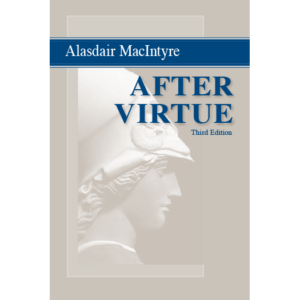
The roots of “the indignant self-righteousness of protest” in modern politics
Alasdair MacIntyre on why unmasking nefarious motives became “one of the most characteristically modern of activities”

Mars Hill Audio Journal, Volume 58
FEATURED GUESTS: Hubert Dreyfus, Francis Fukuyama, Gordon Preece, Gijs van Hensbergen, Ted Prescott, and Bradley J. Birzer