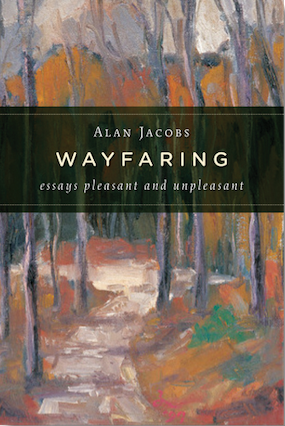
“[T]he paths of the mind, seen honestly, are often paths set by our bodies. This is a particularly interesting fact in light of the fact that so many essays — devoted as they are to following the paths of thought — are built on memories. The cognitive scientist Antonio Damasio has argued that our memories are accompanied by what he calls ‘somatic markers’ — neural encodings of the various physical conditions (sensory, hormonal) that existed in our bodies at the moment that the remembered event happened. So to recall an event is to retrieve the whole somatic context of that event: remembering a moment of fear, we shiver; remembering excitement, we blush.
“This is a reminder of how little we control our own experiences, try though we might. And how little we control the paths we follow, whether neurally or in the great metaphorical sense of life as a pilgrimage — of a person as a viator, a wayfarer. I love the essay primarily because it is the genre par excellence of wayfaring.
“An old phrase holds that to be a Christian is to be homo viator: the human being as wayfarer, as pilgrim. Wayfarers know in a general sense where we are headed: to the City of God, what John Bunyan, that great chronicler of pilgrimage, called the Celestial City — but we aren’t altogether certain of the way. We can get lost for a time, or lose our focus and nap for too long on a soft patch of grass at the side of the road, or dally a few days at Vanity Fair. We can even become discouraged — but we don’t, ultimately and finally, give up. And we don’t think we have arrived. To presume that we have made it to our destination and to despair of arriving are both, as Jürgen Moltmann has wisely said, ways of ‘canceling the wayfaring character of hope.’
“Hope comes from knowing that there is a way — and that we didn’t make it. This is why the road’s unexpected turnings need not alarm us; this is why it’s possible even to enjoy the unpredictable, whether it comes from without or within. That is, there can be pleasure and instruction in the books we stumble across, in the serendipitous skipping from link to link across the Web — and even in our own mental vagaries, the stumbling and skipping through our neural webs.”
— from Alan Jacobs, Wayfaring: Essays Pleasant and Unpleasant (Eerdmans, 2010)
Related reading and listening
- Disengagement from the world — Nicholas Carr encourages us to consider how automation technologies impact our ability to engage with the world and whether — like a good tool — they present a more inviting world or close us off from that world. (30 minutes)
- Modernity’s crisis of place — Craig Bartholomew reflects on the importance of place to our humanity. (58 minutes)
- Silence at the end of history — Alan Jacobs examines several literary imaginings of “the last days” and argues that such narration is profoundly inadequate and perhaps even presumptuous. (51 minutes)
- How music blesses and teaches — FROM VOL. 64 Theologian and musician Jeremy Begbie explores what we learn about time, theology, and the structure of Creation from the experience of music. (28 minutes)
- Mystery novels with theological concerns — In these interviews from 1993, mystery author P. D. James speaks about the philosophical and theological issues woven into her novels, and Alan Jacobs discusses James’s novel The Children of Men. (23 minutes)
- Landscape and living memory — FROM VOL. 44 Gayle Brandow Samuels examines the ways in which trees have served as anchor-points for memory and identity in American culture. (9 minutes)
- Thinking Together — Alan Jacobs discusses some principles he’s compiled to help us think well (and charitably) in our cultural context, and he warns us to be attentive to the ways technology displaces previously fixed communities. (53 minutes)
- Clips from five extended interviews — We are pleased to share clips from five interviews that we’ve recently produced as full-length Conversations. (30 minutes)
- Pathways of the Mind: The Joy of the Essay — Alan Jacobs thinks Christians should embrace the potential in the literary form of the essay, because of the way it corresponds to the navigation and journey of a Christian life. (48 minutes)
- Passing on the virtues to the next generation — Theologian and ethicist Stanley Hauerwas reflects on being a godparent and the responsibility to cultivate and talk about Christian virtue. (21 minutes)
- Manners and morals — FROM VOL. 19 Film and literary critic Alan Jacobs discusses how modern audiences relate to the manners and morals portrayed in Jane Austen films. (16 minutes)
- Learning from experience — Flannery O’Connor on belief and experience
- How social media truncates relationships — In this lecture, Felicia Wu Song explains how social media industrializes and monetizes our relationships, forming us in modes of relationships and identity that are detrimental to ourselves and to society. (41 minutes)
- Knowing the world through the body — FROM VOL. 76 Professor Martin X. Moleski explains why Michael Polanyi (1891-1976) left his career in science to become a philosopher. (16 minutes)
- The collaboration of bodies and minds — F. C. Copleston on Aquinas’s confidence in the embodied nature of knowledge
- An embedded life — Following a move from one state to another, Gilbert Meilaender explores the tension between being simultaneously a sojourner and a body located in place and time. (30 minutes)
- Voluntarily silencing ourselves — FROM VOL. 39 John L. Locke discusses the value of personal communication and how technology is displacing it. (12 minutes)
- Souls in cyberspace — FROM VOL. 25 Douglas Groothuis examines the worldview and mythology behind the creation and marketing of the Internet. (13 minutes)
- Life in a frictionless, synthetic world — FROM VOL. 17 Mark Slouka explores the worldview of techno-visionaries who aim to create a new era of human evolution. (11 minutes)
- Music, silence, and the order of Creation — In this lecture, Ken Myers explains how it is that our participation in harmonic beauty in music is a kind of participation in the life of God, in Whom all order and beauty coheres and is sustained. (61 minutes)
- Cosmetic surgery and human perfectibility — Elizabeth Haiken examines the shift that occurred in 20th century America from a focus on developing character to a focus on developing “personality” and achieving physical perfection. (19 minutes)
- Beauty, the body, and the “true self” — FROM VOL. 62 Lilian Calles Barger shows the necessity and beauty of healthy embodiment and challenges gnostic ideas found in the church that particularly distort the experiences of women. (15 minutes)
- A regard for the whole person — FROM VOL. 16 Alan Jacobs discusses the clinical stories of neurologist Oliver Sacks, whose ability to bring out the dignity and personhood of his “characters” (patients) rivals that of many novelists. (11 minutes)
- Immersion in a different time — FROM VOL. 17 Literary critic Alan Jacobs considers the author Patrick O’Brian as perhaps the best historical novelist ever. (13 minutes)
- Jacobs, Alan — FROM THE GUEST PAGE: Alan Jacobs is Distinguished Professor of Humanities in the Honors Program at Baylor University and a Senior Fellow of the Institute for Advanced Studies in Culture.
- Where mortals dwell — FROM VOL. 113Theologian Craig Bartholomew provides a biblically rich critique of the contemporary “crisis of place,” a disorienting condition caused by neglect of the meaning of our embodiment. (21 minutes)
- Bridges with structural flaws — FROM VOL. 4What made The Bridges of Madison County so popular, and so flawed? Alan Jacobs offers some insights. (14 minutes)
- Faulkner’s tragic vision — Alan Jacobs describes how William Faulkner’s fiction explored the tragedy of living with a legacy of evil acts. (26 minutes)
- “Broken Bodies Redeemed” — Today’s Feature presents a reading of a 2007 article by Gilbert Meilaender that explores the significance for bioethics of the mystery of human being as body and soul. (39 minutes)
- Mars Hill Audio Journal, Volume 153 — FEATURED GUESTS:
Charles C. Camosy, O. Carter Snead, Matt Feeney, Margarita A. Mooney, Louis Markos, and Alan Jacobs
- Thinking Christianly about the body — Theologian and ethicist Gilbert Meilaender discusses some of the themes he explores in two of his books: Body, Soul and Bioethics; and Bioethics: A Primer for Christians. (19 minutes)
- What is at stake for us in a self-driving future? — Matthew Crawford vividly details the “personal knowledge” acquired in interaction with physical things, their mecho-systems, and the people who care for them. (16 minutes)
- On faithful fiction: Larry Woiwode, Alan Jacobs, & Jay Tolson — This Friday Feature represents three interviews on fiction from Volume 3: Larry Woiwode on what makes good fiction, Alan Jacobs on P. D. James’s The Children of Men, and Jay Tolson on Walker Percy. (29 minutes)
- Christina Rossetti and George MacDonald revisited — Alan Jacobs talks about the theme of renunciation in Christina Rossetti’s poems, and Stephen Prickett looks at aspects of nineteenth-century Romanticism from which George MacDonald’s work emerges. (33 minutes)
- Confronting modernity through farming — Jesse Straight, who nurtures the life of Whiffletree Farm in Warrenton, Virginia, talks about how he decided to pursue a vocation as a farmer in an effort to discover a way of life that worked against the characteristic fragmentation so dispiriting in modern culture. (24 minutes)
- Lessons from quarantine: Making do with tinned fruit — In this audio reprint of “Wendell Berry and Zoom,” Front Porch Republic editor Jeffrey Bilbro reflects on two metaphors that can help put our new-found “dependency” on web-based video conferencing into perspective: tinned fruit and a prosthetic limb. (17 minutes)
- When “follow the science” doesn’t work — Peter Leithart reflects on the all-too-human nature of science and the effects of quarantine on the Church’s embodied mission. (32 minutes)
- Perceiving the common good during a pandemic — D. C. Schindler reflects on the shape of our way of life in wake of a killer virus, seeing signs both encouraging and sinister. (35 minutes)
- Philip Pullman’s fantasy trilogy — Critic Alan Jacobs summarizes the theological and moral vision that Philip Pullman’s fantasy trilogy broadcasts — a vision that unfolds through his dark retelling of the Genesis story. (18 minutes)
- Mars Hill Audio Journal, Volume 142 — FEATURED GUESTS:
Stanley Hauerwas, Perry L. Glanzer, Nathan F. Alleman, Jeffrey Bishop, Alan Jacobs, D. C. Schindler, and Marianne Wright
- C. S. Lewis on communities of thought — Alan Jacobs talks about C. S. Lewis’s two essays, “The Inner Ring” and “Membership” and how they explore the fact that all of our thinking is situated within relationships. (19 minutes)
- Mars Hill Audio Journal, Volume 121 — FEATURED GUESTS:
Daniel Gabelman, Curtis White, Michael Hanby, Alan Jacobs, James K. A. Smith, Bruce Herman, and Walter Hansen
- Mars Hill Audio Journal, Volume 113 — FEATURED GUESTS: Steven Shapin, Arthur Boers, Christine Pohl, Norman Wirzba, Craig Bartholomew, and David I. Smith
- Mars Hill Audio Journal, Volume 110 — FEATURED GUESTS: Kevin Belmonte, David Lyle Jeffrey and Gregory Maillet, Mark Noll, Alan Jacobs, and Jonathan Chaplin
- Mars Hill Audio Journal, Volume 105 — FEATURED GUESTS: Julian Young, Perry L. Glanzer, Kendra Creasy Dean, Brian Brock, Nicholas Carr, and Alan Jacobs
- Mars Hill Audio Journal, Volume 104 — FEATURED GUESTS: James Le Fanu, Garret Keizer, Daniel Ritchie, Monica Ganas, Jonathan Wilson-Hartgrove, and Peter J. Leithart
- Mars Hill Audio Journal, Volume 100 — FEATURED GUESTS: Jennifer Burns, Christian Smith, Dallas Willard, Peter Kreeft, P. D. James, James Davison Hunter, Paul McHugh, Ted Prescott, Ed Knippers, Martha Bayles, Dominic Aquila, Gilbert Meilaender, Neil Postman, and Alan Jacobs
- Deadly Legacy: Alan Jacobs on Original Sin — Alan Jacobs discusses his book, Original Sin: A Cultural History, (2008) a survey of how beliefs about sin have affected literature, politics, music, education, and other spheres of human culture. (60 minutes)
- Mars Hill Audio Journal, Volume 93 — FEATURED GUESTS: Alan Jacobs, James A. Herrick, Robert C. Roberts, J. Daryl Charles, Allan C. Carlson, and Sheila O’Connor-Ambrose
- Stronger than death — Alan Jacobs and Mark Shea defend the portrayal of magic in the Harry Potter books.