PREVIEW
The player for this Journal volume is only available to current members or listeners with a legacy account. If you have an active membership, log in here. If you’d like to become a member — with access to all our audio programs — sign up here.
Guests heard on Volume 117
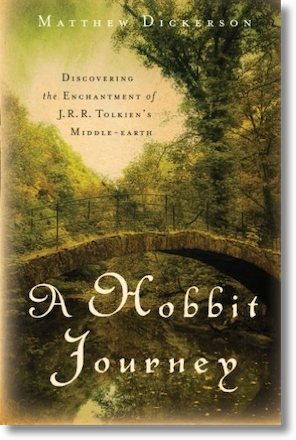
Matthew Dickerson, author of A Hobbit’s Journey: Discovering the Enchantment of J. R. R. Tolkien’s Middle-earth, on the likenesses between Beowulf and three of Tolkien’s heroes, and on how (despite Peter Jackson’s rendition) The Lord of the Rings is more interested in virtue than in military exploits
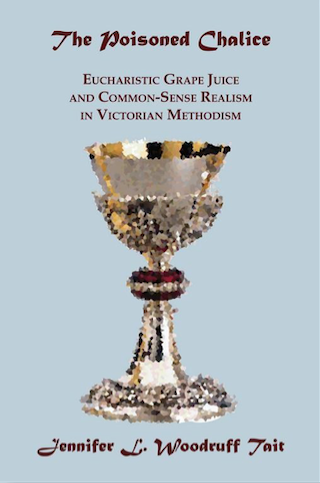
Jennifer Woodruff Tait, author of The Poisoned Chalice: Eucharistic Grape Juice and Common-Sense Realism in Victorian Methodism, on how assumptions about the nature of moral knowledge — derived from the school of common-sense realism — compelled Victorian Methodists and others to substitute grape juice for wine in celebrating the Lord’s Supper
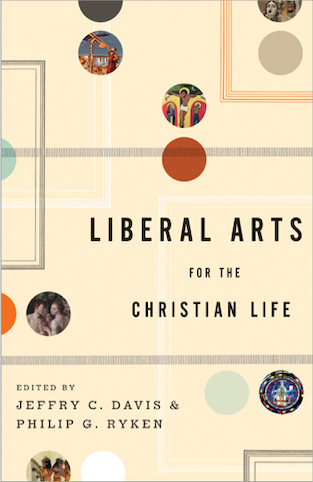
Jeffry Davis and Philip Ryken, co-editors of Liberal Arts for the Christian Life, on why the liberal arts ought to be recognized as a calling that enriches Christian living (Archive Feature available)
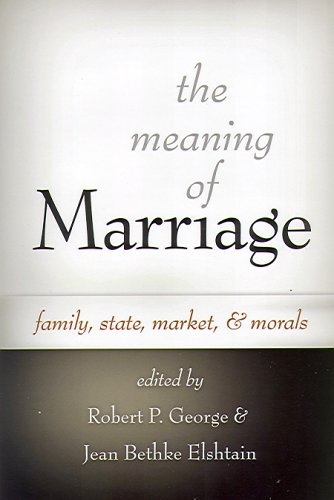
Robert P. George, editor of The Meaning of Marriage: Family, State, Market, and Morals, on the Supreme Court and marriage
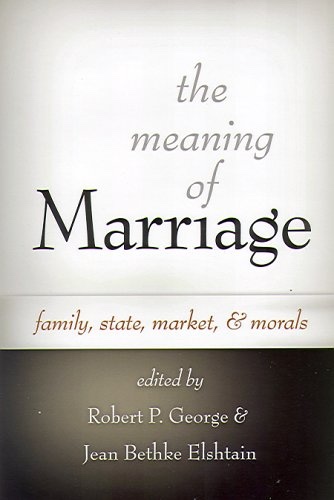
Robert P. George, editor of The Meaning of Marriage: Family, State, Market, and Morals, on the meaning of marriage
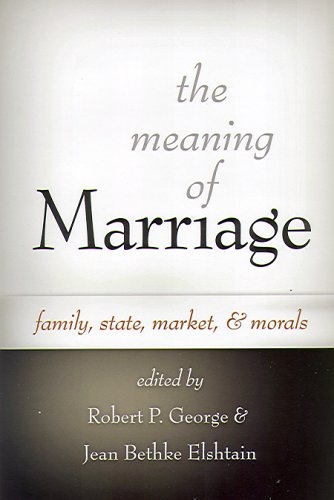
Robert P. George, editor of The Meaning of Marriage: Family, State, Market, and Morals, on the consequences of redefining marriage
Related reading and listening
- Watching, waiting, persevering — Romano Guardini on the necessarily eschatological character of Christian living
- Disengagement from the world — Nicholas Carr encourages us to consider how automation technologies impact our ability to engage with the world and whether — like a good tool — they present a more inviting world or close us off from that world. (30 minutes)
- The just war tradition and whole-life discipleship — Daniel M. Bell, Jr. discusses the just war tradition, a tradition which is often invoked by figures who, upon closer inspection, tend to lack a robust understanding of its history and criteria. (57 minutes)
- The “sovereign uselessness of moral reflection” — Calling on the wisdom of St. Augustine, Oliver O’Donovan reminds his listeners that all knowledge participates in the eternal Logos of God and is rooted in love, not disinterested moral judgement.(Lecture 1 of 3; 52 minutes)
- Beyond a reasonable doubt — From a 1980 interview with Ken Myers, Mortimer J. Adler discusses his argument that belief in the existence of God is rational. (14 minutes)
- Heaven and earth are full of His glory — Gerald R. McDermott examines the typological tradition of the Church, particularly through Jonathan Edwards’s thought, and he argues for a recovery of the Christian understanding of the universe as an “immense Trinitarian symbol.” (61 minutes)
- Mordor versus the Shire — In this lecture, Heidi White explains how the modern project is a diabolical inversion of Christendom and calls for Christians to build lives and a culture that can counter it. (53 minutes)
- A false dichotomy — In this conversation from 2009, Dallas Willard (1934–2013) discusses the truth of spiritual knowledge and its epistemological validity. (63 minutes)
- All trees, no forest — Richard Weaver on the attenuating of knowledge
- Christian belief as real knowledge — Dallas Willard on the modern divorce between faith and knowledge
- Humility and moral knowledge — FROM VOL. 149 Steven L. Porter discusses The Disappearance of Moral Knowledge, an unfinished manuscript (which he helped to complete) by the late philosopher Dallas Willard. (22 minutes)
- Harbinger of disorder — Mark Mitchell on Michael Polanyi’s recognition of the dangerous dead-end of materialistic reductionism
- Universities as the hosts of reciprocating speech — Robert Jenson on how the Christian understanding of Truth in a personal Word shaped the Western university
- The vice of curiosity — Stanley Hauerwas on the warning from Paul Griffiths about desiring to own knowledge
- University or “utiliversity”? — In this essay, Reinhard Hütter examines in depth John Henry Newman’s The Idea of a University and argues that its insights and prescriptions are urgently relevant to the current status of higher education. (87 minutes)
- Thinking Together — Alan Jacobs discusses some principles he’s compiled to help us think well (and charitably) in our cultural context, and he warns us to be attentive to the ways technology displaces previously fixed communities. (53 minutes)
- Setting the liberal arts free — In addressing the state of liberal arts education in the U.S., Gilbert Meilaender raises some core questions and makes some surprising proposals. (28 minutes)
- Students as arbiters of knowledge — FROM VOL. 94 Tim Clydesdale discusses the experience of freshmen year at college, suggesting that by that time students have been effectively inoculated against a love of knowledge. (21 minutes)
- The reciprocity of all things — FROM VOL. 148 Jeffrey Bilbro explores the importance of sustainability through the essays, poetry and fiction of Wendell Berry. (13 minutes)
- Pathways of the Mind: The Joy of the Essay — Alan Jacobs thinks Christians should embrace the potential in the literary form of the essay, because of the way it corresponds to the navigation and journey of a Christian life. (48 minutes)
- In the Image of Our Devices — Nicholas Carr considers how automation technologies impact our ability to engage with the world. (66 minutes)
- How paintings convey meaning — FROM VOL. 121 Theologian Walter Hansen and painter Bruce Herman question contemporary conceptions of meaning that confine it to the verbal or consider visual and verbal meaning to be completely exclusive. (20 minutes)
- The vocation of the life of the mind — FROM VOL. 117 Jeffry Davis and Philip Ryken explain why the liberal arts ought to be recognized as a calling that enriches Christian living. (26 minutes)
- Passing on the virtues to the next generation — Theologian and ethicist Stanley Hauerwas reflects on being a godparent and the responsibility to cultivate and talk about Christian virtue. (21 minutes)
- Moral knowledge of reality — Oliver O’Donovan argues that admiration is the fundamental form of knowing the world, as we cannot know fully those elements of reality (“bare facts”) that contain no significance for us. (Lecture 2 of 3; 55 minutes)
- A life well lived — In this essay, Stanley Hauerwas explains the breadth and depth of Alasdair MacIntyre’s thought, the goal of which was to help people to act intelligibly and live morally worthy lives. (40 minutes)
- It takes a character (and a village) — Herbert McCabe, O.P. on the Aristotelian, Thomistic, and MacIntyrean account of the moral life
- The recovery of an integrated ecology — In this essay, Michael Hanby unpacks the summons of Laudato si’ to an ecological way of life based on a proper understanding of creation in its fullness and integrity. (57 minutes)
- Sacramental Poetics — Poet and Eastern Orthodox believer Scott Cairns explains how a good poem functions like an icon: it assists the process of our becoming aware of what is real, and it is generative in the ways it keeps opening up new understandings. (56 minutes)
- The personal element in all knowing — Mark Mitchell connects key aspects of Michael Polanyi’s conception of knowledge with Matthew Crawford’s insistence that real knowing involves more than technique. (34 minutes)
- Making contact with reality — FROM VOL. 139 Esther Lightcap Meek discusses the realism of philosopher and chemist Michael Polanyi. (23 minutes)
- Knowing the world through the body — FROM VOL. 76 Professor Martin X. Moleski explains why Michael Polanyi (1891-1976) left his career in science to become a philosopher. (16 minutes)
- Steward of knowledge vs. autonomous knower — FROM VOL. 66 Esther Lightcap Meek challenges the modernist view of knowledge, which prefers the figure of the autonomous knower to the figure of a steward of knowledge acquired in part from others. (15 minutes)
- Wonder, being, skepticism, and reason — FROM VOL. 135 Matthew Levering talks about the long and rich tradition of reasoning about God. (23 minutes)
- Metaphysics and sub-creation — FROM VOL. 144 Jonathan McIntosh claims that scholarship has tended to ignore the depth of St. Thomas Aquinas’s influence on J. R. R. Tolkien’s work. (28 minutes)
- The need to recollect ourselves as whole persons — In this 2016 lecture, John F. Crosby explores key personalist insights found in the thinking of John Henry Newman and Romano Guardini. (60 minutes)
- “A sign of contradiction” — In this lecture, Daniel Gibbons compares and contrasts understandings of sacramental poetics proposed by Augustine, Aquinas, and Sydney. (36 minutes)
- Nature’s intelligibility — In this lecture, Christopher Blum argues that scientists need to regain a full appreciation of nature’s intelligibility, as they are apt to lose sight of reality due to the reductionism produced by their theories. (31 minutes)
- Submission to mathematical truth — In this lecture, Carlo Lancellotti argues that integration of the moral, cognitive, and aesthetic aspects of mathematics is needed in a robust liberal arts mathematics curriculum. (25 minutes)
- How fantasy restores the world — In this 2019 lecture, Alison Milbank shows how fantasy can help restore to us a vision of human flourishing that counters the atomization and meaninglessness of modern life. (43 minutes)
- Embodied knowledge — FROM VOL. 121 James K. A. Smith advocates for a return to some pre-modern conceptualizations of the human body. (18 minutes)
- Counterpoint as a “spirited discussion” — In this essay, John Ahern explains the beauty and order of counterpoint, the accumulation of multiple melodies that come together in a harmonious whole. (20 minutes)
- The relationship between prudence and reality — In this lecture, Ken Myers explains how the virtue of prudence is fundamentally connected with a deep and anchored understanding of reality. (54 minutes)
- Why the sexual revolution “failed on its own terms” — FROM VOL. 38 Wendy Shalit argues that when promiscuity is considered natural, women lose the leverage and power inherent in modesty. (13 minutes)
- A metaphysics of realism, relationality, and personalism — John Milbank gives a survey and critique of the efforts of 20th and 21st century theologians to articulate a Trinitarian ontology that reflects reality and counters secularization. (61 minutes)
- Touch’d with a coal from heav’n — Daniel Ritchie finds in the poetry of William Cowper (1731–1800) an anticipation of Michael Polanyi’s epistemology
- How we know the world — Daniel Ritchie argues that poet and hymnodist William Cowper was ahead of his time in critiquing the Enlightenment’s reductionist view of knowledge. (16 minutes)
- William Cowper: Reconciling the Heart with the Head — Daniel E. Ritchie discusses the life and work of poet William Cowper (1731–1800), comparing his commitment to understanding reality through personal knowledge, intuition, and rigorous contemplation with the thought of Michael Polanyi. (43 minutes)
- Approaches to knowing — FROM VOL. 104 Daniel Ritchie describes how many of the figures he studies in his new book emphasize the significance of human experience, enculturation, and contingency to human knowledge. (21 minutes)
- Apprehending the enduring things — Vigen Guroian explains how children’s literature has the capacity to birth the moral imagination in our children, affirming for them the permanent things. (53 minutes)