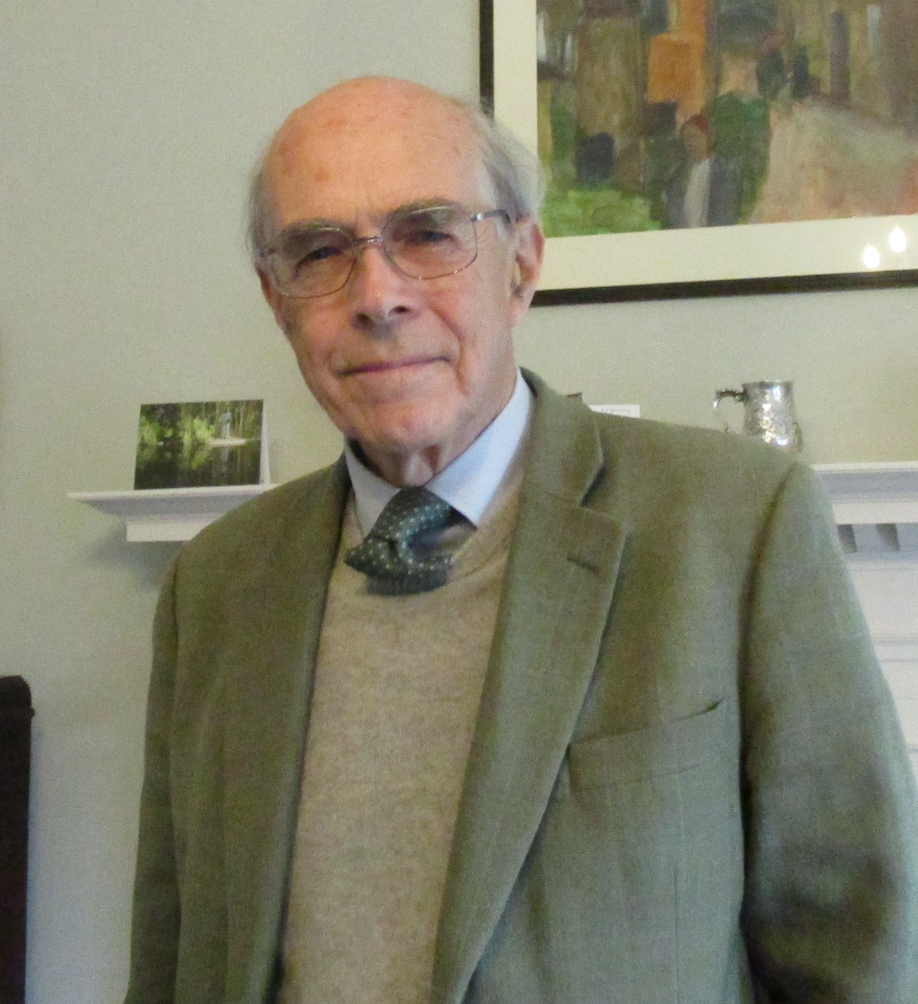
Oliver O’Donovan
Oliver O’Donovan, born in 1945 in London, held teaching posts at Wycliffe Hall, Oxford, and Wycliffe College, Toronto, before becoming Regius Professor of Moral & Pastoral Theology and Canon of Christ Church at the University of Oxford in 1982. He was Professor of Christian Ethics & Practical Theology at the University of Edinburgh from 2006 to his retirement in 2012. Ordained as a priest of the Church of England, he was an active participant in ecumenical dialogue and a past President of the Society for the Study of Christian Ethics. He has been a Fellow of the British Academy since 2000, a Fellow of the Royal Scottish Academy since 2009, and has received an honorary degree of Doctor of Divinity from Wycliffe College, Toronto (2002), Nashotah House, Wisconsin (2002) and the Staats-unverhängige Theologische Hochschule, Basel, Switzerland (2023).
O’Donovan has held distinguished visiting lectureships in Cambridge, Durham, Edinburgh, Rome, Hamilton, Pasadena, Villanova, and Hong Kong, and delivered the Gifford Lectures at St Andrews University in 2021.
He is the author of The Problem of Self-Love in Saint Augustine (Yale 1979), Begotten or Made? (Oxford University Press, 1984), Resurrection and Moral Order (Eerdmans, 1986), On the Thirty-Nine Articles (Paternoster, 1986), Peace and Certainty (Eerdmans, 1989), The Desire of the Nations (Cambridge University Press, 1996), Common Objects of Love (Eerdmans, 2002), The Ways of Judgment (2005), Self World and Time (2013), Finding and Seeking (2014) and Entering into Rest (2017). His Gifford Lectures have been published as The Disappearance of Ethics (2024).
Jointly he and his wife, Joan Lockwood O’Donovan, are the authors of a well-received collection of readings in the history of Christian political thought, From Irenaeus to Grotius: A Sourcebook in Christian Political Thought 100 – 1625 (Grand Rapids, Eerdmans, 1999) and of a volume of essays, Bonds of Imperfection: Christian Politics Past and Present (Grand Rapids, Eerdmans, 2004). The O’Donovans were married in 1978, and have two sons and four grandchildren, and now live in Dunfermline.
Links to posts and programs featuring Oliver O’Donovan:
- Why kings are compelling — Historian Francis Oakley describes how the modern idea of “secular” politics is a striking departure in human history. (32 minutes)
- Thinking coherently about politics — Ken Myers gives an introduction to political theologian Oliver O’Donovan, whose work has been instrumental in teaching many how to think about social and political life in light of the gospel of Christ. (57 minutes)
- The sovereignty of love — In this 2022 lecture, Oliver O’Donovan explains the historical background — and present consequences — of the assertion by Jesus of two great commands. (67 minutes)
- The social context of freedom — Brad Littlejohn talks about the necessity of a more expansive understanding of freedom, one which recognizes that we are really only free within the social experience of shared meaning and mutual recognition. (17 minutes)
- The law of faith and of love — Oliver O’Donovan compares St. Augustine’s interpretation of Psalm 119 with that of others, revealing Augustine’s more nuanced understanding of the complexities of the life of faith that the psalmist explores. (64 minutes)
- The Kingdom of God and the kings of the earth — In a 90-minute conversation with Matthew Lee Anderson and Ken Myers, Oliver O’Donovan explains some of the central themes of his work in political theology. (91 minutes)
- The inevitability of escalating public animosity — With excerpts from books and lectures by Alasdair MacIntyre, Oliver O'Donovan, and Wendell Berry, Ken Myers argues that modern political theory has guaranteed increasing levels of public conflict. (19 minutes)
- The gift of objective reality — Moral philosopher Oliver O’Donovan makes an argument for the consistency of the idea of law when it is conceived in a theological context. (40 minutes)
- The demoralizing effect of pagan Roman religion — Oliver O’Donovan examines St. Augustine’s critique of pagan Roman religion in Book II of his treatise City of God and asks his audience to consider what insights Augustine’s critique has for us today. (Lecture 1 of 3; 51 minutes)
- The “sovereign uselessness of moral reflection” — Calling on the wisdom of St. Augustine, Oliver O’Donovan reminds his listeners that all knowledge participates in the eternal Logos of God and is rooted in love, not disinterested moral judgement.(Lecture 1 of 3; 52 minutes)
- Religion within the bounds of citizenship — In a 2006 lecture, Oliver O’Donovan argues that the conventional way of describing Western civil society creates obstacles to the participation of believers (Muslim, Christian, and other). (68 minutes)
- Publicity and representative images in society — Oliver O’Donovan describes the nature of publicity as the force that mediates our communication with one another, creating common interests and then rapidly subsuming them into newer ones.(Lecture 3 of 3; 57 minutes)
- Oliver O’Donovan on ethics as theology — Oliver O’Donovan explains how moral deliberation always occurs in anticipation of the eschatological fulfillment of redemption. (9 minutes)
- Moral knowledge of reality — Oliver O'Donovan argues that admiration is the fundamental form of knowing the world, as we cannot know fully those elements of reality (“bare facts”) that contain no significance for us. (Lecture 2 of 3; 55 minutes)
- Mars Hill Audio Journal, Volume 138 — FEATURED GUESTS:
John Milbank, Adrian Pabst, Glenn W. Olsen, Rupert Shortt, Oliver O’Donovan, David Bentley Hart
- Mars Hill Audio Journal, Volume 133 — FEATURED GUESTS:
Darío Fernández-Morera, Francis Oakley, Oliver O’Donovan, Thomas Storck, John Safranek, Brian Brock, and George Marsden
- Mars Hill Audio Journal, Volume 127 — FEATURED GUESTS:
Christopher Shannon, Kevin Vanhoozer, Oliver O’Donovan, Rebecca DeYoung, Thomas Forrest Kelly, and Calvin Stapert
- Loving relationships in community — In conversation with moral philosopher Oliver O’Donovan, and with readings from his book, Entering into Rest, Ken Myers explores a central theme in O’Donovan’s work: that we are created to enjoy loving relationships in community. (27 minutes)
- Learning about the meaning of government — In a telephone conversation during COVID-19 lockdowns, Oliver O’Donovan talks about lessons we can learn about the proper role of government from our experience of pandemics and quarantine. (51 minutes)
- Knowing and doing the good — Oliver O’Donovan raises several key questions and complications involved in the task of taking concrete and practical action toward a recognized moral good. (Lecture 3 of 3; 63 minutes)
- Impact of “infotainment” on community — Neil Gabler and C. John Sommerville discuss how the mentalities conveyed by our experience with communications media work against the nurturing of community. (36 minutes)
- How common loves shape communities — Oliver O'Donovan discusses how communities mediate love and knowledge to their members and what challenges arise as a community’s traditions are confronted by sin, error, and plurality. (Lecture 2 of 3; 49 minutes)
- Ethics as Theology, Part 2 — Drawing from St. Augustine and figures such as Aelred of Rievaulx, Oliver O’Donovan describes how the Church, communication, community, and friendship all significantly contribute to how we understand the role of love in both ethical and political reflection. (52 minutes)
- Ethics as Theology, Part 1 — Moral philosopher Oliver O’Donovan discusses the first two volumes of his three-volume set, Ethics as Theology. Among other topics, he reflects on the significance of the thinking moral subject as well as what form of moral inadequacy the “life of the flesh” suggests. (58 minutes)
- Christian unity and civil society — Oliver O’Donovan introduces listeners to Dutch lay theologian Hugo Grotius, arguing that the questions he tackled relate to perennial concerns about the relationship between divine and human agency, and between civil and ecclesiastical authority. (Lecture 2 of 3; 57 minutes)
- Attentiveness to the world, the self, and time — Oliver O’Donovan uses the metaphor of waking to discuss the concept of moral sensibility as attention to the world, the self, and time. (Lecture 1 of 3; 60 minutes)
- A flood of images — Oliver O’Donovan describes the distinctive character of publicity in modernity, which drowns us in a flood of ever-changing representations that do not serve the common good. (37 minutes)
- “The search for shared ends” — Oliver O’Donovan examines whether and to what extent there might be the possibility of a unifying Christian perspective on political doctrine or policy. (59 minutes)
- “Only a real world can save us” — Oliver O’Donovan explores how the “religion” of modernity lacks a coherent world in which one may participate with full human agency and moral purpose. (Lecture 3 of 3; 61 minutes)