
“When Niccolò Machiavelli promoted ‘new modes and orders’ unlike those which had previously existed, he was expressing a vision that came to define modernity (from the late Latin ‘modernus,’ derivative of the classical Latin ‘modo,’ meaning ‘just now’ or ‘in a certain manner’). This vision was shared by others such as Bacon, Galileo Galilei, René Descartes, and Isaac Newton. These thinkers were partly motivated by the old aim of natural theology, as Johannes Kepler phrased it, ‘to think God’s thoughts after him,’ perhaps limiting the role of God but keeping Him central to morality. Yet, from politics and science to philosophy and religion these thinkers also argued for the possibility of introducing a radical historical break. From the Renaissance through the Enlightenment traditional restraints were replaced with an ethical commitment to the pursuit of technology.
“In its basic understandings of nature, rationality, and the self, the moderns differed radically from the premoderns. The old way of thinking about these issues was challenged by the ideas that: (a) nature is a nonpurposive collection of ‘facts’ and therefore can provide no moral guidance; (b) ends or ‘values’ are thus reduced from a species of knowledge to personal preferences projected upon a mechanistic world; and (c) the human self is best conceived as a pre-social and autonomous subject.
“First, modern science altered what it means to know — from an understanding of knowledge as contemplation of a thing’s nature to the ability to control the thing. In the preface to The Great Instauration (1620), Bacon first made the radical argument that ‘human knowledge and human power meet in one.’ Complaining of the vain speculations of the ancients, Bacon urged ‘that knowledge be used not as a courtesan, for pleasure and vanity only . . . but as a spouse for generation, fruit, and comfort.’ The production of knowledge would culminate in ‘the conquest of nature for the relief of man’s estate’ (Novum Organum, LII). This mindset is ‘technological’ at its core, as it upholds an intimate alliance between knowing and changing the world: ‘the nature of things betrays itself more readily under the vexations of art than in its natural freedom’ (Bacon, ‘Plan of the Work,’ paragraph 21). This leads to a focus on manipulating the world ‘out there’ rather than transforming the inner worlds of wants, needs, and desires.
“Second, this altered notion of knowledge changed the human relation to and understanding of nature, including human nature. Descartes argued, ‘So soon as I had acquired some general notions concerning Physics . . . I believed that I could not keep them concealed without greatly sinning against the law which obliges us to procure, as much as in us lies, the general good of all mankind.’ He continued that new knowledge can
render ourselves the masters and possessors of nature. This is not merely to be desired with a view to the invention of an infinity of arts and crafts which enable us to enjoy without any trouble the fruits of the earth and all the good things which are to be found there, but also principally because it brings about the preservation of health, which is without doubt the chief blessing and foundation of all other blessings in this life. For the mind depends so much on the temperament and disposition of the bodily organs that, if it is possible to find a means of rendering men wiser and cleverer than they have hitherto been, I believe that it is in medicine that it must be sought. (Discourse on Method 1637, VI)
“Descartes upheld science and technology as tools of a this-worldly salvation, where it would be a sin not to eat more from the tree of knowledge. Both he and Bacon — working from this altered understanding of knowledge and nature — exalt the preservation of bodily health, treating it as an infinite project, rather than seeing it as one, limited, good among many, as the ancients had done.
“Third, modern scientific knowledge rejects explanations in terms of ends or purposes. Bacon ridiculed the Aristotelian science of final causes:
[F]or although the most general principles in nature ought to be held merely positive, as they are discovered, and cannot with truth be referred to a cause, nevertheless the human understanding being unable to rest still seeks something prior in the order of nature. And then it is that in struggling toward that which is further off it falls back upon that which is nearer at hand, namely, on final causes, which have relation clearly to the nature of man rather than to the nature of the universe; and from this source have strangely defiled philosophy. (Novum Organum, XLVIII, emphasis added)
“Science, the only true rationality, reveals objective facts. Descartes was among the first to set thinking toward the complementary notion that ends are subjective and are thus not properly considered objects of knowledge. For example, in Discourse on Method, he extolled mathematics ‘because of the certainty and self-evidence of the way it reasons’ (I). By contrast, he writes, ‘I compared the writings on morality of the ancient pagans with the very magnificent and superb palaces that were built only on sand and mud. They very much extol the virtues and make them appear more valuable than anything else in the world; but they do not provide adequate instruction about how to recognize them, and frequently something that they classify as virtue is merely insensibility, pride, despair or parricide’ (I). Descartes saw philosophy as a tradition consisting of doubt and dispute, concluding ‘that it was impossible that anything solid could have been built on foundations that were so weak’ (I). The new natural sciences, by contrast, promised certainty that could ground progress.
“But it is Isaac Newton who best symbolizes the triumph of a mechanistic, mathematical universe, understandable without recourse to final ends. Yet Newton found it difficult not to believe in a divine artificer. Indeed, he saw in gravity the constant hand of God at operation in the universe. Later interpreters such as Pierre Laplace began to distance God from the operations of the heavenly bodies, first through deism and later through more thoroughly mechanistic accounts. In a reversal of ancient epistemology and ontology, the modern mathematicization of nature held that intelligibility meant reducibility to the most elemental. At its core, modern science does not explain phenomena in terms of causes, but rather provides a descriptive account of quantitative constants in different positions along a time series. Any rational properties of such a series (e.g., a planetary orbit) were no longer understood as having an intrinsic reason or as aspiring toward harmony. Rather, they were the mechanical uniformity of the elemental factors involved (see Jonas, The Phenomenon of Life, 1966).
“The a-purposive account of the world was extended to living things, including humans, through Charles Darwin’s theory on evolution through natural selection, published in 1859. This new understanding of life opened up new powers for healing and altering the human organism. Yet just as these new powers were gained, traditional sources of order were being eroded. After Darwin, there no longer seemed to be an objective vision of the human form or divine or natural order to direct the newfound technological powers. The original essence of humanity, the form that the ancients believed to provide standards of excellence attainable through right reasoning and proper training, seemed to evaporate into the transience of the evolutionary process.
“For modern science, unlike ancient thought, the absence of life is the primary state of being. Thus, the problem was how to explain life in terms of non-life, by reducing it to its physical and chemical properties. The ancient monism of life-as-being-as-good had been sundered into a dualism most cogently put forward by Descartes in his split between the mind (res cogitans) and the body (res extensa). This unstable dualism was eventually resolved into the modern doctrines of materialism and idealism. As Hans Jonas explained:
The very possibility of an ‘inanimate universe’ emerged as the counterpart to the increasingly exclusive stress laid on the human soul, on its inner life and its incommensurability with anything in nature. The fateful divorce, stretched to the point of a complete foreignness which left nothing in common between the parted members, henceforth qualified them both by this mutual exclusion. As the retreating soul drew about itself all spiritual significance and metaphysical dignity, contracting them and itself alike within its innermost being, it left the world divested of all such claims and, though at first decidedly demonic, in the end indifferent to the very question of value either way. (Jonas, The Phenomenon of Life, 13–14)
“Modern science sundered the realms of freedom and nature, posing a challenge to ethics. Absent a purposeful natural order as a normative guide, the question for ethics became: What are the grounds for the justification of norms and for distinguishing lower and higher pleasures?”
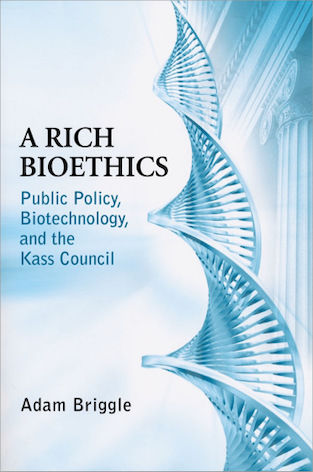
— from Adam Briggle, A Rich Bioethics: Public Policy, Biotechnology, and the Kass Council (University of Notre Dame Press, 2010)
Click on the tags below for listings of related readings or audio features.