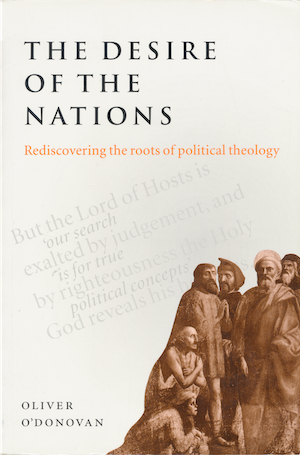
Near the end of The Desire of the Nations: Rediscovering the Roots of Political Theology (Cambridge University Press, 1996), Oliver O’Donovan examines the origins and trajectory of liberal society in the West. He begins by calling attention to a scenario imagined by St. Paul in I Corinthians 14:24f., in which an unbeliever wanders into a church that is saturated in compelling, prophetic witness. The message he hears is both rational and convicting, and he falls on his face in repentance. This story, O’Donovan says, “is a paradigm for the birth of free society, grounded in the recognition of a superior authority which renders all authorities beneath it reactive and provisional. We discover we are free when we are commanded by that authority which commands us according to the law of our being, disclosing the secrets of the heart. There is no freedom except when what we are, and do, corresponds to what has been given to us to be and to do. ‘Given to us’, because the law of our being does not assert itself spontaneously merely by virtue of our existing. We must receive ourselves from outside ourselves, addressed by a summons which evokes that correspondence of existence to being. ‘Where the Spirit of the Lord is, there is liberty’ (2 Cor. 3:18). The church of Christ, which professes the authority of God’s summons in the coming of Jesus, has the role of hearing it, repeating out, drawing attention to it. In heeding the church, society heeds a dangerous voice, a voice that is capable of challenging authority effectively, a voice which, when the oppressed have heard it (even in an echo or at a distance), they cannot remain still.” [p. 252]
A flood of images — Oliver O’Donovan describes the distinctive character of publicity in modernity, which drowns us in a flood of ever-changing representations that do not serve the common good. (37 minutes)
Publicity and representative images in society — Oliver O’Donovan describes the nature of publicity as the force that mediates our communication with one another, creating common interests and then rapidly subsuming them into newer ones.(Lecture 3 of 3; 57 minutes)
How common loves shape communities — Oliver O’Donovan discusses how communities mediate love and knowledge to their members and what challenges arise as a community’s traditions are confronted by sin, error, and plurality. (Lecture 2 of 3; 49 minutes)
The “sovereign uselessness of moral reflection” — Calling on the wisdom of St. Augustine, Oliver O’Donovan reminds his listeners that all knowledge participates in the eternal Logos of God and is rooted in love, not disinterested moral judgement.(Lecture 1 of 3; 52 minutes)
The danger of not defining “freedom” — Richard Bauckham insists that an adequate understanding of freedom requires recognition of God as the ground of true human freedom
Power to the people — Nathan O. Hatch on the DIY spirit of early American Christianity
Free for obedience — Glenn W. Olsen on Augustine’s understanding of freedom
“The search for shared ends” — Oliver O’Donovan examines whether and to what extent there might be the possibility of a unifying Christian perspective on political doctrine or policy. (59 minutes)
Thinking coherently about politics — Ken Myers gives an introduction to political theologian Oliver O’Donovan, whose work has been instrumental in teaching many how to think about social and political life in light of the gospel of Christ. (57 minutes)
The law of faith and of love — Oliver O’Donovan compares St. Augustine’s interpretation of Psalm 119 with that of others, revealing Augustine’s more nuanced understanding of the complexities of the life of faith that the psalmist explores. (64 minutes)
“Only a real world can save us” — Oliver O’Donovan explores how the “religion” of modernity lacks a coherent world in which one may participate with full human agency and moral purpose. (Lecture 3 of 3; 61 minutes)
Christian unity and civil society — Oliver O’Donovan introduces listeners to Dutch lay theologian Hugo Grotius, arguing that the questions he tackled relate to perennial concerns about the relationship between divine and human agency, and between civil and ecclesiastical authority. (Lecture 2 of 3; 57 minutes)
The demoralizing effect of pagan Roman religion — Oliver O’Donovan examines St. Augustine’s critique of pagan Roman religion in Book II of his treatise City of God and asks his audience to consider what insights Augustine’s critique has for us today. (Lecture 1 of 3; 51 minutes)
Knowing and doing the good — Oliver O’Donovan raises several key questions and complications involved in the task of taking concrete and practical action toward a recognized moral good. (Lecture 3 of 3; 63 minutes)
Moral knowledge of reality — Oliver O’Donovan argues that admiration is the fundamental form of knowing the world, as we cannot know fully those elements of reality (“bare facts”) that contain no significance for us. (Lecture 2 of 3; 55 minutes)
Attentiveness to the world, the self, and time — Oliver O’Donovan uses the metaphor of waking to discuss the concept of moral sensibility as attention to the world, the self, and time. (Lecture 1 of 3; 60 minutes)
Jean Porter describes how natural law justifies legal and moral authority within the life of the human person. (17 minutes)
The profound drama of human sexuality — In this lecture, D. C. Schindler explains the cosmological significance of human sexuality and why it is paradigmatic of the relationship between nature and freedom. (32 minutes)
Esther Lightcap Meek challenges the modernist view of knowledge, which prefers the figure of the autonomous knower to the figure of a steward of knowledge acquired in part from others. (15 minutes)
Against hacking babies — Oliver O’Donovan raises questions about IVF and the technologically ordered motive for efficiency
Impact of “infotainment” on community — Neil Gabler and C. John Sommerville discuss how the mentalities conveyed by our experience with communications media work against the nurturing of community. (36 minutes)
Submission to mathematical truth — In this lecture, Carlo Lancellotti argues that integration of the moral, cognitive, and aesthetic aspects of mathematics is needed in a robust liberal arts mathematics curriculum. (25 minutes)
The Decline of Formal Speech and Why It Matters — John McWhorter examines the reasons behind the decline in articulate speech and writing in the late 20th century, and the implications of this change across many areas of culture. (55 minutes)
Why liberalism tends toward absolutism — In this lecture, Michael Hanby examines what causes liberalism to become dictatorial in thought and practice. (49 minutes)
When is a market “free”? — William T. Cavanaugh argues for a richer conception of freedom than the reductionist one promoted by economist Milton Friedman. (44 minutes)
When is civil disobedience necessary? — Douglas Farrow examines the relation between “the kings of the earth” and the law of Christ, particularly when governmental law is exercised without reference to natural or divine law. (49 minutes)
The gift of objective reality — Moral philosopher Oliver O’Donovan makes an argument for the consistency of the idea of law when it is conceived in a theological context. (40 minutes)
Freedom as conformity to reality — W. Bradford Littlejohn summarizes the definitions of liberty offered by Richard Bauckham and Oliver O’Donovan
Renewal of authentic political authority — Brad Littlejohn builds a case for the idea that authority makes free action possible, illustrating how that occurs within the forms of political and epistemic authority, properly understood and wisely practiced. (45 minutes)
The Life was the Light of men — In a lecture from 2018, Ken Myers contrasts the Enlightenment’s understanding of reason with the Christocentric conception of reason. (57 minutes)
David Bentley Hart on how “two-tier Thomism” deviates from historic Christian understanding of the relationship between God and Creation. (42 minutes)
The sovereignty of love — In this 2022 lecture, Oliver O’Donovan explains the historical background — and present consequences — of the assertion by Jesus of two great commands. (67 minutes)
O’Donovan, Oliver — FROM THE GUEST PAGE: Oliver O’Donovan held teaching posts at Wycliffe Hall, Oxford and Wycliffe College Toronto before becoming Regius Professor of Moral & Pastoral Theology and Canon of Christ Church at the University of Oxford in 1982.
Community, the giver of freedom — Thomas H. Naylor and William H. Willimon on why suspicion about big government shouldn’t take the form of autonomous individualism
Why kings are compelling — Historian Francis Oakley describes how the modern idea of “secular” politics is a striking departure in human history. (32 minutes)
The Symbol of Authority — In the second of two lectures given by D. C. Schindler, he explores the nature of authority with reference to the transcendental dance of Truth, Goodness, and Beauty. (60 minutes)
The Authority of the Symbol — In this lecture presented at the CiRCE Institute national conference, D. C. Schindler presents a metaphysical description of what symbols are. (54 Minutes)