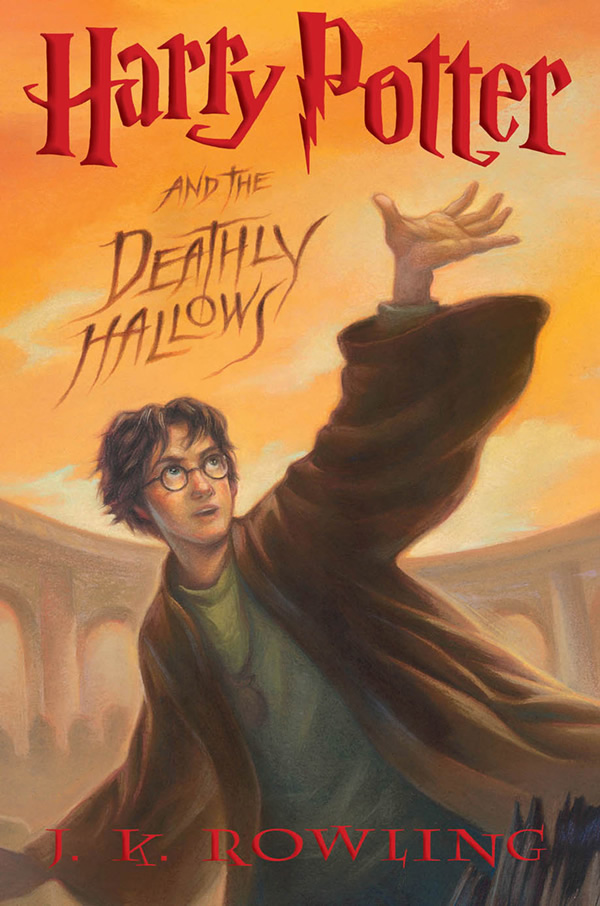
In 1999, I interviewed Alan Jacobs about J. K. Rowling’s Harry Potter novels. After that interview, Dr. Jacobs collected his thoughts for an essay called “Harry Potter’s Magic,” published in First Things. Now that the final Harry Potter book has been published, a number of Mars Hill Audio listeners have suggested that I talk to Jacobs again to discover his take on the completed saga. While we won’t be able to do that interview, you may be interested in reading the essay Alan wrote after reading the seventh book, “The Youngest Brother’s Tale,” published in Books and Culture.
Jacobs argues that “The key theme of the whole series is the opposition of death and love: the devastation wrought by those whose fear of death causes them to shun love as a weakness, and, in contrast, the rich rewards in store for those who will not allow the fear of death to block love, who know that love risks all for the beloved.”
Meanwhile, the First Things website has published a brief but thoughtful response to some of the accusations leveled against Rowling’s book by conservative Christians. In “Harry Potter and the Christian Critics,” Mark Shea argues that the magic in these books is “incantational,” not “invocational,” exactly like the magic of Gandalf.
Born with the talent for magic, Gandalf says the magic words and fire leaps forth from his staff, just as from Harry’s wand. No principalities or powers are invoked in HP. Indeed, if any words are “invocational” they are the prayer to Elbereth and Gilthoniel uttered in Middle Earth. Yet nobody accuses Tolkien of promoting the worship of false gods. That’s because we understand Tolkien’s fictional subcreation and its rootedness in Christian thought. I suggest Christian critics try to extend Rowling the same charity.
Related reading and listening
- Silence at the end of history — Alan Jacobs examines several literary imaginings of “the last days” and argues that such narration is profoundly inadequate and perhaps even presumptuous. (51 minutes)
- Mystery novels with theological concerns — In these interviews from 1993, mystery author P. D. James speaks about the philosophical and theological issues woven into her novels, and Alan Jacobs discusses James’s novel The Children of Men. (23 minutes)
- Thinking Together — Alan Jacobs discusses some principles he’s compiled to help us think well (and charitably) in our cultural context, and he warns us to be attentive to the ways technology displaces previously fixed communities. (53 minutes)
- Clips from five extended interviews — We are pleased to share clips from five interviews that we’ve recently produced as full-length Conversations. (30 minutes)
- Wayfaring, but not strange — Alan Jacobs on being on the way
- Pathways of the Mind: The Joy of the Essay — Alan Jacobs thinks Christians should embrace the potential in the literary form of the essay, because of the way it corresponds to the navigation and journey of a Christian life. (48 minutes)
- Manners and morals — FROM VOL. 19 Film and literary critic Alan Jacobs discusses how modern audiences relate to the manners and morals portrayed in Jane Austen films. (16 minutes)
- Metaphysical impulses beneath techno-utopianism — FROM VOL. 38 Erik Davis describes his research on how humans’ fascination with technology is permeated with “mythic energy” and gnostic aspirations. (11 minutes)
- Alchemy, astrology, energy, and gnosticism — FROM VOL. 85 Catherine Albanese describes the varieties of “metaphysical religion” popular in early American history and draws connections with the more recent New Age movement. (14 minutes)
- How fantasy restores the world — In this 2019 lecture, Alison Milbank shows how fantasy can help restore to us a vision of human flourishing that counters the atomization and meaninglessness of modern life. (43 minutes)
- A regard for the whole person — FROM VOL. 16 Alan Jacobs discusses the clinical stories of neurologist Oliver Sacks, whose ability to bring out the dignity and personhood of his “characters” (patients) rivals that of many novelists. (11 minutes)
- Immersion in a different time — FROM VOL. 17 Literary critic Alan Jacobs considers the author Patrick O’Brian as perhaps the best historical novelist ever. (13 minutes)
- Jacobs, Alan — FROM THE GUEST PAGE: Alan Jacobs is Distinguished Professor of Humanities in the Honors Program at Baylor University and a Senior Fellow of the Institute for Advanced Studies in Culture.
- Bridges with structural flaws — FROM VOL. 4What made The Bridges of Madison County so popular, and so flawed? Alan Jacobs offers some insights. (14 minutes)
- Faulkner’s tragic vision — Alan Jacobs describes how William Faulkner’s fiction explored the tragedy of living with a legacy of evil acts. (26 minutes)
- Mars Hill Audio Journal, Volume 153 — FEATURED GUESTS:
Charles C. Camosy, O. Carter Snead, Matt Feeney, Margarita A. Mooney, Louis Markos, and Alan Jacobs
- On faithful fiction: Larry Woiwode, Alan Jacobs, & Jay Tolson — This Friday Feature represents three interviews on fiction from Volume 3: Larry Woiwode on what makes good fiction, Alan Jacobs on P. D. James’s The Children of Men, and Jay Tolson on Walker Percy. (29 minutes)
- Christina Rossetti and George MacDonald revisited — Alan Jacobs talks about the theme of renunciation in Christina Rossetti’s poems, and Stephen Prickett looks at aspects of nineteenth-century Romanticism from which George MacDonald’s work emerges. (33 minutes)
- The reality that science cannot see — Philosopher Paul Tyson illustrates features of daily life that science cannot “see,” such as love, friendship, justice, and hope, and argues that such things are nonetheless real. (20 minutes)
- Philip Pullman’s fantasy trilogy — Critic Alan Jacobs summarizes the theological and moral vision that Philip Pullman’s fantasy trilogy broadcasts — a vision that unfolds through his dark retelling of the Genesis story. (18 minutes)
- Mars Hill Audio Journal, Volume 142 — FEATURED GUESTS:
Stanley Hauerwas, Perry L. Glanzer, Nathan F. Alleman, Jeffrey Bishop, Alan Jacobs, D. C. Schindler, and Marianne Wright
- C. S. Lewis on communities of thought — Alan Jacobs talks about C. S. Lewis’s two essays, “The Inner Ring” and “Membership” and how they explore the fact that all of our thinking is situated within relationships. (19 minutes)
- Fairy tales and what’s really real — Anna Maria Mendell describes how fairy stories can use the device of magic to call attention to the real nature of things. (13 minutes)
- Mars Hill Audio Journal, Volume 121 — FEATURED GUESTS:
Daniel Gabelman, Curtis White, Michael Hanby, Alan Jacobs, James K. A. Smith, Bruce Herman, and Walter Hansen
- Mars Hill Audio Journal, Volume 110 — FEATURED GUESTS: Kevin Belmonte, David Lyle Jeffrey and Gregory Maillet, Mark Noll, Alan Jacobs, and Jonathan Chaplin
- Mars Hill Audio Journal, Volume 105 — FEATURED GUESTS: Julian Young, Perry L. Glanzer, Kendra Creasy Dean, Brian Brock, Nicholas Carr, and Alan Jacobs
- Mars Hill Audio Journal, Volume 100 — FEATURED GUESTS: Jennifer Burns, Christian Smith, Dallas Willard, Peter Kreeft, P. D. James, James Davison Hunter, Paul McHugh, Ted Prescott, Ed Knippers, Martha Bayles, Dominic Aquila, Gilbert Meilaender, Neil Postman, and Alan Jacobs
- Deadly Legacy: Alan Jacobs on Original Sin — Alan Jacobs discusses his book, Original Sin: A Cultural History, (2008) a survey of how beliefs about sin have affected literature, politics, music, education, and other spheres of human culture. (60 minutes)
- Mars Hill Audio Journal, Volume 93 — FEATURED GUESTS: Alan Jacobs, James A. Herrick, Robert C. Roberts, J. Daryl Charles, Allan C. Carlson, and Sheila O’Connor-Ambrose
- After irony — Richard Rorty’s tangled spiritual pilgrimage has origins in being the grandson of social gospel theologian Walter Rauschenbusch and the son of committed Leninists.
- Alan Jacobs on The Narnian — Alan Jacobs discusses C. S. Lewis’s view of the imagination and his deep conviction that the shaping of the conscience requires the training of the imagination. (53 minutes)
- Mars Hill Audio Journal, Volume 77 — FEATURED GUESTS: Eric Miller, Lisa de Boer, Peter J. Schakel, and Alan Jacobs
- The Christian Mind of C. S. Lewis — Interviews about Lewis with Clyde Kilby, Michael Aeschliman, James Como, Bruce L. Edwards, Thomas Howard, and Gilbert Meilaender. Plus a reading by Alan Jacobs. (73 minutes)
- Mars Hill Audio Journal, Volume 59 — FEATURED GUESTS: Ron Hansen, Bernard Lewis, Alan Jacobs, Adrienne Chaplin, Todd Gitlin, and Quentin Schultze
- Mars Hill Audio Journal, Volume 48 — FEATURED GUESTS: Jon Butler, Gary Cross, Zygmunt Bauman, Pico Iyer, Richard Stivers, Larry Woiwode, Alan Jacobs, and James Trott
- Mars Hill Audio Journal, Volume 40 — FEATURED GUESTS: Joseph Epstein, John Gray, Kenneth R. Craycraft, Jr., William T. Pizzi, Pamela Walker Laird, Albert Borgmann, Neal Stephenson, and Alan Jacobs
- Decadent Immortals — What do Ann Rice’s The Vampire Chronicles have to say about human nature? Critic Alan Jacobs illuminates the deeper moral questions raised by Rice’s first novel, which she seems to abandon as the series evolves. (51 minutes)
- The Public Poetry of W. H. Auden — Alan Jacobs explains why W. H. Auden returned to the Church after recognizing that liberal humanism had no answers to the problem of human evil. (58 minutes)