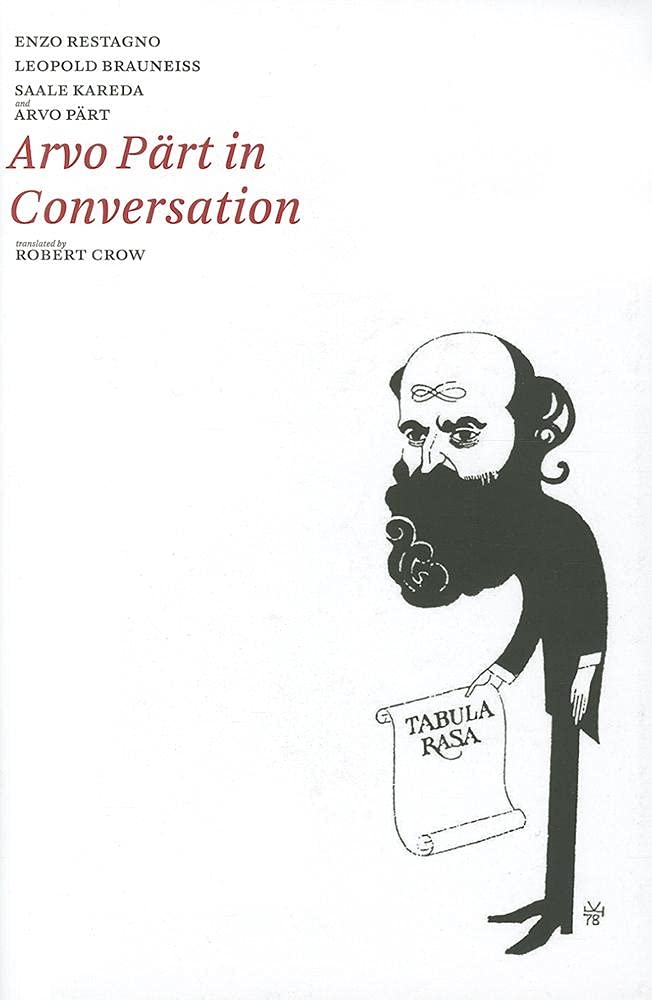
In 2003, musicologist Enzo Restagno recorded a long interview with composer Arvo Pärt about the trajectory of his life and work. During their conversation — presented in a book titled Arvo Pärt in Conversation — Restagno asked Pärt to describe the events that led him to abandon the conventional twelve-tone compositional technique common to many twentieth-century composers.
“At the time I was convinced that I just could not go on with the compositional means at my disposal. There simply wasn’t enough material to go on with, so I just stopped composing altogether. I wanted to find something that was alive and simple and not destructive. When I worked at the radio I was allowed to deal with the most elaborate and powerful electronic equipment, such as loudspeakers and tape recorders. Suddenly however I felt the need to distance myself from this luxury, because I had the feeling that I was locked in a gilded cage and was being forced in the wrong direction. If I had to work with technical equipment I always chose the most simple, for example a simple tape recorder that offered just the basics. I was no longer at all interested in the adjustment of high and low frequencies, reducing the noise level and so on. What I wanted was only a simple musical line that lived and breathed inwardly, like those in the chants of distant epochs, or such as still exist today in folk music: an absolute melody, a naked voice which is the source of everything else. I wanted to learn how to shape a melody, but I had no idea how to do it.
“All that I had to go on was a book of Gregorian chant, a Liber usualis, that I had received from a church in Tallinn. When I began to sing and to play these melodies I had the feeling that I was being given a blood transfusion. It was terribly strenuous work because it was not simply a matter of absorbing information. I had to be able to understand this music down to its very roots: how it had come into existence, what the people were like who had sung it, what they’d felt during their lives, how they’d written this music down and passed it on through the centuries until it became the source of our own music. In some way or other I succeeded in getting into contact with this music. But I never used this closeness as a quote, with the exception of one early piece that I wrote for Bologna Cathedral: Statuit ei Dominus. In Gregorian chant the succession of notes forms something like real speech, the notes offer concrete information, something that is comparable to birdsong. We do not understand them, but they understand each other. Monodic music has a certain informal content, it has arisen like a cathedral from ground that bears within it the ruins of earlier temples, probably a heathen temple that in its turn was erected in early pre-history on that site for quite specific reasons. This chain of forms, temples, and chants, each built upon the ruins of the other, is something more potent than we can imagine. In my daily work, too, I came up against tremendous difficulties. For a time I succeeded in writing a single musical line, but then I didn’t know how to go on. Should I have written just monodic music? What would have become of polyphony and harmony? What should I have done with the second and third voice? Where should a second voice come from? Tormented by these questions, I began to think about the beginnings of polyphony. It became clear to me that it was far more complex and profound than the rigid rules with which Knud Jeppesen had analysed and explained this music would have us suppose. The second voice must be something independent, like the husband and wife in a family. This relationship of independent parts can, in my opinion, already be seen in the beginnings of ancient polyphony. I tried to realise this intuition in my third symphony where I conceived the entire form of the composition through the metaphor of the building of a town: small, increasingly numerous centres that spread out until they touch each other and form a unity. The same thing happens with the harmonic progression in the piece that is evolved from a series of short cadences. Upon this idea is based the idea of polyphonic complexity. Nonetheless, my experience with the third symphony left me dissatisfied. It became clear to me that I was caught within my relationship to musical history, which was too much one of debt. And that my work somehow lacked a style of its own. But I had succeeded in building a bridge within myself between yesterday and today — a yesterday that was several centuries old — and this encouraged me to go on exploring. During those years I filled thousands of pages with exercises in which I wrote out single voiced melodies. At home there is a cupboard full of exercises like this.”
— from Arvo Pärt in Conversation (Dalkey Archive Press, 2010)
Related reading and listening
- Rose without thorns — Ken Myers introduces various settings of “Ther is no rose of swych vertu,” a medieval carol that uses imagery of a rosebush to describe the Virgin Mary. (29 minutes)
- “Investigations of divine works” — Greg Wilbur explains how closely connected music is to the order of the cosmos and how it even reveals attributes of God. (56 minutes)
- The experience of a “real presence” in sacred music — FROM VOL. 126 Jonathan Arnold explores why people of no religious commitment pay money to hear specifically sacred music. (22 minutes)
- How music blesses and teaches — FROM VOL. 64 Theologian and musician Jeremy Begbie explores what we learn about time, theology, and the structure of Creation from the experience of music. (28 minutes)
- The founding of a choral ensemble — FROM VOL. 119 Founder Peter Phillips recounts the history of his choral ensemble The Tallis Scholars. (23 minutes)
- A beautiful human geometry — Musicologist Leopold Brauneiss compares Arvo Pärt’s compositional technique with Jungian archetypes
- From the heart of silence — Conductor Paul Hillier on the sources of Arvo Pärt’s distinctive musical expression
- Prayer and complexity in Arvo Pärt’s music — In honor of Estonian composer Arvo Pärt’s 90th birthday, Ken Myers talks with Peter Bouteneff, about the singular qualities of Pärt’s music. (19 minutes)
- How to illustrate music and mystery — FROM VOL. 164 Illustrator Joonas Sildre discusses his graphic biography of Estonian composer Arvo Pärt. (19 minutes)
- Mars Hill Audio Journal, Volume 164 — FEATURED GUESTS: Dana Gioia, Brady Stiller, Robert Royal, Richard DeClue, Tiffany Schubert, and Joonas Sildre
- Music, silence, and the order of Creation — In this lecture, Ken Myers explains how it is that our participation in harmonic beauty in music is a kind of participation in the life of God, in Whom all order and beauty coheres and is sustained. (61 minutes)
- Angelic voices: saying or singing? — Pope Benedict XVI on the intrinsically musical character of angelic utterance
- Seven Messianic titles, seven attributes of Christ — Ken Myers introduces listeners to four composers who each have set all seven of the O Antiphons to music. (17 minutes)
- The physical beauty of music — Music can be likened to a cathedral, says professional guitarist Gordon Kreplin, when it creates through silence and sound a meditative space into which one may enter and encounter God. (14 minutes)
- Music and the meaning of Creation — In this 2018 lecture, Ken Myers advocates for a recovery of the pre-Enlightenment idea of the intelligibility of music. (61 minutes)
- Counterpoint as a “spirited discussion” — In this essay, John Ahern explains the beauty and order of counterpoint, the accumulation of multiple melodies that come together in a harmonious whole. (20 minutes)
- The Decline of Formal Speech and Why It Matters — John McWhorter examines the reasons behind the decline in articulate speech and writing in the late 20th century, and the implications of this change across many areas of culture. (55 minutes)
- Forms as portals to reality — Ken Myers explains the ancient classical and Christian view that music embodies an order and forms that correspond to the whole of created reality, in its transcendence and materiality. (54 minutes)
- How music reflects and continues the created order — Musician, composer, and teacher Greg Wilbur explores how music reflects the created order of the cosmos. (55 minutes)
- Martyrdom and music — To mark the feast day of the Martyrdom of Polycarp, we offer an interview from 2004 with composer J. A. C. Redford and poet Scott Cairns about their work together on an oratorio based on the story of Polycarp’s death. (15 minutes)
- Melody, harmony, unity, and diversity — FROM VOL. 144Theologian Peter Bouteneff explains how Arvo Pärt’s rediscovery of the meaning of melody and harmony led to an awareness of the significance of prayer. (23 minutes)
- A contemplative musical space — FROM VOL. 129Arvo Pärt’s music, says conductor Peter Phillips, shares with that of the Renaissance an experience of timelessness within time. (22 minutes)
- Maximalist music — FROM VOL. 8Dominic Aquila explains how — unlike the minimalist composers John Cage and Philip Glass — Arvo Pärt uses purity and simplicity to point beyond the created world to the transcendent Creator. (6 minutes)
- Turn to the Lord your God — Ken Myers introduces musical settings from the book of Lamentations, traditionally sung during Holy Week. (26 minutes)
- Music without emotivism — Julian Johnson discusses how novel, historically speaking, is the idea of complete relativism in musical judgment. (33 minutes)
- Music, passion, and politics — In this interview from 2001, Carson Holloway discusses his book All Shook Up: Music, Passion, and Politics, which summarizes the dramatic chasm between the classical and modern views of political ends and of musical means. (45 minutes)
- The mysteries and glory of Christmas and its music — Ken Myers presents examples of music from five centuries that capture some sense of the astonishing fact of the Nativity of our Lord. (15 minutes)
- Mars Hill Audio Journal, Volume 154 — FEATURED GUESTS:
Felicia Wu Song, Michael Ward, Norman Wirzba, Carl Trueman, D. C. Schindler, and Kerry McCarthy
- Stabat Mater dolorosa — Ken Myers offers some thoughts on the aesthetics of sympathy, and introduces some of the musical settings of the remarkable medieval poem known as “Stabat Mater dolorosa.” (23 minutes)
- The Incarnation presented in music — Composer J.A.C. Redford talks about the theme of the Incarnation as musically presented in his choral symphony for Christmas entitled “Welcome All Wonders.” (23 minutes)
- Music for St. Cecilia’s Day — Ken Myers introduces several poems and related musical compositions that celebrate the heavenly gift of music and thereby honor St. Cecilia. (21 minutes)
- The Mystery Sonatas of Heinrich Biber — Baroque violinist Fiona Hughes reflects on Heinrich Biber’s 15 “Mystery Sonatas,” each of which corresponds to one of the mysteries in the life of Jesus and Mary that focused meditative devotion. (14 minutes)
- Roger Scruton: Music as an Art — Philosopher Roger Scruton explains why there are some things — music in particular and art in general — which one can’t rightly or fully perceive without making judgments. (32 minutes)
- Origins and attributes of Handel’s Messiah — Calvin Stapert explains the origins and character of Handel’s Messiah and describes the work as a Christocentric theological response to the nascent deism in the society and church in Handel’s time. (19 minutes)
- Mars Hill Audio Journal, Volume 144 — FEATURED GUESTS:
Jonathan Mcintosh, Kevin Vost, Malcolm Guite, R. David Cox, Grant Brodrecht, and Peter Bouteneff
- St. Paul’s conversion set to music — Mendelssohn biographer R. Larry Todd provides a context for appreciating Mendelssohn’s work in the context of his life and faith. (24 minutes)
- Mars Hill Audio Journal, Volume 130 — FEATURED GUESTS:
Jacob Silverman, Carson Holloway, Joseph Atkinson, Greg Peters, Antonio López, and Julian Johnson
- Mars Hill Audio Journal, Volume 129 — FEATURED GUESTS:
Nicholas Carr, Robert Pogue Harrison, R. J. Snell, Norman Wirzba, Philip Zaleski, Carol Zaleski, and Peter Phillips
- Cadences which break (or mend) the heart — George Steiner on the mystery of musical meaning
- Mars Hill Audio Journal, Volume 128 — FEATURED GUESTS:
Matthew Crawford, Carlo Lancellotti, James Turner, Rod Dreher, Mark Evan Bonds, and Jeremy Beer
- Mars Hill Audio Journal, Volume 124 — FEATURED GUESTS:
John Fea, Robert F. Rea, John C. Pinheiro, R. J. Snell, Duncan G. Stroik, Kate Tamarkin, and Fiona Hughes
- Mars Hill Audio Journal, Volume 107 — FEATURED GUESTS: Victor Lee Austin, Ellen T. Charry, Anthony Esolen, Ferdinand Schlingensiepen, Allen Verhey, and Calvin Stapert
- Robert R. Riley: “The Music of the Spheres, or the Metaphysics of Music” — Robert R. Riley contrasts two sets of assumptions about music, and introduces two 20th-century composers who rejected the metaphysics of chaos in their compositions: the Danish composer Vagn Holmboe and the American John Adams. (43 minutes)
- Mars Hill Audio Journal, Volume 94 — FEATURED GUESTS: Maggie Jackson, Mark Bauerlein, Tim Clydesdale, Andy Crouch, and Jeremy Begbie
- Mars Hill Audio Journal, Volume 88 — FEATURED GUESTS: Diana Pavlov Glyer, Michael J. Lewis, Steve Talbott, Darryl Tippens, Everett Ferguson, Alexander Lingas, and Calvin Stapert
- Mars Hill Audio Journal, Volume 80 — FEATURED GUESTS: Stephen A. McKnight, Tim Morris, Don Petcher, Vigen Guroian, Paul Valliere, and Calvin Stapert
- Mars Hill Audio Journal, Volume 69 — FEATURED GUESTS: John McWhorter, Douglas Koopman, Daniel Ritchie, Vincent Miller, and Barrett Fisher
- Mars Hill Audio Journal, Volume 51 — FEATURED GUESTS: Nigel Cameron, David Blankenhorn, Robert Wuthnow, Mortimer Adler, Roger Lundin, Dana Gioia, Mary Midgely, and Ted Libbey
- Mars Hill Audio Journal, Volume 50 — FEATURED GUESTS: Stanley Carlson-Thies, Bruce S. Thornton, A. J. Conyers, Stanton L. Jones, Arthur F. Holmes, Carson Holloway, Ted Prescott, and Glenn Arbery
- Mars Hill Audio Journal, Volume 45 — FEATURED GUESTS: Jeff Speck, Victor Davis Hanson, Allan C. Carlson, Paulina Borsook, John F. Kilner, Robert E. Webber, and Christoph Wolff