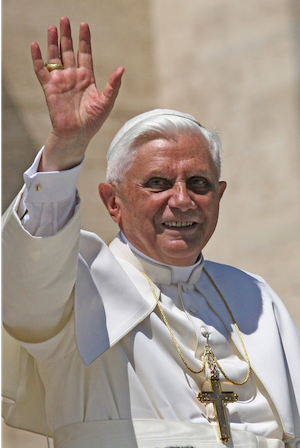
“St Maximus demonstrates that man does not find his unity, the integration of himself or his totality within himself but by surpassing himself, by coming out of himself. Thus, also in Christ, by coming out of himself, man finds himself in God, in the Son of God. It is . . . in God alone that we find ourselves, our totality and our completeness. Hence, we see that the person who withdraws into himself is not a complete person but the person who is open, who comes out of himself, becomes complete and finds himself, finds his true humanity, precisely in the Son of God. For St Maximus, this vision did not remain a philosophical speculation; he saw it realized in Jesus’ actual life, especially in the drama of Gethsemane. In this drama of Jesus’ agony, of the anguish of death, of the opposition between the human will not to die and the divine will which offers itself to death, in this drama of Gethsemane the whole human drama is played out, the drama of our redemption. St Maximus tells us that, and we know that this is true, Adam (and we ourselves are Adam) thought that the ‘no’ was the peak of freedom. He thought that only a person who can say ‘no’ is truly free; that if he is truly to achieve his freedom, man must say ‘no’ to God; only in this way he believed he could at last be himself, that he had reached the heights of freedom. This tendency also carried within it the human nature of Christ, but went beyond it, for Jesus saw that it was not the ‘no’ that was the height of freedom. The height of freedom is the ‘yes’, in conformity with God’s will. It is only in the ‘yes’ that man truly becomes himself; only in the great openness of the ‘yes’, in the unification of his will with the divine, that man becomes immensely open, becomes ‘divine’. What Adam wanted was to be like God, that is, to be completely free. But the person who withdraws into himself is not divine, is not completely free; he is freed by emerging from himself, it is in the ‘yes’ that he becomes free; and this is the drama of Gethsemane: not my will but yours. It is by transferring the human will to the divine will that the real person is born, it is in this way that we are redeemed.”
How the Church promotes the cause of freedom — Oliver O’Donovan: “We discover we are free when we are commanded by that authority which commands us according to the law of our being, disclosing the secrets of the heart.”
The danger of not defining “freedom” — Richard Bauckham insists that an adequate understanding of freedom requires recognition of God as the ground of true human freedom
Power to the people — Nathan O. Hatch on the DIY spirit of early American Christianity
Free for obedience — Glenn W. Olsen on Augustine’s understanding of freedom
The profound drama of human sexuality — In this lecture, D. C. Schindler explains the cosmological significance of human sexuality and why it is paradigmatic of the relationship between nature and freedom. (32 minutes)
Mars Hill Audio Journal, Volume 164 — FEATURED GUESTS: Dana Gioia, Brady Stiller, Robert Royal, Richard DeClue, Tiffany Schubert, and Joonas Sildre
Why liberalism tends toward absolutism — In this lecture, Michael Hanby examines what causes liberalism to become dictatorial in thought and practice. (49 minutes)
When is a market “free”? — William T. Cavanaugh argues for a richer conception of freedom than the reductionist one promoted by economist Milton Friedman. (44 minutes)
The gift of objective reality — Moral philosopher Oliver O’Donovan makes an argument for the consistency of the idea of law when it is conceived in a theological context. (40 minutes)
Freedom as conformity to reality — W. Bradford Littlejohn summarizes the definitions of liberty offered by Richard Bauckham and Oliver O’Donovan
The Life was the Light of men — In a lecture from 2018, Ken Myers contrasts the Enlightenment’s understanding of reason with the Christocentric conception of reason. (57 minutes)
David Bentley Hart on how “two-tier Thomism” deviates from historic Christian understanding of the relationship between God and Creation. (42 minutes)
Community, the giver of freedom — Thomas H. Naylor and William H. Willimon on why suspicion about big government shouldn’t take the form of autonomous individualism
Light from Neither the East nor the West — John Betz distinguishes a Christian understanding of freedom from the conventional modern definitions. (41 minutes; Part 3 of 3)
Culture in trinitarian perspective — An article by theologian Tracey Rowland titled “Joseph Ratzinger’s Trinitarian Theology of Culture” summarizes the ramifications of Ratzinger’s confidence that a recognition of the Trinity is the foundation of any reliable and faithful account of the relationship between faith and culture. (65 minutes)
Is irrational freedom truly freedom? — Joseph Cardinal Ratzinger argues that freedom must be understood in the context of interplay of reason and the will
Freedom, real and counterfeit — D. C. Schindler contrasts the classical and Christian understanding of freedom with the modern understanding of freedom, and explains how true freedom is a condition of harmony with reality. (59 minutes)
We Hold These Freedoms: Modern, Postmodern, Christian — John Betz explores the theological grounding of real freedom and argues that human freedom cannot be understood apart from divine freedom. (36 minutes; Part 1 of 3)
God is not Zeus; you are not Prometheus — Ron Highfield addresses those who doubt Christianity’s goodness, especially as regards modern assumptions about identity, freedom, and dignity. (24 minutes)
Why churches should be more attentive to space — Eric O. Jacobsen discusses New Urbanism with a Christian perspective, imagining how we might organize places in which life may be lived at a human scale and in which real community is nourished. (26 minutes)
Diagnosing our political conflicts — Michael Hanby explains why the modern pursuit of freedom — obeying its founding logic — has taken such a destructive turn. (36 minutes)
The social context of freedom — Brad Littlejohn talks about the necessity of a more expansive understanding of freedom, one which recognizes that we are really only free within the social experience of shared meaning and mutual recognition. (17 minutes)
The paradoxes of therapeutic culture — Stephen Gardner and Elisabeth Lasch-Quinn discuss Philip Reiff’s diagnosis of how psychology replaced the social roles of religion, morality, and custom, redefining the meaning of what is public.(39 minutes)
The Sixth Commandment and the obligation to protect public health — Ethicist Gilbert Meilaender explains why our experience with COVID-19 has made it difficult for many — citizens and officials — to honor a proper obligation to protect public health. (17 minutes)
Freedom, ancient and modern — In a brief excerpt from David Bentley Hart’s book Atheist Delusions, and a longer excerpt from an Areopagus Lecture by D. C. Schindler, the modern view of freedom is contrasted with the understanding of freedom present in ancient Hebrew, Greek, and Roman thought. (27 minutes)
Perceiving the common good during a pandemic — D. C. Schindler reflects on the shape of our way of life in wake of a killer virus, seeing signs both encouraging and sinister. (35 minutes)
Loving your neighbor during a pandemic — Brad Littlejohn reflects on how best to ask and answer some of the questions raised by our current disease-ravaged circumstances, particularly questions related to Christian freedom and love of neighbor. (29 minutes)
Mars Hill Audio Journal, Volume 146 — FEATURED GUESTS:
Mark Mitchell, Hans Boersma, Henry T. Edmondson, III, Brian Clayton, Douglas Kries, Conor Sweeney, and Carole Vanderhoof
Freedom and equality according to Flannery O’Connor — Three guests discuss Flannery O’Connor’s ideas: Henry T. Edmondson, III, on O’Connor’s understanding of political life; Ralph C. Wood, on O’Connor as a “hillbilly Thomist”; and Susan Srigley, on O’Connor’s sacramental and incarnational fiction. (18 minutes)
D. C. Schindler: “For Freedom Set Free” — D. C. Schindler argues that the Christian notion of religious liberty is a synthesis of the Jewish, Roman, and Greek traditions. (61 minutes)
Is the First Amendment religiously neutral? — David L. Schindler and Nicholas J. Healy, Jr. discuss how the First Amendment is not as sympathetic to religious freedom as is commonly believed, as it is based on contestable assumptions about the nature of “religion,” “freedom,” and “human nature.” (33 minutes)
Fischer, Hart, and Highfield on freedom — Three past guests on the Journal explore the meaning of freedom and some common modern misunderstandings of the concept — errors with real consequences. (22 minutes)
The nature of freedom reconsidered — In anticipation of this Fall’s Areopagus Lecture entitled “‘For Freedom Set Free’: Retrieving Genuine Religious Liberty,” we present selections from interviews with three MARS HILL AUDIO guests who have raised questions about the modern understanding of freedom. (27 minutes)
Mars Hill Audio Journal, Volume 142 — FEATURED GUESTS:
Stanley Hauerwas, Perry L. Glanzer, Nathan F. Alleman, Jeffrey Bishop, Alan Jacobs, D. C. Schindler, and Marianne Wright
Unbearable Lightness: R. J. Snell on Acedia and Metaphysical Boredom — Philosopher R. J. Snell argues that the metaphysical boredom of modernity is sustained by our deeply-held convictions about freedom and contingency, which view the former as necessary and the latter as offensive. (48 minutes)