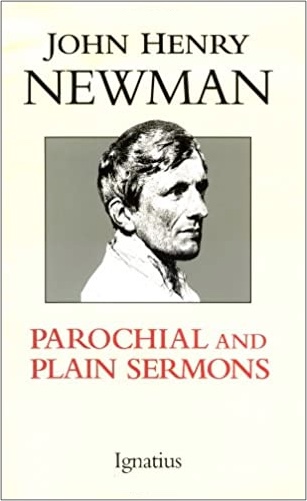
“Let us guard against discontent in any shape; and as we cannot help hearing what goes on in the world, let us guard, on hearing it, against all intemperate, uncharitable feelings towards those who differ from us, or oppose us. Let us pray for our enemies; let us try to make out men to be as good as they can fairly and safely be considered; let us rejoice at any symptoms of repentance, or any marks of good principle in those who are on the side of error. Let us be forgiving. Let us try to be very humble, to understand our ignorance, and to rely constantly on the enlightening grace of our Great Teacher. Let us be ‘slow to speak, slow to wrath;’ — not abandoning our principles, or shrinking from the avowal of them when seasonable, or going over to the cause of error, or fearing consequences, but acting ever from a sense of duty, not from passion, pride, jealousy, or an unbelieving dread of the future; feeling gently, even when we have reason to act severely.”
— from John Henry Newman, “Contracted Views in Religion,” a sermon on the story of the Prodigal Son, in Parochial and Plain Sermons, Volume 3 (published 1834–42).
Related reading and listening
- University or “utiliversity”? — In this essay, Reinhard Hütter examines in depth John Henry Newman’s The Idea of a University and argues that its insights and prescriptions are urgently relevant to the current status of higher education. (87 minutes)
- The “scandal” of theology in the university — Edward T. Oakes, S.J. explains why John Henry Newman’s eloquent defense of the nature of university education, The Idea of a University, continues to inspire, challenge, and even frustrate its sympathizers. (24 minutes)
- The need to recollect ourselves as whole persons — In this 2016 lecture, John F. Crosby explores key personalist insights found in the thinking of John Henry Newman and Romano Guardini. (60 minutes)
- The aboriginal Vicar of Christ, the voice of God in the heart of Man — Reinhard Hütter on John Henry Newman’s insistence that conscience — rightly formed — bears witness to the law of God
- Conscience and its counterfeits — A 2014 lecture by theologian Reinhard Hütter examines “Freedom of Conscience as Freedom in the Truth: Conscience according to Thomas Aquinas and John Henry Newman.” (64 minutes)
- Maintaining a connected grasp of things — Ian Ker summarizes the central concern of John Henry Newman’s educational philosophy as developed in The Idea of a University
- The university and the unity of knowledge — Biographer Ian Ker discusses John Henry Newman’s understanding the goal of “mental cultivation.” (17 minutes)
- Teachers and Learners — Ian Ker shares John Henry Newman’s ideals of learning, and Mark Schwehn discusses the virtues of good teachers. (27 minutes)
- Stephen Gurney: “John Henry Newman: The Poetics of Devotion” — Stephen Gurney shows how in his sermons, John Henry Newman draws the listener in through the craft and beauty of his prose while nonetheless removing himself from the spotlight in order to convey his listeners to the True Presence of Christ. (51 minutes)
- Mars Hill Audio Journal, Volume 52 — FEATURED GUESTS: Tom Shippey, Jeffrey Meyers, Ralph McInerny, Daniel Ritchie, Ian Ker, Mark Schwehn, Gilbert Meilaender, and Tiina Nunnally.