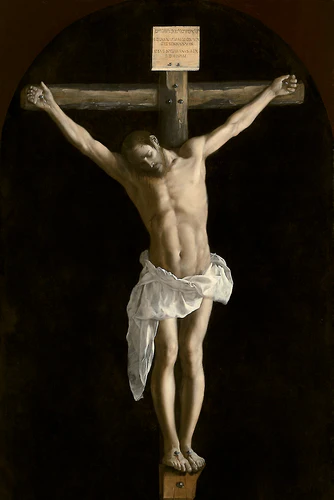
Johann Sebastian Bach’s St. John Passion was first heard during the Good Friday Vespers service at the Nikolaikirche in Leipzig on April 7, 1724. It was composed to be experienced in a liturgical setting, within a Christian congregation at worship. Today, it is much more likely heard in concert or on recordings.
In deference to the origins of the work, the 2013 recording featuring the Dunedin Consort, conducted by John Butt, presented a reconstruction of the liturgical experience of the original performance, complete with congregational singing, liturgical chant, and the reading of a sermon (in German) originally given by Erdmann Neumeister and published in 1720.
In 2017, John Butt conducted a performance of the St. John Passion at a BBC Proms concerts, in which the audience at the Royal Albert Hall sang with the choir the same Lutheran chorales that were sung during the original 1724 service. The YouTube recording of this concert (embedded below) provides English subtitles for the text being sung throughout the work, a helpful addition for listeners without adequate German.
Just last week (March 23, 2018), the Netherlands Bach Society released a video recording of their performance of the St. John Passion. It is one of many fine performances on their remarkable website, allofbach.com.
In the video below, conductor Jos van Veldhoven talks about leitmotifs in the St John Passion.
FURTHER READING
It is better to listen to Bach’s St. John Passion than to read about it. But the books and articles listed below might help enrich the experience of listening for you.
Jaroslav Pelikan, Bach among the Theologians (Philadelphia: Fortress Press, 1986) A learned theologian and Church historian situates Bach’s sacred choral music in several contexts, including the rhythm of the Church year, the musical heritage of the Reformation, and the cultural revolution of the Enlightenment. Of special interest is his essay on the Christological and soteriological emphases in the St. John Passion.
Markus Rathey, Bach’s Major Vocal Works: Music, Drama, Liturgy (New Haven: Yale University Press, 2016) A guest on volume 135 of the MARS HILL AUDIO Journal, Dr. Rathey includes a chapter in his book on the St. John Passion, along with discussions of the St. Matthew Passion, the Magnificat, the Christmas, Easter, and Ascension oratorios, and the B-minor Mass.
Calvin Stapert, “Christus Victor: Bach’s St. John Passion,” The Reformed Journal, March 1989. Similar in emphasis to Pelikan’s essay in Bach among the Theologians, Dr. Stapert discusses in detail how the St. John Passion emphasizes the themes in John’s Gospel of the power and glory of Jesus the King.
Michael Steinberg, “The Passion of Saint John, BWV 245,” posted on the Bach Cantatas Website. This brief essay is adapted from Steinberg’s Choral Masterworks: A Listener’s Guide (New York: Oxford University Press, 2005). In it, Steinberg offers a brief historical background to Bach’s composition of the St. John Passion, as well as some helpful points in understanding how the structure of the work establishes its meaning.
The following texts are more specialized and scholarly:
John Butt, Bach’s Dialogue with Modernity: Perspectives on the Passions (Cambridge: Cambridge University Press, 2010) A discussion by a prominent Bach scholar and conductor of how the two extant settings of the Passion story by Bach illustrate an interplay between traditional and modern mentalities and sensibilities.
Eric Chafe, J. S. Bach’s Johannine Theology: The St. John Passion and the Cantatas for Spring 1725 (New York: Oxford University Press, 2014) A detailed study of how the distinctive theological concerns of the Gospel of St. John are reflected in the structure of the St. John Passion.
Robin Leaver, “The mature vocal works and their theological and liturgical context,” The Cambridge Companion to Bach, edited by John Butt (Cambridge: Cambridge University Press, 1997) This scholarly article includes a long section on the St. John Passion, which concludes: “Here is Bach the preacher in sound, whose purpose is not simply to relate in musical terms the great dramatic story, as if he had written a religious opera, but rather to draw the worshipper at Good Friday Vespers into the story itself and to find within it a contemporary significance.”
Michael Marissen, Bach and God (New York: Oxford University Press, 2016) Dr. Marissen discussed this book on volume 137 of the MARS HILL AUDIOJournal.
Michael Marissen, Bach’s Oratorios: The Parallel German-English Texts with Annotations (New York: Oxford University Press, 2008) The literal translations of the German texts for these major works (including the St. John Passion) are explicated with citations from the Luther Bible of Bach’s own day, as well as extensive footnotes discussing theological themes addressed in the text.
Michael Marissen, Lutheranism, Anti-Judaism, and Bach’s St. John Passion (New York: Oxford University Press, 1998) Dr. Marissen discussed this book on volume 37 of the MARS HILL AUDIOJournal.
Related reading and listening
The roots of J. S. Bach’s fruitfulness — Music historian Markus Rathey explains why and how J. S. Bach composed his choral works as he did. (54 minutes)
Celebrating Christmas with Bach (through Epiphany) — Ken Myers offers a detailed introduction to J. S. Bach’s Christmas Oratorio, a work composed to be sung on six occasions from Dec. 25th to Jan. 6th
Nun komm der Heiden Heiland — Ken Myers looks at the history of an Advent hymn written by St. Ambrose in the fourth century, adapted by Martin Luther in the sixteenth century, and transformed by J. S. Bach and many others in the years since. (21 minutes)
An ancient liturgical form — Calvin Stapert on the long history of recounting Christ’s sufferings musically
The St. Matthew Passion: A Listener’s Guide — In this lecture, Paul Munson guides listeners into a deeper theological and musical appreciation of J. S. Bach’sSt. Matthew Passion. (1 hour 48 minutes)
Musicologist Michael Marissen discusses the masterful way in which J. S. Bach uses musical idiom and quotation by way of theological counterpoint to the texts of his sacred vocal works. (13 minutes)
The physical beauty of music — Music can be likened to a cathedral, says professional guitarist Gordon Kreplin, when it creates through silence and sound a meditative space into which one may enter and encounter God. (14 minutes)
David Bentley Hart describes how the Christian understanding of Creation as beauty and gift, as the outward expression of the delight the Trinity has in itself, reveals a vision of reality different from the pagan or fatalist vision of reality. (12 minutes)
Genealogy of a work of praise — For Good Friday, Ken Myers tells the history of the text and music behind the popular hymn, “O Sacred Head, now wounded.” (27 minutes)
Bach retrospective — In light of Passiontide and Holy Week, Ken Myers revisits three interviews — with Calvin Stapert, Robin Leaver, and Christoph Wolff — that provide an illustrative background for listeners to appreciate J. S. Bach’s theological attentiveness and scholarly genius. (36 minutes)
The infinity of beauty in Bach — David Bentley Hart on why Johann Sebastian Bach is the greatest of Christian theologians
Turn to the Lord your God — Ken Myers introduces musical settings from the book of Lamentations, traditionally sung during Holy Week. (26 minutes)
The music and the notes are precious — Ken Myers encourages an understanding of the Church as a particular culture that should be nourished and sustained, and then describes the history of an Advent hymn written by St. Ambrose. (27 minutes)
Stabat Mater dolorosa — Ken Myers offers some thoughts on the aesthetics of sympathy, and introduces some of the musical settings of the remarkable medieval poem known as “Stabat Mater dolorosa.” (23 minutes)
Passions before Bach — In preparation for Holy Week, Ken Myers presents a whirlwind music history lesson with musical examples from the sixteenth, seventeenth, and eighteenth centuries. (22 minutes)
Renaissance music for Good Friday — In a special Feature for Good Friday, Ken Myers shares settings of passages from the Book of Lamentations and of the Tenebrae Responsories by Tomás Luis de Victoria. (18 minutes)
Meditative music for Passiontide — At the start of Passiontide, Ken Myers introduces listeners to works by the Renaissance composer Orlande de Lassus which highlight the theme of lamentation. (18 minutes)
The Cross in artistic expression — Richard Viladesau examines how the Passion of the Christ has been depicted artistically and aesthetically throughout Church history. (21 minutes)
Music for Good Friday — A conversation with Markus Rathey and Michael Marissen about Johann Sebastian Bach’sSt. John Passion. (12 minutes)
Mars Hill Audio Journal, Volume 137 — FEATURED GUESTS:
Gilbert Meilaender, James L. Nolan, Joel Salatin, Michael Di Fuccia, Robin Leaver, and Michael Marissen
Mars Hill Audio Journal, Volume 135 — FEATURED GUESTS:
Bob Cutillo, Hans Boersma, Dana Gioia, Matthew Levering, Bruce Gordon, and Markus Rathey
Mars Hill Audio Journal, Volume 120 — FEATURED GUESTS:
Douglas Rushkoff, Phillip Thompson, Jonathan Wilson, James Bratt, D. C. Schindler, and Paul Elie
Mars Hill Audio Journal, Volume 47 — FEATURED GUESTS: Christopher Clausen, Don Eberly, George Weigel, Luci Shaw, Steve Wilkens, David Harvey, John Durham Peters, and Masaaki Suzuki
Mars Hill Audio Journal, Volume 45 — FEATURED GUESTS: Jeff Speck, Victor Davis Hanson, Allan C. Carlson, Paulina Borsook, John F. Kilner, Robert E. Webber, and Christoph Wolff
Mars Hill Audio Journal, Volume 44 — FEATURED GUESTS: James Davison Hunter, Brian C. Robertson, David Myers, Robert Frank, Gayle Brandow Samuels, Thomas Hine, Thomas Hibbs, and Robin Leaver
Mars Hill Audio Journal, Volume 43 — FEATURED GUESTS: Jedediah Purdy, Lendol Calder, John Nelson, George Arasimowicz, James Calvin Schaap, Frederick Buechner, Kay Hymowitz, and Calvin Stapert