“Natural science, which associates knowledge with power, is indifferent to the distinction between man and nature. The expansion of mastery over nature is therefore always at the same time an expansion of our ability to be masters over human beings. But the process of this expansion remains itself ‘natural’ in the raw sense. And a history of man that is understood as nothing more than a history of the mastery of nature, is itself nothing more than natural history. But this means that it has no place for the distinction between what is ‘natural’ and what is ‘unnatural.’ From this perspective, even man’s total destruction of the biosphere on this planet could be understood as a change occurring in the course of natural history. From the same perspective, a garbage dump is no more unnatural than a mountain stream. The drive that dissolves and transforms the pre-given structures of nature, and thus reduces nature to its molecular elemental structures, is just as natural as the thing that it destroys. There is no transcendence of nature in this drive. Total technologization, carried to its end, is at the very same time total naturalization.
“A transcendence of nature occurs only when nature is recalled as it is in truth. The basic meaning of the word ‘culture’ is ‘cultivation,’ the care for precisely that nature from which culture frees itself. For thousands of years, culture meant a symbiotic relationship between man and nature, in which nature appeared at the same time as enemy, as giver, and as object of man’s cultivating mastery, ‘because a nature that one can rein in and tame so that it becomes something more friendly is the most beautiful thing there is on the earth.’ In modernity, what has replaced this symbiosis is the relationship of a progressive mastery that we would have to call despotic, because it progressively erodes the individual reality of what it masters. If Socrates could still say that the shepherd’s art is defined by the well-being of the sheep, and not from the perspective of the butcher, even though the sheep are ultimately handed over to the latter, this can no longer be said of modern raisers of livestock and breeders.
“The process of the naturalistic mastery of nature has in any event arrived at a point at which it has turned against man himself. Only now are we coming to realize that nature’s resources are finite with respect to what constitutes the living conditions of the human race. The survival of the race thus depends on bringing the expansion of technology and industry, as well as the population explosion produced by modern medicine, to an end for the sake of a new, longer-term state of equilibrium, a new symbiosis, which is no longer stabilized by human impotence, but by the conscious recollection of the natural foundations of human existence. The naturalistic expansion of the mastery of nature, far from lessening man’s mastery over man, instead increases both the need and the means for this mastery. It increases the need for an ever more comprehensive manipulation of human beings in order to make them useful cogs in its own nature-mastering machine. The ‘liberation’ from all historical modes of life serves this instrumentalization. Conversely, the increasing capacity to master nature in turn increases mastery over human beings, a mastery that is not based on freedom as is the relationship between command and obedience, but that, as ‘manipulation,’ objectifies man as nature instead. One attempts to justify such manipulation by pointing out that, to the extent that man is able to be manipulated, he is in fact a natural being, and thus is not free; and that what we are doing in this case is nothing more than putting rationally guided processes of socialization in the place of those provided by raw nature. But freedom is not a ‘core’ that remains left over after everything having to do with nature has been subjugated. The fundamental act of freedom is that of refraining from dominating what we are able to dominate, the act of ‘letting be.’ Only by reciprocally acknowledging the other and letting the other be free does the natural being transcend nature.”
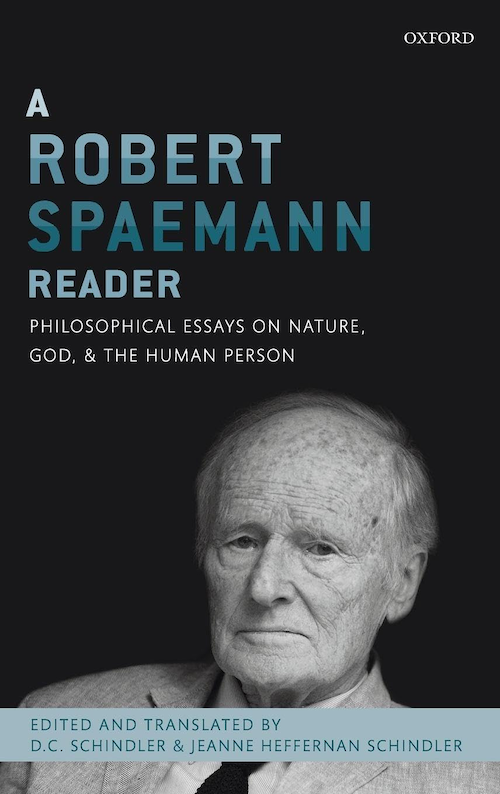
— from “Nature,” an essay written in 1973, included in Robert Spaemann, A Robert Spaemann Reader: Philosophical Essays on Nature, God, and the Human Person (Oxford University Press, 2015)
Related reading and listening
Christian culture and the myth of the secular — Ken Myers draws on T. S. Eliot to argue that Western civilization has broken down, not into a multiplicity of cultures, but into a “post-culture.” (47 minutes)
How to make war on nothingness? — David Bentley Hart argues that if it rejects Christ, the only remaining option for a post-Christian culture is conscious or “narcotic” nihilism, which takes the form of absolute, meaningless volition. (66 minutes)
A letter from Ken Myers — Ken Myers examines the cultural implications of the Incarnation and the deep-seated dualism of modernity that divorces spirituality from our material experience. (22 minutes)
Christian Smith discusses the aimless cultural world of emerging adulthood and on how it makes the idea of objective moral order implausible. (17 minutes)
Media as agencies of order — Media theorist John Durham Peters wants us to reexamine the purposes of media and how fundamental media are. (59 minutes)
Good News for All Creation — Theologian Norman Wirzba helps us rethink the category of nature in terms of the Christian doctrine of creation. (66 minutes)
How the Church promotes the cause of freedom — Oliver O’Donovan: “We discover we are free when we are commanded by that authority which commands us according to the law of our being, disclosing the secrets of the heart.”
The danger of not defining “freedom” — Richard Bauckham insists that an adequate understanding of freedom requires recognition of God as the ground of true human freedom
Power to the people — Nathan O. Hatch on the DIY spirit of early American Christianity
Free for obedience — Glenn W. Olsen on Augustine’s understanding of freedom
D. C. Schindler discusses the thought of contemporary German philosopher Robert Spaemann, and his defense of a purposeful structure in nature. (28 minutes))
The profound drama of human sexuality — In this lecture, D. C. Schindler explains the cosmological significance of human sexuality and why it is paradigmatic of the relationship between nature and freedom. (32 minutes)
Dana Gioia discusses the important role literary reading plays in society and the 2004 publication from the NEA about such reading. (13 minutes)
Mars Hill Audio Journal, Volume 164 — FEATURED GUESTS: Dana Gioia, Brady Stiller, Robert Royal, Richard DeClue, Tiffany Schubert, and Joonas Sildre
From culture war to culture care — In this 2016 lecture, artist Makoto Fujimura asks what would it look like for Christians to be stewards of beauty and human flourishing in all areas of life and culture. (48 minutes)
Excluding cranks and dabblers — Drusilla Scott on Michael Polanyi’s insistence that the “community of science” required authority
How discovery happens — Esther Lightcap Meek on Michael Polanyi’s account of scientific discovery
Professor Martin X. Moleski explains why Michael Polanyi (1891-1976) left his career in science to become a philosopher. (16 minutes)
Etiquette and ethics — In this essay, Judith Martin (a.k.a. Miss Manners) argues that etiquette is “civilization’s first necessity” and an indispensable societal virtue. (21 minutes)
Professor Christopher Shannon discusses how early twentieth-century social scientists encouraged the American idea that individual identity works against communal membership. (17 minutes)
Nature’s intelligibility — In this lecture, Christopher Blum argues that scientists need to regain a full appreciation of nature’s intelligibility, as they are apt to lose sight of reality due to the reductionism produced by their theories. (31 minutes)
Is American culture now story-less? — From our archives, Michael Kammen compares popular and mass culture, and Philip Fisher analyzes the idea that new cultural forms inevitably dissolve old ones. (26 minutes)
Why liberalism tends toward absolutism — In this lecture, Michael Hanby examines what causes liberalism to become dictatorial in thought and practice. (49 minutes)
Theological realism — Kevin J. Vanhoozer discusses theologian T. F. Torrance’s understanding of the positive relation between science and theology. (52 minutes)
A fearful darkness in mind, heart, and spirit — Roberta Bayer draws on the work of George Parkin Grant (1918–1988) to argue that our “culture of death” must be countered with an understanding of reality based in love, redemptive suffering, and a recognition of limitations to individual control. (33 minutes)
When is a market “free”? — William T. Cavanaugh argues for a richer conception of freedom than the reductionist one promoted by economist Milton Friedman. (44 minutes)
The gift of objective reality — Moral philosopher Oliver O’Donovan makes an argument for the consistency of the idea of law when it is conceived in a theological context. (40 minutes)
Freedom as conformity to reality — W. Bradford Littlejohn summarizes the definitions of liberty offered by Richard Bauckham and Oliver O’Donovan
Eric Miller discusses the late historian and social critic Christopher Lasch’s intense commitment to understand the logic of American cultural confusion. (20 minutes)
Mechanism and the abolition of meaning — On the occasion of philosopher Daniel Dennett’s death this week, Ken Myers presents an archive interview with David Bentley Hart in which he explains how pure naturalism leads to the un-doing of rationality. (37 minutes)
The Life was the Light of men — In a lecture from 2018, Ken Myers contrasts the Enlightenment’s understanding of reason with the Christocentric conception of reason. (57 minutes)
David Bentley Hart on how “two-tier Thomism” deviates from historic Christian understanding of the relationship between God and Creation. (42 minutes)
Community, the giver of freedom — Thomas H. Naylor and William H. Willimon on why suspicion about big government shouldn’t take the form of autonomous individualism
Freedom from the nature of things? — Leon Kass on the pressure exerted by the authority of science to embrace reductionistic materialism
Life, liberty, and the defense of dignity — In a 2003 interview, Leon Kass discussed his book Life, Liberty, and the Defense of Dignity: The Challenge for Bioethics. The unifying theme in the book’s essays is the threat of dehumanization in one form or another. (36 minutes)