The Eliot Society is a nonprofit based in Annapolis, MD, that exists to enrich the church and foster spiritual formation through the arts. T. S. Eliot believed that religion and the arts can illuminate one another. In a 2013 essay, “The Catholic Writer Today,” the poet Dana Gioia notes that Eliot’s life, particularly the two decades after World War II, coincided with a flowering of Christian art in Europe and America. Many of the Christian writers of that period are still household names in both Christian and secular circles: Walker Percy, Flannery O’Conner, Thomas Merton, T. S. Eliot, Dorothy L. Sayers, Graham Greene, J. R. R. Tolkien, C. S. Lewis.
But the years since then, says Gioia, have marked a growing “schism between Christianity and the arts,” and along with it, “the intellectual retreat and creative inertia of American religious life.” Gioia proposes a remedy. He says, “Culture is not an intellectual abstraction. It is human energy expressed through creativity, conversation, and community.”
The Eliot Society exists to foster the creativity, conversation, and community that Gioia describes. Its members are working to create a place where writers, poets, musicians, visual artists, and others can gather and fellowship. The Eliot Society also provides opportunities for people within the church to experience excellent art in an intimate and accessible way. It hosts an annual lecture series that brings in various artists and scholars. It also hosts more intimate community gatherings, such as house concerts, poetry readings, discussion groups, and other special events. In everything, the Eliot Society aims to challenge and inspire both artists and lovers of the arts to grow in their appreciation for beauty and for the ways that human creativity reflects Divine artistry.
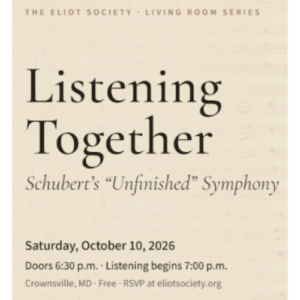
On Saturday, October 10, 2026, the Eliot Society will host its next Living Room Series event: a gathering to listen to Franz Schubert’s “Unfinished” Symphony. Musician Stephen Horst will guide attendees through the symphony . . .
Philip Bess imagines what metropolitan Chicago might look like in one hundred years if it were designed according to classical humanist principles and with an overt acknowledgement of sacred order. (93 minutes)
Artist Margaret Adams Parker explores the human need to lament and reveals how various “arts of lament” console, strengthen, bear witness to those who engage with them. (51 minutes)
In this lecture, Paul Munson guides listeners into a deeper theological and musical appreciation of J. S. Bach’sSt. Matthew Passion. (1 hour 48 minutes)
In this lecture, Gregory Wilbur explains how liturgy and liturgical time align us to the rhythms and order of Creation, forming us as disciples. (45 minutes)
In the inaugural lecture for the Eliot Society, titled “Faithful Imaginations in a Meaningful Creation,” Ken Myers addresses the question of the relationship between the arts and the Church. (59 minutes)
Michael Hanby argues that our current civilizational crisis can be understood as a “new totalitarianism” that negates or disallows every form of transcendence. (32 minutes)
T. S. Eliot’s Four Quartets is regarded by many as his greatest accomplishment. Today’s Feature presents a lecture about this monumental work, a talk given in 2019 by Dr. Janice Brown. (58 minutes)
Every volume of the Journal produced since November 1999 (Volume 40) is now available to members in our catalog, and on the first Friday of each month, we will highlight one of these archived collections of interviews. The entire highlighted volume will be available for one month to members and to anyone who signs up for a free Visitor’s Pass.*
Volume 146 of the Journal, produced in February 2020, is this month’s free sample volume. In this Friday Feature you will hear excerpts from interviews with Mark Mitchell about why the modern denigration of tradition has rendered political life so volatile; with Hans Boersma about how the ultimate end of seeing God should inform how we live now; with Henry Edmondson, III, about political ideas in Flannery O’Connor’s work; with Brian Clayton and Douglas Kries about integrating faith and reason; with Conor Sweeney about wrestling with the ‘death of God’ with the help of hobbit wisdom; and with Carole Vanderhoof about Dorothy L. Sayers.
*Follow the instructions on our “Listen for free” page to sign up for a free Visitor’s Pass. With this Pass, you can download these audio files to our app on your mobile device. NB: We don’t sell or share our listeners’ information with anyone else. No one who signs up for any of our memberships, free or paid, need fear that their contact information will be sold or shared with any other entity.
Antón Barba-Kay on the shape of the virtues in the digital age
What virtues do we need to live well in our digital age, and how might those virtues be best formed, not only individually but as communities? In this March 2026 lecture, Antón Barba-Kay examines the notion of virtue ethics, a concept that has become increasingly alien to many. He then discusses how digital technology actively deforms, disassociates, and disembeds our lives and experiences. Barba-Kay proposes key principles that educational institutions can embody in order to help form virtuous human beings and communities in light of what we are; and he articulates three “interlocking” virtues that relate to those principles. Throughout the lecture, he offers reflections on these issues from his teaching experience at Deep Springs College, a unique school that forms students through academics, self-government, and manual labor.