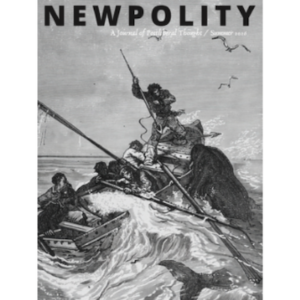
New Polity is a magazine of postliberal thought that aims to investigate and construct a Christian political worldview.
Published four times a year by the Institute for Political Philosophy and Theology, the magazine hosts articles that deconstruct liberalism and build a definitive vision for Christian politics. To that end, the magazine has published articles and debates on a number of topics, including on the political theory of integralism, the morality of investing in the stock market, the social meaning of gender, and the current technocratic paradigm. New Polity also publishes a bi-weekly podcast with series such as “The Politics of Tyranny,” “Good Money,” and “The Politics of Gender.”
As the political order of liberalism continues to isolate and divide, New Polity aims to voice an alternative; one which ennobles and informs the Christian to sanctify the temporal order.
The theme of the Summer 2026 issue of New Polity magazine is “Artificial Intelligence.” This issue includes essays by Ronald Klingler on the death of the coding community; Joshua May on the Central Intelligence Agency; Slavoj Žižek on the pope; Michael Poland on blame he assigns to the 17th century . . .
In this lecture, Marc Barnes critiques the current reigning system of gender for its ironies, internal inconsistencies, and failure to satisfy or “work” on its own terms. (32 minutes)
Andrew Willard Jones explains the two paths that exist with the development of new technologies: one which leads to an expansion of the humane world and one which exploits and truncates both Creation and humanity. (65 minutes)
In this lecture, Matthew Crawford draws a distinction between an orientation toward receiving life as gift and a timid and cramped rationalism that views man as an object to be synthetically remade. (52 minutes)
Political philosopher Andrew Willard Jones lays out a robust vision for a just society in which virtues are formed in an analogical manner through relational obedience and trust. (71 minutes)
Shawn and Beth Dougherty make a theological case for biomimicry, or fulfilling our original vocation of tending the earth by working according to the nature of Nature. (68 minutes)
Poet Malcolm Guite discusses Merlin’s Isle: An Arthuriad, his epic ballad cycle in four volumes. He summarizes the significance of the Wasteland in the Arthurian legend and its connection with the Holy Grail. Guite brings out the story’s clear Christian symbolism and reveals the hope that is given right upon the heels of the “dolorous stroke” that wounds the Fisher King and plunges the land into ruin. He also discusses the character of King Arthur as a symbol of national hope and recovery for England, and he shares his particular intention that his retelling would be an epic of place, not of race. Guite ends with his hope even for lands like America, that a diversity of peoples in one land might learn to “begin to belong to the same story.” The first two volumes of the Arthuriad are Galahad and the Grail and The Coming of Arthur(both from Rabbit Room Press, 2026).
This Feature includes a portion of a much longer Conversation with Malcolm Guite, which is available to members here.
Conversations from 2020
Every volume of the Journal produced since November 1999 (Volume 40) is now available to members in our catalog, and on the first Friday of each month, we will highlight one of these archived collections of interviews. The entire highlighted volume will be available for one month to members and to anyone who signs up for a free Visitor’s Pass.*
Volume 146 of the Journal, produced in February 2020, is this month’s free sample volume. In this Friday Feature you will hear excerpts from interviews with Mark Mitchell about why the modern denigration of tradition has rendered political life so volatile; with Hans Boersma about how the ultimate end of seeing God should inform how we live now; with Henry Edmondson, III, about political ideas in Flannery O’Connor’s work; with Brian Clayton and Douglas Kries about integrating faith and reason; with Conor Sweeney about wrestling with the ‘death of God’ with the help of hobbit wisdom; and with Carole Vanderhoof about Dorothy L. Sayers.
*Follow the instructions on our “Listen for free” page to sign up for a free Visitor’s Pass. With this Pass, you can download these audio files to our app on your mobile device. NB: We don’t sell or share our listeners’ information with anyone else. No one who signs up for any of our memberships, free or paid, need fear that their contact information will be sold or shared with any other entity.
Antón Barba-Kay on the shape of the virtues in the digital age
What virtues do we need to live well in our digital age, and how might those virtues be best formed, not only individually but as communities? In this March 2026 lecture, Antón Barba-Kay examines the notion of virtue ethics, a concept that has become increasingly alien to many. He then discusses how digital technology actively deforms, disassociates, and disembeds our lives and experiences. Barba-Kay proposes key principles that educational institutions can embody in order to help form virtuous human beings and communities in light of what we are; and he articulates three “interlocking” virtues that relate to those principles. Throughout the lecture, he offers reflections on these issues from his teaching experience at Deep Springs College, a unique school that forms students through academics, self-government, and manual labor.