
“The thirst for a sacred theocracy, the desire to illumine the sinful stuff of history with the light of Christ; everything that could justify the union of Church and empire — this ideal required for its attainment a very subtle but very clear distinction between the Church and the world. For the Church is thoroughly fulfilling its mission to transform the world only when it completely feels itself to be a kingdom not of this world.
“The tragedy of the Byzantine Church consisted precisely in the fact that it became merely the Byzantine Church, that it merged itself with the empire not so much administratively as, above all, psychologically, in its own self-awareness. The empire became for it the absolute and supreme value, unquestioned, inviolable, and self-evident. The Byzantine hierarchs — like the Russian, later on — were simply incapable of going beyond the categories of the sacred empire, of appraising it in the light of the life-giving freedom of the Gospel. Everything became sacred and everything was justified through this sacred character. One could shut one’s eyes to sin and evil — these things were simply the result of ‘men’s frailty’; there remained a heavy embroidery of sacred symbols which converted the whole of life into a solemn ritual, lulling and gilding over conscience itself.
“Theoretical perfectionism, completeness of dedication, led in an ironic way to a minimizing of morality. On his deathbed the black monk’s robe shrouded all the emperor’s sins, the outcry of conscience found relief in the liturgical confession of impurity. Everything — even penitence, even the conviction of sin — had its order, and in this Christian world with its pall woven of gold, frozen in a kind of motionless ceremonial, there no longer remained any place for the simple, bare, incorruptibly sober judgment of the most artless book in the world: ‘For where your treasure is, there will your heart be also.’ The real tragedy of the Byzantine Church lies, not in the arbitrary rule of emperors, or its own sins, but in the fact that the real treasure that filled its heart completely, and subjected everything to itself, became — the empire. It was not force that vanquished the Church, but the temptation of ‘flesh and blood.’ The Church’s consciousness came under the spell of an earthly illusion, an earthly affection.”
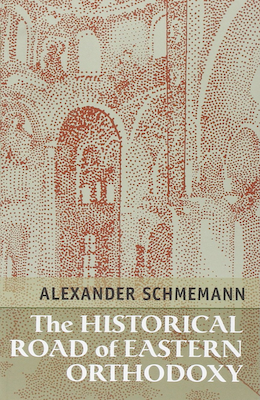
— from Alexander Schmemann, The Historical Road of Eastern Orthodoxy (St. Vladimir’s Seminary Press, 1963)
Click on the tags below for listings of related readings or audio features.