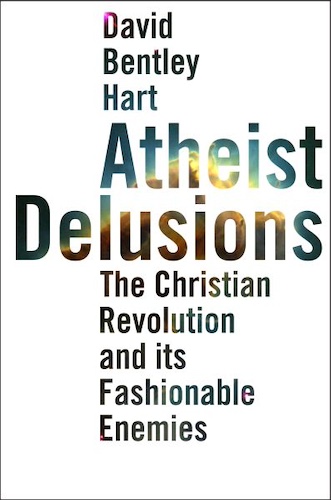
“To be entirely modern (which very few of us are) is to believe in nothing. This is not to say it is to have no beliefs: the truly modern person may believe in almost anything, or perhaps in everything, so long as all these beliefs rest securely upon a more fundamental and radical faith in the nothing — or, better, in nothingness as such. Modernity’s highest ideal — its special understanding of personal autonomy — requires us to place our trust in an original absence underlying all of reality, a fertile void in which all things are possible, from which arises no impediment to our wills, and before which we may consequently choose to make of ourselves what we choose. We trust, that is to say, that there is no substantial criterion by which to judge our choices that stands higher than the unquestioned good of free choice itself, and that therefore all judgment, divine no less than human, is in some sense an infringement upon our freedom. This is our primal ideology. In the most unadorned terms possible, the ethos of modernity is — to be perfectly precise — nihilism. . . .”
“Again, however, almost no one is entirely modern in this way, and very few of us are conscious or consistent nihilists, even of the extremely benign variety I have just described. The majority of us, if polls are to be trusted, even believe in God. And even the majority of unbelievers are aware that human nature and human society place not merely necessary but desirable limits upon the will’s free exercise. Nevertheless, we live in an age whose chief value has been determined, by overwhelming consensus, to be the inviolable liberty of personal volition, the right to decide for ourselves what we shall believe, want, need, own, or serve. The will, we habitually assume, is sovereign to the degree that it is obedient to nothing else and is free to the degree that it is truly spontaneous and constrained by nothing greater than itself. This, for many of us, is the highest good imaginable. And a society guided by such beliefs must, at least implicitly, embrace and subtly advocate a very particular ‘moral metaphysics’: that is, the nonexistence of any transcendent standard of the good that has the power (or the right) to order our desires toward a higher end. We are, first and foremost, heroic and insatiable consumers, and we must not allow the specters of transcendent law or personal guilt to render us indecisive. For us, it is choice itself, not what we choose, that is the first good, and this applies not only to such matters as what we shall purchase or how we shall live. In even our gravest political and ethical debates — regarding economic policy, abortion, assisted suicide, censorship, genetic engineering, and so on — ‘choice’ is a principle not only frequently invoked, by one side or by both, but often seeming to exercise an almost mystical supremacy over all other concerns.”
—from David Bentley Hart, Atheist Delusions: The Christian Revolution and Its Fashionable Enemies(New Haven: Yale University Press, 2009)
Christian culture and the myth of the secular — Ken Myers draws on T. S. Eliot to argue that Western civilization has broken down, not into a multiplicity of cultures, but into a “post-culture.” (47 minutes)
How to make war on nothingness? — David Bentley Hart argues that if it rejects Christ, the only remaining option for a post-Christian culture is conscious or “narcotic” nihilism, which takes the form of absolute, meaningless volition. (66 minutes)
Susanna Lee discusses moral authority in the heroes of hard-boiled crime fiction. (24 minutes)
How the Church promotes the cause of freedom — Oliver O’Donovan: “We discover we are free when we are commanded by that authority which commands us according to the law of our being, disclosing the secrets of the heart.”
The danger of not defining “freedom” — Richard Bauckham insists that an adequate understanding of freedom requires recognition of God as the ground of true human freedom
Power to the people — Nathan O. Hatch on the DIY spirit of early American Christianity
Free for obedience — Glenn W. Olsen on Augustine’s understanding of freedom
R. J. Snell discusses how novel ideas about natural law focus less on moral propositions and concepts and more on the thrust for meaning and value. (27 minutes)
The profound drama of human sexuality — In this lecture, D. C. Schindler explains the cosmological significance of human sexuality and why it is paradigmatic of the relationship between nature and freedom. (32 minutes)
Mars Hill Audio Journal, Volume 164 — FEATURED GUESTS: Dana Gioia, Brady Stiller, Robert Royal, Richard DeClue, Tiffany Schubert, and Joonas Sildre
Mars Hill Audio Journal, Volume 163 — FEATURED GUESTS: Andrew Youngblood, R. J. Snell, Nicholas Denysenko, Nigel Biggar, Robert McNamara, and David Cayley
An “austerely chastened” pneumatology — In this lecture, Ephraim Radner critiques modern pneumatology for effectually denying the “difficult givenness” of this life and implicitly subverting our human creatureliness. (40 minutes)
Why liberalism tends toward absolutism — In this lecture, Michael Hanby examines what causes liberalism to become dictatorial in thought and practice. (49 minutes)
Christopher Hitchens vs. G. K. Chesterton — Ralph Wood compares Christopher Hitchens‘s view of the cosmos with that of G. K. Chesterton, arguing that Chesterton succeeded where Hitchens failed. (44 minutes)
A fearful darkness in mind, heart, and spirit — Roberta Bayer draws on the work of George Parkin Grant (1918–1988) to argue that our “culture of death” must be countered with an understanding of reality based in love, redemptive suffering, and a recognition of limitations to individual control. (33 minutes)
When is a market “free”? — William T. Cavanaugh argues for a richer conception of freedom than the reductionist one promoted by economist Milton Friedman. (44 minutes)
The gift of objective reality — Moral philosopher Oliver O’Donovan makes an argument for the consistency of the idea of law when it is conceived in a theological context. (40 minutes)
Freedom as conformity to reality — W. Bradford Littlejohn summarizes the definitions of liberty offered by Richard Bauckham and Oliver O’Donovan
This Archive Feature revisits two conversations, one with Roger Lundin and one with David Bentley Hart, on what makes Christian belief so implausible to non-believers. (39 minutes)
Thomas Hibbs, author of Shows about Nothing, discusses the nihilism that runs through films and television shows in recent American popular culture. (9 minutes)
David Bentley Hart describes how the Christian understanding of Creation as beauty and gift, as the outward expression of the delight the Trinity has in itself, reveals a vision of reality different from the pagan or fatalist vision of reality. (12 minutes)
Ralph C. Wood describes G. K. Chesterton’s imagination as especially fruitful in conveying grace and edification to his readers. (19 minutes)
Mechanism and the abolition of meaning — On the occasion of philosopher Daniel Dennett’s death this week, Ken Myers presents an archive interview with David Bentley Hart in which he explains how pure naturalism leads to the un-doing of rationality. (37 minutes)
Dreary atheist fundamentalism — David Bentley Hart defends the naturalness of religious belief against the assertions of the Naturalists
The Life was the Light of men — In a lecture from 2018, Ken Myers contrasts the Enlightenment’s understanding of reason with the Christocentric conception of reason. (57 minutes)
David Bentley Hart on how “two-tier Thomism” deviates from historic Christian understanding of the relationship between God and Creation. (42 minutes)
Community, the giver of freedom — Thomas H. Naylor and William H. Willimon on why suspicion about big government shouldn’t take the form of autonomous individualism
Light from Neither the East nor the West — John Betz distinguishes a Christian understanding of freedom from the conventional modern definitions. (41 minutes; Part 3 of 3)
Recovering a sacramental imagination — Hans Boersma argues that we need to recover the pre-modern view that Creation not only points to God, but that it participates in the very being of God — that in God we live and move and have our being. (29 minutes)
Mars Hill Audio Journal, Volume 155 — FEATURED GUESTS:
Donald Kraybill, Thaddeus Kozinski, David Bentley Hart, Nigel Biggar, Ravi Scott Jain, and Jason Baxter
Is irrational freedom truly freedom? — Joseph Cardinal Ratzinger argues that freedom must be understood in the context of interplay of reason and the will
Freedom, real and counterfeit — D. C. Schindler contrasts the classical and Christian understanding of freedom with the modern understanding of freedom, and explains how true freedom is a condition of harmony with reality. (59 minutes)
We Hold These Freedoms: Modern, Postmodern, Christian — John Betz explores the theological grounding of real freedom and argues that human freedom cannot be understood apart from divine freedom. (36 minutes; Part 1 of 3)
God is not Zeus; you are not Prometheus — Ron Highfield addresses those who doubt Christianity’s goodness, especially as regards modern assumptions about identity, freedom, and dignity. (24 minutes)
Why churches should be more attentive to space — Eric O. Jacobsen discusses New Urbanism with a Christian perspective, imagining how we might organize places in which life may be lived at a human scale and in which real community is nourished. (26 minutes)
Shrinking sources of causality — David Bentley Hart on the loss of a recognition of inherent meaning in the natural world
Diagnosing our political conflicts — Michael Hanby explains why the modern pursuit of freedom — obeying its founding logic — has taken such a destructive turn. (36 minutes)
The social context of freedom — Brad Littlejohn talks about the necessity of a more expansive understanding of freedom, one which recognizes that we are really only free within the social experience of shared meaning and mutual recognition. (17 minutes)
The paradoxes of therapeutic culture — Stephen Gardner and Elisabeth Lasch-Quinn discuss Philip Reiff’s diagnosis of how psychology replaced the social roles of religion, morality, and custom, redefining the meaning of what is public.(39 minutes)