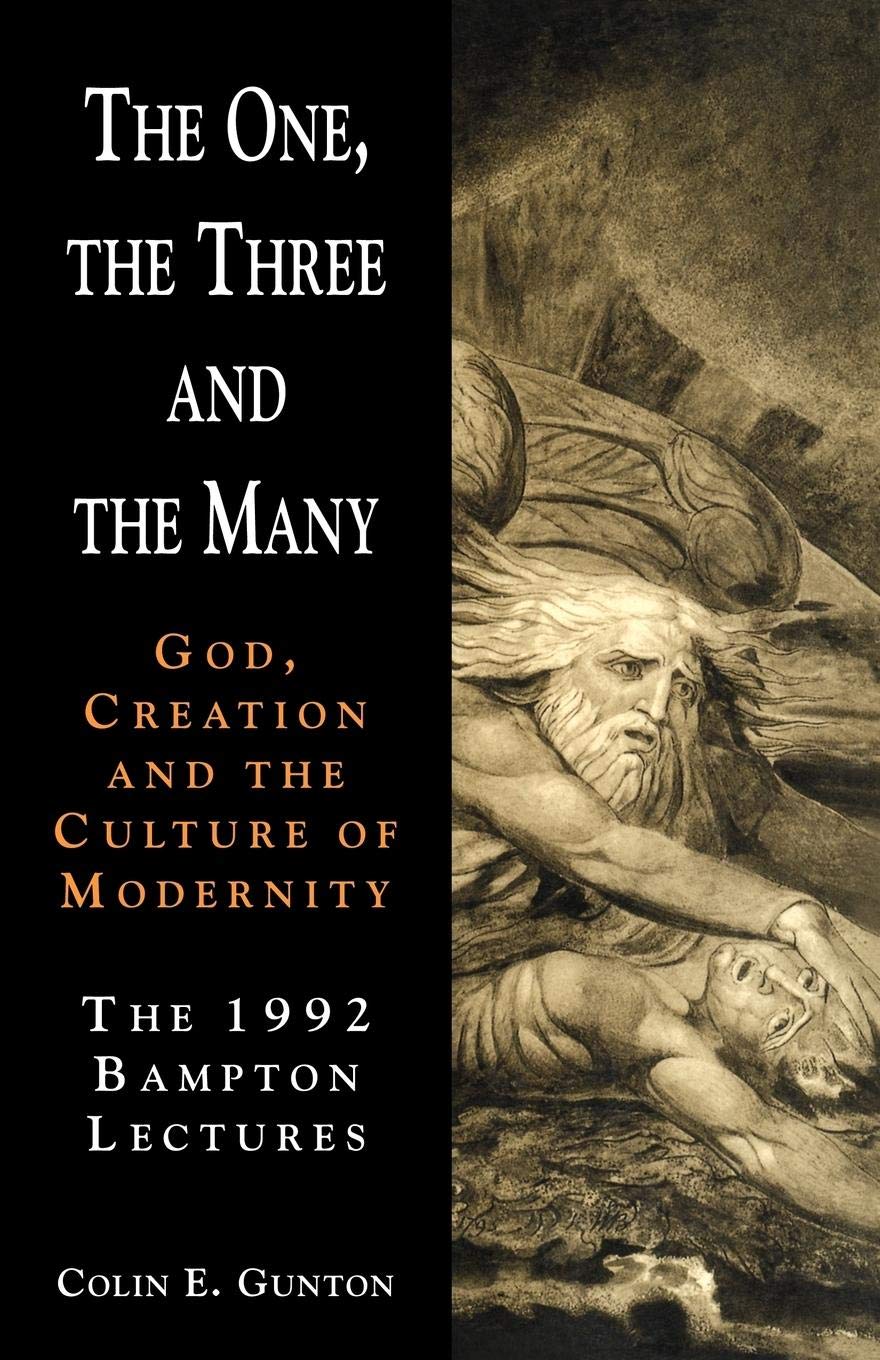
In “the opening chapters of Genesis, . . . it is made clear that creation is of beings in relationship, and in three distinct but related senses. First, the world is what it is by virtue of its createdness, which means a calling into otherness to and relation with its creator. The denial of that is the underlying reason why the misconstruals of human and worldly being that were charted in the first four chapters take the form that they do. In attempting to see the creation apart from the creator, they fail in important ways to see it at all. Second, the human creation is what it is as a being in relationship. That we have our true being in communion, and especially in the communion-in-otherness that is male and female, is the message of Genesis on both its positive and negative sides. Positively, humankind is social kind. Adam can find no true fellow creature among the animals, none that will enable him truly to be himself. It is only when he can rejoice in the fellowship of one who is a true other-in-relation that he is able to transcend the merely individual state that is a denial of human fullness. Negatively, the Fall leads to ever more disastrous breaches of communion, culminating in murder, the most serious sin against the image of God. The centrality of the two dimensions of communion is symbolized especially by Babel, according to which breach of communion with God leads to the depotentiation of that most central means of communion and communication, language. With the Fall, language divides rather than relates, and it is no accident that in the Acts of the Apostles one of the first actions of the Holy Spirit, the giver of communion, is symbolically to reverse Babel by restoring communication and so communion between the divided nations of the earth.
“Third, and this is the conception with which we are chiefly concerned in this chapter, the world is what it is by virtue of its relation to those who bear the image of God. The shape that the world takes is in large part determined by what we, the human creation, make of it. Again, we can say that many disasters of all eras, but especially of modernity, derive from a misconstruction of that relation. The image has been understood individualistically, rather than in terms of a being in relation, so that patterns of alienation in relation to other human beings, of domination over rather than dominion of the rest of the creation, have eventuated. Yet despite the distortions, we must maintain a point that will recur, that the created world is not truly itself without us, its most problematic inhabitants. Without us, there is suffering and death but not pollution and moral evil; without us there is no science and art, none of the essentially moral action which enables the world to be itself. In summary, it can be said that the created world, as that which is what it distinctively is by virtue of its createdness, reflects in different ways the being of God in communion. The human creation, made in the image of God, reflects most directly the divine being in communion. But by virtue of its relation to both God and man, the rest of the created order, too, is brought into the relation of one and many that all this entails.”
— Colin E. Gunton, The One, the Three and the Many: God, Creation and the Culture of Modernity (Cambridge University Press, 1993)
Related reading and listening
When myth becomes fact — In this 1976 interview, Clyde Kilby (1902–1986) discusses C. S. Lewis’s critique of scientism and rationalism, his belief in the primacy of the imagination, and his mythic vision. (37 minutes)
A sampling of newly published lectures — Ken Myers introduces listeners to four recently released lectures, courtesy of our Partners. The lecturers are Jennifer Frey, Gary Saul Morson, N. T. Wright, and Andrew Kern. (27 minutes)
The inward eye, cosmic truth, and making well — Andrew Kern takes his listeners along an “interlinear” reading of a portion of St. Augustine’s Confessions that explores the differences between how God makes and how we create. (38 minutes)
“Investigations of divine works” — Greg Wilbur explains how closely connected music is to the order of the cosmos and how it even reveals attributes of God. (56 minutes)
A letter from Ken Myers — Ken Myers examines the cultural implications of the Incarnation and the deep-seated dualism of modernity that divorces spirituality from our material experience. (22 minutes)
Theologian and musician Jeremy Begbie explores what we learn about time, theology, and the structure of Creation from the experience of music. (28 minutes)
Mars Hill Audio Journal, Volume 166 — FEATURED GUESTS: William Cavanaugh, Kent Burreson, Beth Hoeltke, Jeffrey Barbeau, Jason Baxter, John Betz, and Bruce Herman
An icon of the whole world — Jason Baxter explains how Dante includes a panoply of characters and creatures in his Comedia, offering a prismatic view of all of Creation in its glory. (20 minutes)
Cosmic realities in the built world — Christopher and Christine Perrin discuss the implications of architect Christopher Alexander’s (1936–2022) discovery of patterns of building that cohere with the the created cosmos and with ourselves as human creatures. (59 minutes)
The “book” of Creation — Alan Noble explains why the modern world makes it profoundly difficult to experience Creation as revelation, and he encourages unmediated encounters with Creation that lead to meditation. (52 minutes)
Life more abundantly — Jeanne Schindler advocates for a return to an understanding and prioritizing of sensory experience — real engagement with the real world — as foundational to learning and living. (35 minutes)
Heaven and earth are full of His glory — Gerald R. McDermott examines the typological tradition of the Church, particularly through Jonathan Edwards’s thought, and he argues for a recovery of the Christian understanding of the universe as an “immense Trinitarian symbol.” (61 minutes)
An invitation to a feast — Christina Bieber Lake explains how poetry is an invitation to experience the beauty and goodness of Creation as gift. (44 minutes)
Fred Bahnson talks about how a Christian understanding of God’s redemptive work on the earth should influence our practices of growing and sharing food. (19 minutes)
Junius Johnson warns that the pursuit of beauty is both perilous and an experience that points to the desire for God. (25 minutes)
Clips from five extended interviews — We are pleased to share clips from five interviews that we’ve recently produced as full-length Conversations. (30 minutes)
Good News for All Creation — Theologian Norman Wirzba helps us rethink the category of nature in terms of the Christian doctrine of creation. (66 minutes)
Lives of generosity — Jonathan Wilson distinguishes between two fundamental ways of viewing Creation: a true Christian account of the world and a “survival of the fittest” one. (21 minutes)
What we can know about God’s nature — Bruce McCormack outlines the history of the development of the doctrine of the Trinity. He shows how early Christians’ understanding of the nature of God moved from a focus on His oneness to a more full apprehension of His Triune nature. (66 minutes)
What it means to be a creature — Fred Sanders offers a Trinitarian analysis of the doctrinal significance of the biblical Adam, explaining how his creaturehood is paradigmatic for human beings and their relationship with the Triune God. (46 minutes)
The recovery of an integrated ecology — In this essay, Michael Hanby unpacks the summons of Laudato si’ to an ecological way of life based on a proper understanding of creation in its fullness and integrity. (57 minutes)
Speaking the word in love — In this lecture, D. C. Schindler examines core insights from Ferdinand Ulrich on the central vocation of man and the meaning of being. (32 minutes)
Mars Hill Audio Journal, Volume 164 — FEATURED GUESTS: Dana Gioia, Brady Stiller, Robert Royal, Richard DeClue, Tiffany Schubert, and Joonas Sildre
Music, silence, and the order of Creation — In this lecture, Ken Myers explains how it is that our participation in harmonic beauty in music is a kind of participation in the life of God, in Whom all order and beauty coheres and is sustained. (61 minutes)
The gift of liturgical time — In this lecture, Gregory Wilbur explains how liturgy and liturgical time align us to the rhythms and order of Creation, forming us as disciples. (45 minutes)
A metaphysics of realism, relationality, and personalism — John Milbank gives a survey and critique of the efforts of 20th and 21st century theologians to articulate a Trinitarian ontology that reflects reality and counters secularization. (61 minutes)
Festivity and the goodness of Creation — Drawing on Josef Pieper’s ideas, Ken Myers explains why the spirit of festivity is the spirit of worship, and that “entertainment” is ultimately an artificial, contrived, and empty effort to achieve festivity. (25 minutes)
Forms as portals to reality — Ken Myers explains the ancient classical and Christian view that music embodies an order and forms that correspond to the whole of created reality, in its transcendence and materiality. (54 minutes)
Farming and our primal vocation — Shawn and Beth Dougherty make a theological case for biomimicry, or fulfilling our original vocation of tending the earth by working according to the nature of Nature. (68 minutes)
Popular innovator and speaker on farming practices Joel Salatin talks about the challenges of caring for Creation within an agricultural and food system that pays little attention to the purposes and inclinations of Creation. (25 minutes)
What does it mean to be a creature? — Canon-theologian Simon Oliver explains how and why the doctrine of Creation is cardinal and must frame all theology. (62 minutes)
“Reading Lewis with blinders on” — Chris Armstrong explains how C. S. Lewis’s work is grounded deeply in the Christian humanist tradition. (45 minutes)
David Bentley Hart describes how the Christian understanding of Creation as beauty and gift, as the outward expression of the delight the Trinity has in itself, reveals a vision of reality different from the pagan or fatalist vision of reality. (12 minutes)
The Life was the Light of men — In a lecture from 2018, Ken Myers contrasts the Enlightenment’s understanding of reason with the Christocentric conception of reason. (57 minutes)
Discerning an alternative modernity — In a lecture from 2019, Simon Oliver presents a summary of the cultural consequences of the comprehensiveness of the work of Christ. (28 minutes)
Lessons from Leviticus — The book of Leviticus may be assumed to be irrelevant for charting a way through the challenges of modernity. Theologian Peter J. Leithart disagrees. (22 minutes)
A theology of active beauty — In a 2010 lecture, George Marsden examines a few ways in which the distorting effects of Enlightenment rationalism were resisted in the work of Jonathan Edwards.(64 minutes)
Mars Hill Audio Journal, Volume 161 — FEATURED GUESTS: Andrew Wilson, Kyle Edward Williams, Andrew James Spencer, Landon Loftin, Esther Lightcap Meek, Andrew Davison
Christology and human relationality — Joseph Ratzinger on how the longing for eternity expressed in human love is an analogue of Trinitarian love
Theologian and priest Andrew Davison believes that retrieving the historic doctrine of participation is vital to help Christians escape from the default philosophy of the age. (32 minutes)
Hans Boersma — author of Heavenly Participation: The Weaving of a Sacramental Tapestry — explains why Christians should reject the modern separation of Heaven and Earth and recover a “sacramental ontology.” (26 minutes)