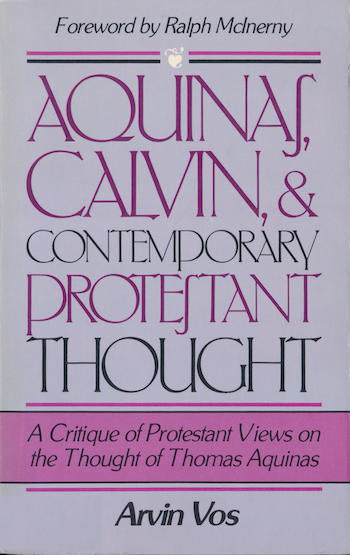
“Ignorance of Aquinas’s culture and times has contributed to misunderstandings of his use of philosophy. Contemporary Protestant opinion is still largely shaped by the rhetoric and the ideals of the sixteenth-century Reformation, which was itself deeply molded not only by a return to the gospel but also by the fourteenth- and fifteenth-century Italian Renaissance. It is well known that a recovery of past knowledge was key to the Italian Renaissance, but the process of this recovery was not unique to that era. Aquinas also lived during a period of renaissance; the treasures of the ancient world were being recovered and assimilated in the thirteenth century as well. And yet there were decisive differences between the earlier and the later movements. These differences have contributed to a number of misconceptions. I would like to look at three of them in order to get a better perspective on the problem.
“First we ought to note that Aquinas’s way of dealing with the past is very different from that found among the later Humanists, the Reformers, and ourselves. Scholars of later generations have tended to return to the ancients in order to study them for their own sake, but Aquinas sought out their ideas in order to make them live anew in his own setting. Aquinas approached Aristotle, for instance, with the intent of appropriating such truth as he could from the philosopher and incorporating it into considerations of the issues that were important in his own day. He does not simply recapitulate Aristotle; rather, he silently corrects and enriches his position. He employs Aristotelian principles in contexts and ways Aristotle never used them. In doing this Aquinas was doing something quite similar to what his contemporaries did in the areas of liturgical drama, painting, and the like, when they took Bible stories and treated them as if they were contemporaneous.
“In contrast to Aquinas and his contemporaries, who tended to study the ancients in order to put their wisdom to practical use, the later Humanists (our generation included) have tended to study the ancients for their own sake. It has been their concern to determine just what the views of the ancients were. Such an approach naturally accentuates the differences between the ancients and ourselves; indeed, contemporary scholarship tends to focus almost exclusively on how our own views differ from and go beyond those of our predecessors rather than on how their views are applicable to our concerns. For someone steeped in the Humanist perspective, Aquinas’s use of Aristotle is likely to be very perplexing. Being oriented to differences rather than agreements, when we observe Aquinas utilizing Aristotle we are inclined to think first of the historical Aristotle who held that the universe is uncreated and eternal, that man is a being who belongs to a lower changing world but in part also to a higher eternal and divine world, that there is no personal immortality, and so on. Naturally one thinking in these terms will wonder how Aquinas could have considered such a view to be compatible with his own. If he had simply adopted the historical Aristotle, there would be large chunks of undigested paganism in his theology. Only if we recognize that his way of dealing with the past is very different from our own can we see that what Aquinas attempted is not impossible.
“Moderns encountering Aquinas’s method of utilizing Aristotle for the first time are also likely to suspect that he is relying slavishly upon the past. It may well appear to such an observer that the mere fact that Aristotle said something is reason enough for Aquinas to accept it as true. This does indeed seem to have been the case with a number of Aquinas’s contemporaries; Siger of Brabant in particular, along with some other radical Aristotelians, seems to have fallen into the error of identifying philosophy exclusively with the thought of Aristotle. But Aquinas himself maintained that authority is the weakest argument in matters related to human reason (see ST, la. 1, 8 ad 2m). He states that ‘the study of philosophy is not done in order to know what men have thought, but rather to know how truth herself stands.’”
— from Arvin Vos, Aquinas, Calvin, and Contemporary Protestant Thought: A Critique of Protestant Views on the Thought of Thomas Aquinas (Christian University Press, 1985)
Related reading and listening
- The desire for truth — In this article, Romanus Cessario, O.P., recounts the life, theology, and influence of St. Thomas Aquinas (1224/5–1274). (38 minutes)
- A brief for “prophetic Thomism” — David Decosimo on assuming a charitable posture toward pagan virtue
- The collaboration of bodies and minds — F. C. Copleston on Aquinas’s confidence in the embodied nature of knowledge
- St. Thomas the anthropologist — G. K. Chesterton on Aquinas’s complete Science of Man
- Discipline and piety — Bishop Robert Barron on Aquinas, the man
- A sampling of newly published lectures — Ken Myers introduces listeners to four recently released lectures, courtesy of our Partners. The lecturers are Jennifer Frey, Gary Saul Morson, N. T. Wright, and Andrew Kern. (27 minutes)
- Moral reasoning and human flourishing — Tim McIntosh describes moral philosopher Alasdair MacIntyre’s intellectual conversion to a synthesis of Aristotelian ethics and Christianity, best embodied in Thomism. (44 minutes)
- It takes a character (and a village) — Herbert McCabe, O.P. on the Aristotelian, Thomistic, and MacIntyrean account of the moral life
- Flannery at 100 — In honor of Flannery O’Connor’s 100th birthday, we have gathered here an aural feast of interviews with O’Connor scholars and aficionados discussing her life, work, and faith. (3 hours, 28 minutes)
- Insights from St. Thomas’s biblical exegesis — Jason Paone explains how St. Thomas’s commentaries reveal the saint’s personality, his rhetorical flair, and the Christocentric vision that underlie all his work. (24 minutes)
- Economics and personhood — FROM VOL. 147 Mary Hirschfeld argues that modern economics makes some fundamental assumptions about personhood, material goods, and God that prevent the development of a truly human understanding of economic life. (20 minutes)
- Metaphysics and sub-creation — FROM VOL. 144 Jonathan McIntosh claims that scholarship has tended to ignore the depth of St. Thomas Aquinas’s influence on J. R. R. Tolkien’s work. (28 minutes)
- Mars Hill Audio Journal, Volume 162 — FEATURED GUESTS: Mark Noll, R. Jared Staudt, Paul Weston, William C. Hackett, Hans Boersma, and David Paul Baird
- “A society of friends at work” — Political philosopher Andrew Willard Jones lays out a robust vision for a just society in which virtues are formed in an analogical manner through relational obedience and trust. (71 minutes)
- Prudence in politics — FROM VOL. 146
Henry T. Edmondson, III talks about Flannery O’Connor’s understanding of political life, which was influenced by a range of thinkers including Aristotle, Thomas Aquinas, Eric Voegelin, and Russell Kirk. (19 minutes)
- The artist’s commitment to truth — Fr. Damian Ference, author of Understanding the Hillbilly Thomist, explores the depths to which Flannery O’Connor was steeped in Thomistic philosophy. (18 minutes)
- Flannery O’Connor and Thomistic philosophy — Fr. Damian Ference explores the depths to which Flannery O’Connor was steeped in Thomistic philosophy, as evidenced by her reading habits, letters, prayer journal, and, of course, essays and fiction. (48 minutes)
- What does it mean to be a creature? — Canon-theologian Simon Oliver explains how and why the doctrine of Creation is cardinal and must frame all theology. (62 minutes)
- The aboriginal Vicar of Christ, the voice of God in the heart of Man — Reinhard Hütter on John Henry Newman’s insistence that conscience — rightly formed — bears witness to the law of God
- Conscience and its counterfeits — A 2014 lecture by theologian Reinhard Hütter examines “Freedom of Conscience as Freedom in the Truth: Conscience according to Thomas Aquinas and John Henry Newman.” (64 minutes)
- Mars Hill Audio Journal, Volume 158 — FEATURED GUESTS:
David Setran, Vigen Guroian, Michael Dominic Taylor, Thomas Pfau, Jason Paone, and Matthew Levering
- The light shines in the darkness — Physicist David Park explores the physical, aesthetic, and spiritual aspects of light, considering the phenomenon of light in profound ways, from spiritual meanings embedded in our culture to the challenging questions put forth by great scientists and philosophers. (17 minutes)
- The problem of a degenerate electorate — Aquinas, Augustine, and Aristotle on good government, as summarized by Reginald Garrigou-Lagrange
- Mars Hill Audio Journal, Volume 147 — FEATURED GUESTS:
R. Jared Staudt, Jason Peters, D. C. Schindler, Craig Gay, Mary Hirschfeld, and Patrick Samway
- Mars Hill Audio Journal, Volume 144 — FEATURED GUESTS:
Jonathan Mcintosh, Kevin Vost, Malcolm Guite, R. David Cox, Grant Brodrecht, and Peter Bouteneff
- St. Thomas and the wisdom of Creation — Christopher Thompson offers a renewed vision of “the human person [as] an embodied, spiritual creature dwelling in a cosmos of created natures, intelligently ordered by God and capable of being intelligibly grasped by human reason.” (16 minutes)
- Hillbilly Thomist: Flannery O’Connor and the Truth of Things — Susan Srigley and Ralph Wood examine Flannery O’Connor‘s sacramental fiction and her understanding of the wisdom of limits. (60 minutes)