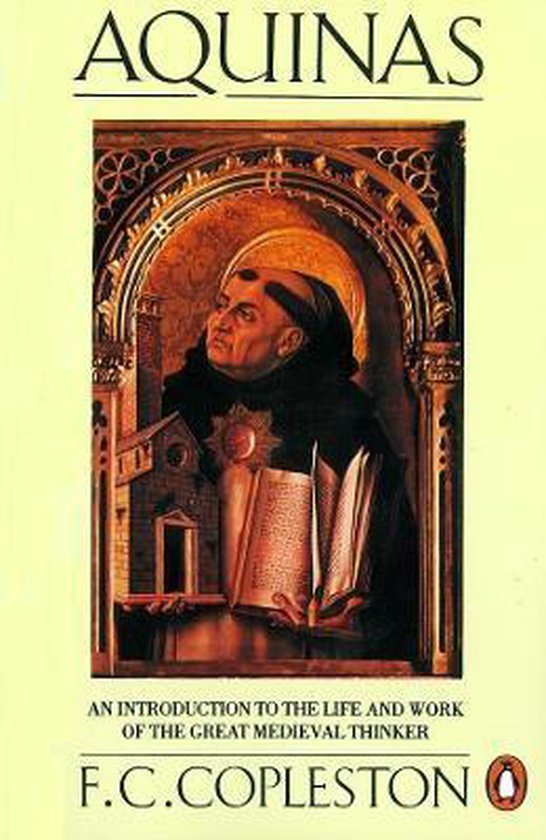
“[I]n a sense Aquinas laid more stress than did the classical British empiricists on the part played by sense-perception in human cognition. For while not excluding introspection or reflection as a source of knowledge, he did not mention sense-perception and reflection as parallel sources of knowledge. He did not think that introspection or reflection is an initial source in the same sense in which sense-perception is. His point of view was that I become aware of my existence as a self through concrete acts of perceiving material things other than myself, inasmuch as I am concomitantly aware of these acts as mine. I do not enjoy a direct intuition of the self as such: I come to know myself only through acts directed towards things other than myself. I not only perceive a man, for example, but I am concomitantly aware that I perceive him, that the act of perception is my act. And this awareness involves the awareness of my existence as a self. ‘The soul is known by its acts. For a man perceives that he has a soul and lives and exists by the fact that he perceives that he senses and understands and performs other vital operations of this kind. . . . No one perceives that he understands except through the fact that he understands something, for to understand something is prior to understanding that one understands. And so the soul comes to the actual realization of its existence through the fact that it understands or perceives’ (De veritate, 10, 8).
“To prevent misunderstanding of this passage it should be added that Aquinas draws a distinction between my awareness of the existence of the self and my knowledge of the nature of the self. To know that I have a soul or that there is in me that by which I perceive, desire, and understand is one thing: to know the nature of the soul is another. For the latter knowledge deliberate reflection, ‘second’ reflection, is required; but the reflection by which one is aware of the self in a very general sense is not a deliberate reflection, and it is common to all human beings. It must not be confused therefore with philosophic reflection: it is automatic in the sense that I cannot perceive without an implicit awareness that I perceive. And the point is that my awareness that I perceive is dependent on my perceiving something. I can indeed reflect consciously and deliberately on my interior acts; but this presupposes a non-deliberate or automatic awareness of my outwardly-directed acts (of seeing, hearing, desiring, and so on) as mine. And this in turn presupposes the fundamental rôle of sense-experience or sense-perception. Aquinas believed that man does not consist of two juxtaposed substances, the operations of which are independent one of another, but that he is a unity, the soul being naturally united with a body. And because of the intimate union of soul and body the mind is naturally dependent on the senses for the acquisition of ideas and of knowledge.”
— from F. C. Copleston, Aquinas (Penguin Books, 1955)
Related reading and listening
Disengagement from the world — Nicholas Carr encourages us to consider how automation technologies impact our ability to engage with the world and whether — like a good tool — they present a more inviting world or close us off from that world. (30 minutes)
Modernity’s crisis of place — Craig Bartholomew reflects on the importance of place to our humanity. (58 minutes)
A sampling of newly published lectures — Ken Myers introduces listeners to four recently released lectures, courtesy of our Partners. The lecturers are Jennifer Frey, Gary Saul Morson, N. T. Wright, and Andrew Kern. (27 minutes)
Theologian and musician Jeremy Begbie explores what we learn about time, theology, and the structure of Creation from the experience of music. (28 minutes)
Moral reasoning and human flourishing — Tim McIntosh describes moral philosopher Alasdair MacIntyre’s intellectual conversion to a synthesis of Aristotelian ethics and Christianity, best embodied in Thomism. (44 minutes)
The “sovereign uselessness of moral reflection” — Calling on the wisdom of St. Augustine, Oliver O’Donovan reminds his listeners that all knowledge participates in the eternal Logos of God and is rooted in love, not disinterested moral judgement.(Lecture 1 of 3; 52 minutes)
Beyond a reasonable doubt — From a 1980 interview with Ken Myers, Mortimer J. Adler discusses his argument that belief in the existence of God is rational. (14 minutes)
Heaven and earth are full of His glory — Gerald R. McDermott examines the typological tradition of the Church, particularly through Jonathan Edwards’s thought, and he argues for a recovery of the Christian understanding of the universe as an “immense Trinitarian symbol.” (61 minutes)
Gayle Brandow Samuels examines the ways in which trees have served as anchor-points for memory and identity in American culture. (9 minutes)
A false dichotomy — In this conversation from 2009, Dallas Willard (1934–2013) discusses the truth of spiritual knowledge and its epistemological validity. (63 minutes)
Steven L. Porter discusses The Disappearance of Moral Knowledge, an unfinished manuscript (which he helped to complete) by the late philosopher Dallas Willard. (22 minutes)
Harbinger of disorder — Mark Mitchell on Michael Polanyi’s recognition of the dangerous dead-end of materialistic reductionism
The vice of curiosity — Stanley Hauerwas on the warning from Paul Griffiths about desiring to own knowledge
University or “utiliversity”? — In this essay, Reinhard Hütter examines in depth John Henry Newman’s The Idea of a University and argues that its insights and prescriptions are urgently relevant to the current status of higher education. (87 minutes)
Thinking Together — Alan Jacobs discusses some principles he’s compiled to help us think well (and charitably) in our cultural context, and he warns us to be attentive to the ways technology displaces previously fixed communities. (53 minutes)
Tim Clydesdale discusses the experience of freshmen year at college, suggesting that by that time students have been effectively inoculated against a love of knowledge. (21 minutes)
Pathways of the Mind: The Joy of the Essay — Alan Jacobs thinks Christians should embrace the potential in the literary form of the essay, because of the way it corresponds to the navigation and journey of a Christian life. (48 minutes)
In the Image of Our Devices — Nicholas Carr considers how automation technologies impact our ability to engage with the world. (66 minutes)
Theologian Walter Hansen and painter Bruce Herman question contemporary conceptions of meaning that confine it to the verbal or consider visual and verbal meaning to be completely exclusive. (20 minutes)
Passing on the virtues to the next generation — Theologian and ethicist Stanley Hauerwas reflects on being a godparent and the responsibility to cultivate and talk about Christian virtue. (21 minutes)
Moral knowledge of reality — Oliver O’Donovan argues that admiration is the fundamental form of knowing the world, as we cannot know fully those elements of reality (“bare facts”) that contain no significance for us. (Lecture 2 of 3; 55 minutes)
The recovery of an integrated ecology — In this essay, Michael Hanby unpacks the summons of Laudato si’ to an ecological way of life based on a proper understanding of creation in its fullness and integrity. (57 minutes)
Sacramental Poetics — Poet and Eastern Orthodox believer Scott Cairns explains how a good poem functions like an icon: it assists the process of our becoming aware of what is real, and it is generative in the ways it keeps opening up new understandings. (56 minutes)
Flannery at 100 — In honor of Flannery O’Connor’s 100th birthday, we have gathered here an aural feast of interviews with O’Connor scholars and aficionados discussing her life, work, and faith. (3 hours, 28 minutes)
How social media truncates relationships — In this lecture, Felicia Wu Song explains how social media industrializes and monetizes our relationships, forming us in modes of relationships and identity that are detrimental to ourselves and to society. (41 minutes)
The personal element in all knowing — Mark Mitchell connects key aspects of Michael Polanyi’s conception of knowledge with Matthew Crawford’s insistence that real knowing involves more than technique. (34 minutes)
Esther Lightcap Meek challenges the modernist view of knowledge, which prefers the figure of the autonomous knower to the figure of a steward of knowledge acquired in part from others. (15 minutes)
Insights from St. Thomas’s biblical exegesis — Jason Paone explains how St. Thomas’s commentaries reveal the saint’s personality, his rhetorical flair, and the Christocentric vision that underlie all his work. (24 minutes)
Mary Hirschfeld argues that modern economics makes some fundamental assumptions about personhood, material goods, and God that prevent the development of a truly human understanding of economic life. (20 minutes)
Jonathan McIntosh claims that scholarship has tended to ignore the depth of St. Thomas Aquinas’s influence on J. R. R. Tolkien’s work. (28 minutes)
An embedded life — Following a move from one state to another, Gilbert Meilaender explores the tension between being simultaneously a sojourner and a body located in place and time. (30 minutes)
The need to recollect ourselves as whole persons — In this 2016 lecture, John F. Crosby explores key personalist insights found in the thinking of John Henry Newman and Romano Guardini. (60 minutes)
Mark Slouka explores the worldview of techno-visionaries who aim to create a new era of human evolution. (11 minutes)
“A sign of contradiction” — In this lecture, Daniel Gibbons compares and contrasts understandings of sacramental poetics proposed by Augustine, Aquinas, and Sydney. (36 minutes)
Nature’s intelligibility — In this lecture, Christopher Blum argues that scientists need to regain a full appreciation of nature’s intelligibility, as they are apt to lose sight of reality due to the reductionism produced by their theories. (31 minutes)
Submission to mathematical truth — In this lecture, Carlo Lancellotti argues that integration of the moral, cognitive, and aesthetic aspects of mathematics is needed in a robust liberal arts mathematics curriculum. (25 minutes)
Music, silence, and the order of Creation — In this lecture, Ken Myers explains how it is that our participation in harmonic beauty in music is a kind of participation in the life of God, in Whom all order and beauty coheres and is sustained. (61 minutes)