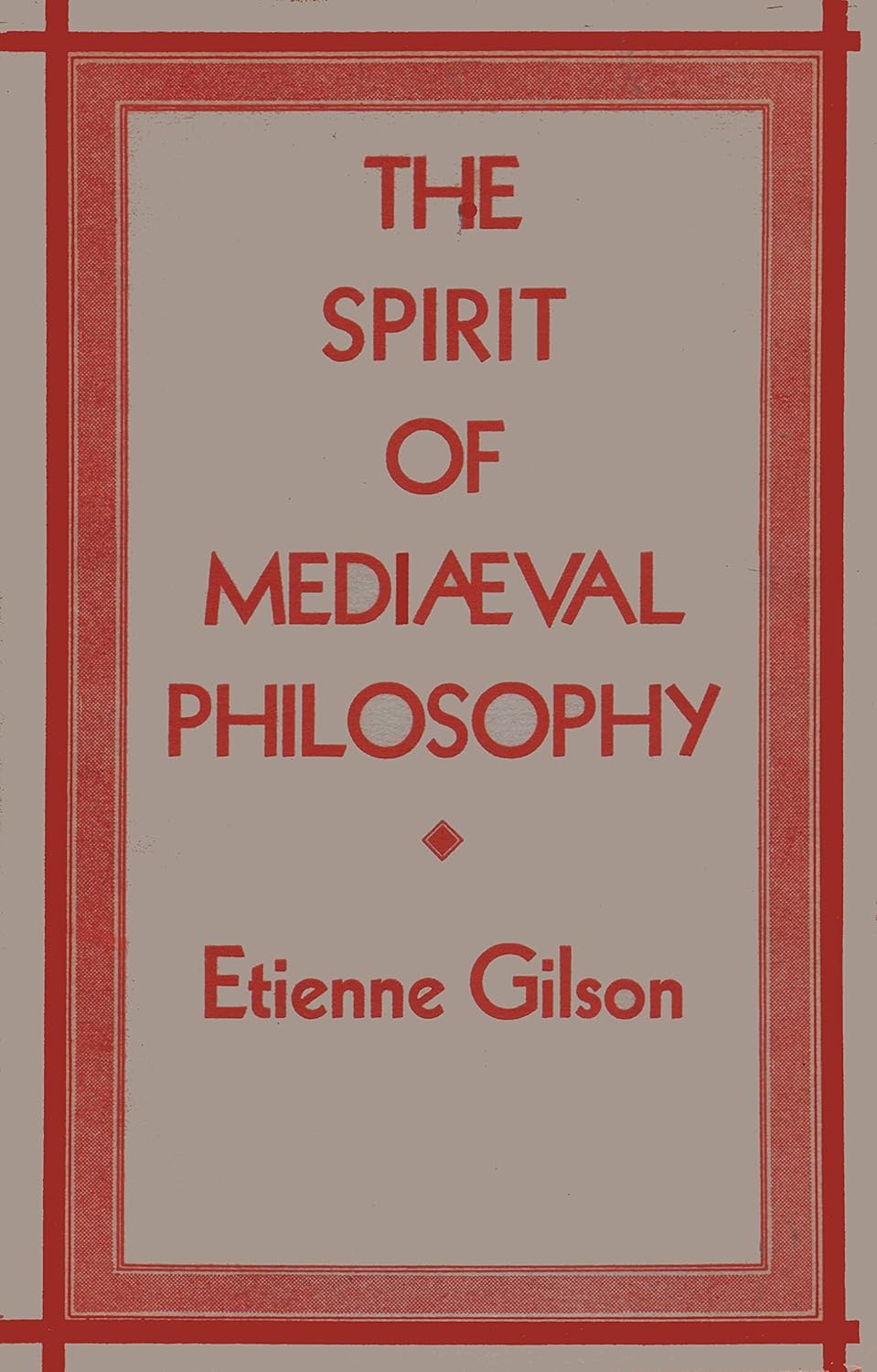
Between 1930 and 1932, philosopher Étienne Gilson (1884–1978) gave twenty lectures at the University of Aberdeen. In these Gifford Lectures, Gilson argued that medieval philosophy is the Christian philosophy par excellence. In two of the lectures, he challenged the common view that Christianity is radically pessimistic in light of the apparent widespread asceticism in the Middle Ages. While he acknowledged a “gloomy asceticism to which certain medieval authors succumbed,” he insisted — with the help of texts from Augustine and Aquinas — that authentic Christian belief is grounded in an affirmation of the goodness of Creation, a goodness that is not undone by the Fall.
“No one, in fact, could be further than St. Augustine from considering the world in the state of fallen nature as worthless. His own metaphysical principles would forbid it, to start with. Since evil is but the corruption of a good and cannot possibly subsist at all save in this good, it follows that inasmuch as there is evil, there is also good. Certainly, we have travelled very far from that degree of order, beauty and measure which God bestowed on the world in creating it, but if sin had abolished all good it would have abolished all being along with the good and the world would no longer exist. In this sense we may say that evil could not eliminate nature without eliminating itself, since it would have no subject left to inhere in, there would be none of which it could be affirmed. It is not in the least surprising therefore to find St. Augustine indulging in genuine eulogies of fallen nature. If he deplores all that we have lost he never dreams of despising what remains; even our present miserable state has not lost all its glory in his eyes.”
Gilson observes that while St. Augustine was “quite sure that evil is powerless to destroy nature,” it is in St. Thomas — that is, in a medieval Christian philosopher that one finds the most thorough defense of the claim that the essential goodness of Creation, including the goodness of human nature, was not undone by the Fall. “Man’s metaphysical status is essentially unchangeable and independent of all the accidents that may befall him.
“When therefore the Renaissance is held up to our admiration for its discovery of nature and its worth, and opposed to the Middle Ages as the day of its unjust depreciation, we must carefully scrutinize the meaning of this assertion. In so far as it has any it can only be this: that the Renaissance marks the opening of an era in which man will profess to be satisfied with the state of fallen nature. And that, no doubt, happened, although to a much lesser extent than alleged; but it would be altogether unjust to conclude against the Middle Ages that having unfavourably compared the state of fallen nature with another and a better, it had no feeling left for it at all. . . .
“[J]ust as it is not Christian to run away from the body, so neither is it Christian to despise nature. How can we possibly belittle these heavens and this earth that so wonderfully proclaim the glory of their Creator, so evidently bear on them the marks of His infinite wisdom and goodness? The true Christian feeling for nature is that which finds expression throughout the Psalms, and, above all, in the Canticle of the Three Children in the fiery furnace: Benedicite opera Domini Domino; laudate et superexultate eum in saecula [Bless the Lord, all ye works of the Lord, praise and exalt Him above all forever]. And after many centuries St. Francis of Assisi will echo that song in his Laudes and the Canticle of Brother Sun, wherein not only water, earth, and air, and stars, but the very death of the body itself, will receive their meed of praise and benediction. If anywhere the heart of man entered into fraternal communion with all that lives and breathes and has being, most assuredly it did so there; for this purely Christian soul it was altogether one and the same thing to love the works of God and to love God.
“Here perhaps we have arrived at the point where the mistake that obscured the significance of Christian optimism begins to become clear. Not even the Middle Ages knew any ruder asceticism than that of St. Francis — or any more absolute confidence in the goodness of nature. Far from excluding optimism, Christian asceticism is merely the reverse side of its optimism. Certainly there is no true Christianity without the contemptus saeculi, but contempt for the world is not the same thing as hatred of being — quite the contrary, it is hatred of non-being. By wrestling with the flesh, the medieval ascetic sought to restore the body to its pristine perfection; if he did not rejoice in the world for the world’s sake, it was because he knew that the true way to use the world is to restore it to its own integrity by referring it to God; the world that the Christian detests consists of all that mass of disorder, deformity and evil introduced into creation by man’s own voluntary defection. He turns away from these, no doubt, but precisely to adhere with all his heart to the order, beauty and good which was willed from the beginning; he works to restore these in himself and others; with an heroic effort he would clear the face of the universe and render it resplendent once more as the face of God. Nothing could be more positive than such an asceticism, nothing could be better grounded in hope and resolute optimism. The disaccord that persists between Christian and non-Christian on this point is of another order therefore than is usually supposed. The question is not whether the world is good or evil, but whether the world is sufficient to itself, and whether it suffices. The testimony, and, we may add, the secular experience of Christendom is, that nature itself is powerless to realize itself, or even fully to survive as nature, when it attempts to do this without the help of grace. If optimism thus consists, not in denying the existence of evil, nor in accepting evil, but in looking it in the face and fighting it, then we may legitimately speak of Christian optimism. The work of creation is shattered, but the fragments remain good, and, with the grace of God, they may be reconstituted and restored.”
— from Étienne Gilson, The Spirit of Mediaeval Philosophy (Gifford Lectures 1931–1932) (Charles Scribner’s Sons, 1936, 1964)
Related reading and listening
- When myth becomes fact — In this 1976 interview, Clyde Kilby (1902–1986) discusses C. S. Lewis’s critique of scientism and rationalism, his belief in the primacy of the imagination, and his mythic vision. (37 minutes)
- Christian culture and the myth of the secular — Ken Myers draws on T. S. Eliot to argue that Western civilization has broken down, not into a multiplicity of cultures, but into a “post-culture.” (47 minutes)
- Disengagement from the world — Nicholas Carr encourages us to consider how automation technologies impact our ability to engage with the world and whether — like a good tool — they present a more inviting world or close us off from that world. (30 minutes)
- A sampling of newly published lectures — Ken Myers introduces listeners to four recently released lectures, courtesy of our Partners. The lecturers are Jennifer Frey, Gary Saul Morson, N. T. Wright, and Andrew Kern. (27 minutes)
- The inward eye, cosmic truth, and making well — Andrew Kern takes his listeners along an “interlinear” reading of a portion of St. Augustine’s Confessions that explores the differences between how God makes and how we create. (38 minutes)
- “Investigations of divine works” — Greg Wilbur explains how closely connected music is to the order of the cosmos and how it even reveals attributes of God. (56 minutes)
- A letter from Ken Myers — Ken Myers examines the cultural implications of the Incarnation and the deep-seated dualism of modernity that divorces spirituality from our material experience. (22 minutes)
- How music blesses and teaches — FROM VOL. 64 Theologian and musician Jeremy Begbie explores what we learn about time, theology, and the structure of Creation from the experience of music. (28 minutes)
- Mars Hill Audio Journal, Volume 166 — FEATURED GUESTS: William Cavanaugh, Kent Burreson, Beth Hoeltke, Jeffrey Barbeau, Jason Baxter, John Betz, and Bruce Herman
- Creation, in harmony with the Logos — Rowan Williams on the Logos and the diverse logoi that mirror it
- An icon of the whole world — Jason Baxter explains how Dante includes a panoply of characters and creatures in his Comedia, offering a prismatic view of all of Creation in its glory. (20 minutes)
- Cosmic realities in the built world — Christopher and Christine Perrin discuss the implications of architect Christopher Alexander’s (1936–2022) discovery of patterns of building that cohere with the the created cosmos and with ourselves as human creatures. (59 minutes)
- The “book” of Creation — Alan Noble explains why the modern world makes it profoundly difficult to experience Creation as revelation, and he encourages unmediated encounters with Creation that lead to meditation. (52 minutes)
- Life more abundantly — Jeanne Schindler advocates for a return to an understanding and prioritizing of sensory experience — real engagement with the real world — as foundational to learning and living. (35 minutes)
- Heaven and earth are full of His glory — Gerald R. McDermott examines the typological tradition of the Church, particularly through Jonathan Edwards’s thought, and he argues for a recovery of the Christian understanding of the universe as an “immense Trinitarian symbol.” (61 minutes)
- An invitation to a feast — Christina Bieber Lake explains how poetry is an invitation to experience the beauty and goodness of Creation as gift. (44 minutes)
- Mordor versus the Shire — In this lecture, Heidi White explains how the modern project is a diabolical inversion of Christendom and calls for Christians to build lives and a culture that can counter it. (53 minutes)
- Stewarding God’s creation — FROM VOL. 116 Fred Bahnson talks about how a Christian understanding of God’s redemptive work on the earth should influence our practices of growing and sharing food. (19 minutes)
- “Earth-shaking” and “heart-breaking” beauty — FROM VOL. 151 Junius Johnson warns that the pursuit of beauty is both perilous and an experience that points to the desire for God. (25 minutes)
- Clips from five extended interviews — We are pleased to share clips from five interviews that we’ve recently produced as full-length Conversations. (30 minutes)
- Breaking out of the immanent frame — Norman Wirzba on the true character of Creation and of our creatureliness
- Good News for All Creation — Theologian Norman Wirzba helps us rethink the category of nature in terms of the Christian doctrine of creation. (66 minutes)
- Ten, seven, and the rhythm of God’s love — Joseph Cardinal Ratzinger on the meaningfulness of numbers in Creation and Scripture
- Lives of generosity — Jonathan Wilson distinguishes between two fundamental ways of viewing Creation: a true Christian account of the world and a “survival of the fittest” one. (21 minutes)
- Creation and redemption as trinitarian projects — Colin Gunton on Christ and Spirit in creation and redemption
- Reflecting the being of God in communion — Colin Gunton on the relationality at the heart of Creation
- The whole world in his Hands — Colin Gunton on the trinitarian emphasis in St. Irenaeus’s doctrine of Creation
- Passing on the virtues to the next generation — Theologian and ethicist Stanley Hauerwas reflects on being a godparent and the responsibility to cultivate and talk about Christian virtue. (21 minutes)
- “Only a real world can save us” — Oliver O’Donovan explores how the “religion” of modernity lacks a coherent world in which one may participate with full human agency and moral purpose. (Lecture 3 of 3; 61 minutes)
- Knowing and doing the good — Oliver O’Donovan raises several key questions and complications involved in the task of taking concrete and practical action toward a recognized moral good. (Lecture 3 of 3; 63 minutes)
- Moral knowledge of reality — Oliver O’Donovan argues that admiration is the fundamental form of knowing the world, as we cannot know fully those elements of reality (“bare facts”) that contain no significance for us. (Lecture 2 of 3; 55 minutes)
- A life well lived — In this essay, Stanley Hauerwas explains the breadth and depth of Alasdair MacIntyre’s thought, the goal of which was to help people to act intelligibly and live morally worthy lives. (40 minutes)
- The recovery of an integrated ecology — In this essay, Michael Hanby unpacks the summons of Laudato si’ to an ecological way of life based on a proper understanding of creation in its fullness and integrity. (57 minutes)
- Politics and the good — FROM VOL. 160 D. C. Schindler argues that political order cannot be disentangled from the social, and that fundamental questions of what humans are and what the good is cannot be bracketed from politics. (30 minutes)
- Truth, goodness, and beauty (and why they matter) — FROM VOL. 147 Philosopher D. C. Schindler examines how postmodernism poses a unique threat to our sense of an interior self. (28 minutes)
- Speaking the word in love — In this lecture, D. C. Schindler examines core insights from Ferdinand Ulrich on the central vocation of man and the meaning of being. (32 minutes)
- Ideas made incarnate — In this lecture, Karen Swallow Prior examines the power of great literature to shape lives, nourish imaginations, and develop a vision of the good life. (43 minutes)
- The personal element in all knowing — Mark Mitchell connects key aspects of Michael Polanyi’s conception of knowledge with Matthew Crawford’s insistence that real knowing involves more than technique. (34 minutes)
- Knowing the world through the body — FROM VOL. 76 Professor Martin X. Moleski explains why Michael Polanyi (1891-1976) left his career in science to become a philosopher. (16 minutes)
- Music, silence, and the order of Creation — In this lecture, Ken Myers explains how it is that our participation in harmonic beauty in music is a kind of participation in the life of God, in Whom all order and beauty coheres and is sustained. (61 minutes)
- The gift of liturgical time — In this lecture, Gregory Wilbur explains how liturgy and liturgical time align us to the rhythms and order of Creation, forming us as disciples. (45 minutes)
- Cosmetic surgery and human perfectibility — Elizabeth Haiken examines the shift that occurred in 20th century America from a focus on developing character to a focus on developing “personality” and achieving physical perfection. (19 minutes)
- Embodied knowledge — FROM VOL. 121 James K. A. Smith advocates for a return to some pre-modern conceptualizations of the human body. (18 minutes)
- The powerful presence of the body — FROM VOL. 9 Painter Ed Knippers discusses how he attempts to capture the reality and mystery of the human body without reducing it to a wooden object or exalting it to the status of an idol. (7 minutes)
- The Body Worlds exhibit and Western art — FROM VOL. 88 Michael J. Lewis explores the effects of the Body Worlds exhibits on the moral imagination of the viewer, who encounters human cadavers in a mechanistic way erased of all moral context. (26 minutes)
- Human nature through the eyes of Lucian Freud — FROM VOL. 7 Art critic and sculptor Ted Prescott discusses the work of British realist painter Lucian Freud (notably, the grandson of Sigmund Freud). (8 minutes)
- Depicting the human form — FROM VOL. 6 Ted Prescott explains the history of portraying the nude human body in art and contrasts it with the way the naked human form is often used in advertising. (9 minutes)
- Beauty, the body, and the “true self” — FROM VOL. 62 Lilian Calles Barger shows the necessity and beauty of healthy embodiment and challenges gnostic ideas found in the church that particularly distort the experiences of women. (15 minutes)
- The gift of meaningful work — In this lecture, D. C. Schindler argues that genuine work is inherently meaningful and facilitates an encounter with reality and therefore, ultimately, with God. (36 minutes)
- The relationship between prudence and reality — In this lecture, Ken Myers explains how the virtue of prudence is fundamentally connected with a deep and anchored understanding of reality. (54 minutes)