
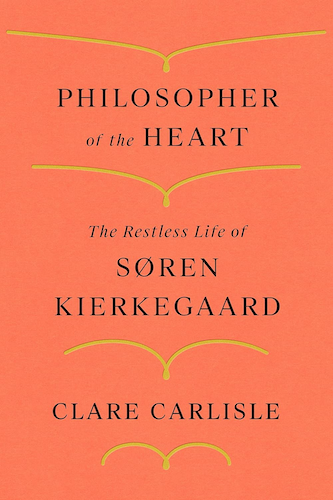
“‘A love affair is always an instructive theme regarding what it means to exist,’ wrote Søren Kierkegaard, after his only love affair had ended in a broken engagement. Kierkegaard did philosophy by looking at life from the inside, and more than any other philosopher he brought his own life into his work. His romantic crisis yielded insights into human freedom and identity that earned him an enduring reputation as the ‘father of existentialism’. He created a new philosophical style, rooted in the inward drama of being human. Although he was a difficult person — and perhaps dangerous as an exemplar — he was inspirational in his willingness to bear witness to the human condition. He became an expert on love and suffering, humour and anxiety, despair and courage; he made these affairs of the heart the subject matter of his philosophy, and his writing has reached the hearts of generations of readers.
“When the Swedish writer Fredrika Bremer visited Copenhagen in 1849 to chronicle Denmark’s cultural life, Kierkegaard had for several years been a celebrity in his home town. Bremer did not meet him — he refused her requests for an interview — though she heard plenty of gossip about his restless habits: ‘During the daytime one sees him walking in the midst of the crowd, up and down the busiest streets of Copenhagen for hours at a time. At night his lonely dwelling is said to glow with light.’ Perhaps unsurprisingly, she perceived him as an ‘inaccessible’ figure, whose gaze was fixed uninterruptedly on a single point. ‘He places his microscope over this point,’ wrote Bremer, ‘carefully investigating the tiniest atoms, the most fleeting motions, the innermost alterations. And it is about this that he speaks and writes endless folios. For him, everything is to be found at this point. But this point is — the human heart.’ She noted that his works were especially admired by female readers: ‘The philosophy of the heart must be important to them.’ It has proved to be important to men, too, as we see from a glance at successive generations of Kierkegaard’s readers, among them some of the most influential thinkers and artists of the last century.
“Of course, Kierkegaard was not the first to strive to make sense of being human. He grappled with Europe’s awesome intellectual tradition, absorbing ancient Greek metaphysics, the Old and New Testaments, the Church Fathers and medieval monastics, Luther and Lutheran pietism, the serially path-breaking philosophies of Descartes, Spinoza, Leibniz, Kant, Schelling and Hegel, and Romantic literature. During three fertile, tumultuous decades of the nineteenth century he channelled these currents of thought into his own existence, and felt their tensions and paradoxes move through him. And at the same time his heart was pierced, filled, stretched and bruised by a series of intense loves, each one of them — perhaps excepting the first — deeply ambivalent: his mother Anne, his father Michael Pedersen, his fiancée Regine; his city, his literary work, his God. . . .
“Kierkegaard’s parents gave him a name that means ‘severe’, and he became more and more true to this name as he grew older. In Concluding Unscientific Postscript, written in his thirty-third year, Kierkegaard argued that to become religious a person must ‘grasp the secret of suffering as the form of the highest life, higher than all good fortune . . . For this is the severity of the religious, that it begins by making everything more severe.’ A few pages later, however, he described a religious person enjoying an excursion to Copenhagen’s Deer Park — ‘because the humblest expression of the God-relationship is to admit one’s humanity, and because it is human to enjoy oneself.’ Real joy, he argued, always lies on the far side of suffering.
“It is certainly true that the joy of being human never came easily to Kierkegaard. At the beginning of the 1840s he was a wealthy, gifted, sociable young man, loved passionately by a beautiful, intelligent woman — yet he made life exceptionally difficult for himself. This deep and mysterious fact of Kierkegaard’s psychology was inseparable from his philosophical stance towards the world. He was perhaps the first great philosopher to attend to the experience of living in a recognizably modern world of newspapers, trains, window-shopping, amusement parks, and great stores of knowledge and information. Although life was becoming materially easier and more comfortable for affluent people like himself, it also provoked new anxieties about who to be and how to appear. Exposed to public view not only in his published works but on the streets of Copenhagen, through the windows of the fashionable cafés on Strøget, and in the pages of his city’s newspapers, Kierkegaard felt other people’s eyes upon him – and he agonized about what they saw. . . .
“Kierkegaard had no wife to talk to at the end of the day, and instead he wrote out his anger and self-pity in lucid, finely detailed prose. This was unusual, but his feelings were not: when we read his journals we recognize his ignoble sentiments because we already know them intimately. In his philosophy Kierkegaard interrogated the human habit of judging, so deeply rooted in our private thinking and collective culture that it is very nearly inevitable, and he called this ‘the ethical sphere’, or simply ‘the world’, because (like Plato’s cave) it surrounds and encloses us. But though the judgements of others are as difficult to avoid as our own, Kierkegaard believed that none of these human judgements is absolute or final. It is always possible, he suggested, to occupy a different place — for each individual belongs to a sphere of infinite depth, which he called ‘inwardness’, ‘the God-relationship’, ‘eternity’, ‘the religious sphere’, or simply ‘silence’. His writing opens up this sphere, right at the heart of life, and beckons the reader into it.”
— from Clare Carlisle, Philosopher of the Heart: The Restless Life of Søren Kierkegaard (Farrar, Straus and Giroux, 2020)
Click on the tags below for listings of related readings or audio features.