
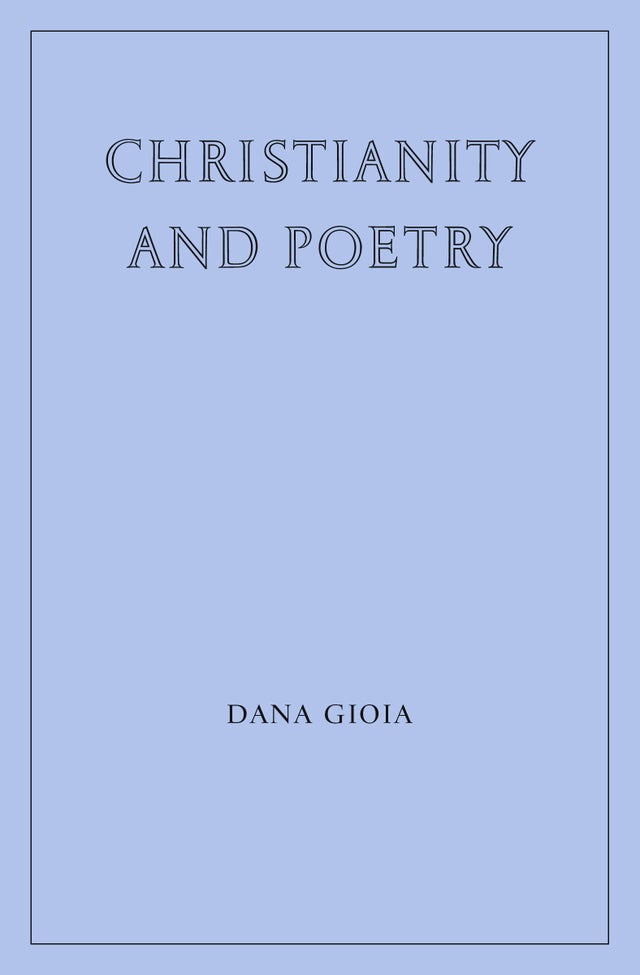
“Mary, Luke, and the prophets spoke in poetry because they understood that some truths require the utmost power of language to carry the full weight of their meaning. It isn’t just intellectual meaning at stake but also emotional, imaginative, and experiential meaning — all of the ways in which humans understand this world and imagine the next. To stir faith in things unseen, poetry evokes a deeper response than do abstract ideas. Angels may be content to speak in prose, but incarnate beings like us require the physicality of poetry.
“Sacred poetry is a human universal. Every culture has felt the need to invoke and describe the divine in the most potent language possible. Poetry itself seems to have originated in sacred ritual. Only gradually did the art expand into secular uses. Since the development of poetry as an art predates the invention of writing, the genealogy of sacred verse is lost in prehistory. It is always hard to assign an exact date or occasion to surviving ancient texts. Even the dating of the Old Testament is difficult to establish; the books were composed and compiled across a millennium.
“For Christian poetry, however, it is possible to assign its emergence to a specific moment: Mary’s announcement of the Incarnation. Christian poetry begins — quite literally — at the first moment in which Christ is announced to humanity. That origin demonstrates the supreme and inextricable importance of poetry to Christian experience. In Scripture, verse is the idiom for the revelation of mystery.
“For most believers, the truths of their faith have become platitudes taught in Catechism or Sunday School. The mysteries of faith — those strange events such as the Incarnation, Transfiguration, and Resurrection — have lost their awe and wonder and become replaced by sensible morality and proper reverence. There is nothing wrong with morality or reverence, but pious propriety is a starvation diet for the soul. Modern versions of the Bible, which translate verse passages into prosaic language for the supposed sake of clarity, are mistranslations since they change the effect of the text.
“Christianity is not animated by rules or reverence: it is inspired by supernatural mystery. ‘Certum est quia impossibile,’ said the Church Father Tertullian about Christ’s resurrection. He believed not because it made sense, but just the opposite: ‘It is certain because it is impossible.’ The tenets of Christianity from the Incarnation to the Resurrection are mysteries beyond rational explanation. The Trinity is both three and one. Christ is simultaneously human and divine. A virgin gave birth to a son. We don’t apprehend the realities of faith through rational arguments; we feel them intuitively through vision and imagination. Faith comes first, reason much later. Theology is necessarily an afterthought; it reasons from the certainties of faith, not towards them.”
— from Dana Gioia, Christianity and Poetry (Wiseblood Books, 2024)
Related reading and listening
- Knowing and living our metaphysical totality — Clyde Kilby on the power of myth to bring together “the slender hints of the knowable”
- Savoring the taste of Reality — C. S. Lewis on the transporting, illuminating capacity of Myth
- When myth becomes fact — In this 1976 interview, Clyde Kilby (1902–1986) discusses C. S. Lewis’s critique of scientism and rationalism, his belief in the primacy of the imagination, and his mythic vision. (37 minutes)
- Theology and the imagination — Jeffrey Barbeau explains what made C. S. Lewis an effective “translator” of theology for non-theologians. (21 minutes)
- The pathos of sin —
FROM VOL. 15 Poet Robert Pinsky discusses his translation of Dante’s Inferno. (9 minutes) - Existential preparation for reading literature —
FROM VOL. 128 Rod Dreher recounts how he thought he was reading Dante’s Commedia, when in reality the poem was reading him. (18 minutes) - An icon of the whole world — Jason Baxter explains how Dante includes a panoply of characters and creatures in his Comedia, offering a prismatic view of all of Creation in its glory. (20 minutes)
- An invitation to a feast — Christina Bieber Lake explains how poetry is an invitation to experience the beauty and goodness of Creation as gift. (44 minutes)
- Sacred and Profane Love: Graham Greene and the Catholic Imagination — Katy Carl discusses novelist Graham Greene’s fiction and spiritual struggles in light of the concept of the Catholic imagination. (49 minutes)
- The “scandal” of theology in the university — Edward T. Oakes, S.J. explains why John Henry Newman’s eloquent defense of the nature of university education, The Idea of a University, continues to inspire, challenge, and even frustrate its sympathizers. (24 minutes)
- Christ-animated learning —
FROM VOL. 142 Perry L. Glanzer and Nathan F. Alleman discuss the fragmentation of modern higher education and why we need theology to unify universities. 26 minutes) - “A man after reality” —
FROM VOL. 30 Clyde Kilby discusses C. S. Lewis‘s critique of scientism and rationalism, and his belief in the primacy of the imagination. (15 minutes) - We were created for this — Joshua Jipp explores St. Paul’s theology to propose that doctrine ought to be intimately concerned with the way one lives one’s life. (31 minutes)
- What we can know about God’s nature — Bruce McCormack outlines the history of the development of the doctrine of the Trinity. He shows how early Christians’ understanding of the nature of God moved from a focus on His oneness to a more full apprehension of His Triune nature. (66 minutes)
- Poetry and Liturgy — Karen Dieleman explores the influence of liturgical practices on shaping the imaginations and poetry of Elizabeth Barrett Browning, Christina Rossetti, and Adelaide Proctor. (49 minutes)
- The Transformed Vision of Samuel Taylor Coleridge — Poet Malcolm Guite explores the dramatic and even prophetic parallels between the life of Samuel Taylor Coleridge and that of the titular character in his famous poem “The Rime of the Ancient Mariner.” (59 minutes)
- Sacramental Poetics — Poet and Eastern Orthodox believer Scott Cairns explains how a good poem functions like an icon: it assists the process of our becoming aware of what is real, and it is generative in the ways it keeps opening up new understandings. (56 minutes)
- Poetry and piety —
FROM VOL. 48 James Trott discusses insights he learned while editing A Sacrifice of Praise: An Anthology of Christian Poetry in English from Caedman to the Mid-Twentieth Century. (7 minutes) - A poet’s relationship to time —
FROM VOL. 57 Poet Wilmer Mills (1969–2011) discusses how his agricultural and cross-cultural childhood in Brazil shaped his imagination and his relationship with modernity. (11 minutes) - The life of the city in poetry —
FROM VOL. 1 Ken Myers talks with W. H. Auden’s biographer and literary executor, Edward Mendelson, about political and social themes in Auden’s poetry. (7 minutes) - Joy & sorrow, destitution & abundance — In this poetry reading and talk, poet Christian Wiman discusses his own faith journey and how his struggles worked themselves into his poems. (40 minutes)
- Seeing Creation Anew: The Life & Poetry of Gerard Manley Hopkins — Dana Gioia examines Gerard Manley Hopkins‘s poetic genius and dedication to Christ in spite of his personal trials and difficult cultural context. (55 minutes)
- “The essence of a moment, clearly perceived” — Haiku poet Gary Hotham reads his poetry and discusses how the form of haiku reveals the connection between creatures and creation. (45 minutes)
- The joy and mystery of poetry —
FROM VOL. 98 Jeanne Murray Walker discusses how she helps students approach and appreciate poetry as the mysteriously meaningful literature it is, rather than as a linguistic cage containing static meaning to be abstracted from the words of the poem. (23 minutes) - Breaking the frozen sea — Dana Gioia on how poetry enchants
- Seneca’s moral courage — Dana Gioia explains how Seneca’s family was interwoven with the Roman governing class, ultimately leading to the philospher’s death at the hands of Emperor Nero. (27 minutes)
- John Donne’s Passion in Life, Faith, & Verse — Poet Dana Gioia discusses the remarkable life of poet John Donne and how his spiritual and intellectual struggles created the conditions for his unique poetic voice. (53 minutes)
- The importance of literary reading —
FROM VOL. 70 Dana Gioia discusses the important role literary reading plays in society and the 2004 publication from the NEA about such reading. (13 minutes) - Longfellow’s appeal —
FROM VOL. 53 Poet and critic Dana Gioia explains why Henry Wadsworth Longfellow (1807-1882) is one of the three great American poets. (30 minutes) - Sacramental correspondence —
FROM VOL. 51 Poet Dana Gioia discusses the state of contemporary poetry and the sacramental relationship between language and reality. (15 minutes) - Mars Hill Audio Journal, Volume 164 — FEATURED GUESTS: Dana Gioia, Brady Stiller, Robert Royal, Richard DeClue, Tiffany Schubert, and Joonas Sildre
- Flannery at 100 — In honor of Flannery O’Connor’s 100th birthday, we have gathered here an aural feast of interviews with O’Connor scholars and aficionados discussing her life, work, and faith. (3 hours, 28 minutes)
- Ideas made incarnate — In this lecture, Karen Swallow Prior examines the power of great literature to shape lives, nourish imaginations, and develop a vision of the good life. (43 minutes)
- “A sign of contradiction” — In this lecture, Daniel Gibbons compares and contrasts understandings of sacramental poetics proposed by Augustine, Aquinas, and Sydney. (36 minutes)
- Knowing by heart — D. C. Schindler reflects on Plato’s idea of “conversion” in education, assuming the symbol of the heart as the center of man. (39 minutes)
- Education as a pilgrimage and a mystery — In this lecture, James Matthew Wilson gives a compelling argument for understanding the role of a literary or poetic education as an immersion of the whole being in truth and beauty. (43 minutes)
- A prophetic “wake-up call” — In this 2024 lecture honoring the bicentennial of George MacDonald’s birth, Malcolm Guite explores MacDonald’s power to awaken readers’ spirits and effect in them a change of consciousness. (59 minutes)
- Perceiving truths that dazzle gradually — Rolland Hein on lessons from George MacDonald about the imagination as a spiritual faculty
- Foolishness, gravity, and the Church — In this essay, Albert L. Shepherd V explains why George MacDonald’s story “The Light Princess” is meant for “all who are childlike in faith and imagination.” (8 minutes)
- Victorian ideas about belief and doubt —
FROM VOL. 148 Timothy Larsen situates George MacDonald within a Victorian understanding of faith and doubt. (17 minutes) - “Prophet of holiness” — Timothy Larsen discusses a new edition of George MacDonald‘s Diary of An Old Soul, a slim book of poem-prayers to be read daily as a devotional aid. (30 minutes)
- Touch’d with a coal from heav’n — Daniel Ritchie finds in the poetry of William Cowper (1731–1800) an anticipation of Michael Polanyi’s epistemology
- How we know the world — Daniel Ritchie argues that poet and hymnodist William Cowper was ahead of his time in critiquing the Enlightenment’s reductionist view of knowledge. (16 minutes)
- William Cowper: Reconciling the Heart with the Head — Daniel E. Ritchie discusses the life and work of poet William Cowper (1731–1800), comparing his commitment to understanding reality through personal knowledge, intuition, and rigorous contemplation with the thought of Michael Polanyi. (43 minutes)
- Apprehending the enduring things — Vigen Guroian explains how children’s literature has the capacity to birth the moral imagination in our children, affirming for them the permanent things. (53 minutes)
- Mars Hill Audio Journal, Volume 162 — FEATURED GUESTS: Mark Noll, R. Jared Staudt, Paul Weston, William C. Hackett, Hans Boersma, and David Paul Baird
- Bearing witness through poetry — Roger Lundin discusses the incarnational witness of poet Czesław Miłosz (1911–2004), exploring his service to truth and to his native tongue, Polish. (16 minutes)
- Czesław Miłosz: A Poet of Luminous Things — Roger Lundin discusses the themes, breadth, and depth of poet Czesław Miłosz‘s work, explaining how Milosz incarnated in his life and work a sense of exile and alienation so common to modern man. (43 minutes)
- Theological realism — Kevin J. Vanhoozer discusses theologian T. F. Torrance’s understanding of the positive relation between science and theology. (52 minutes)
- Soundings of the human soul — Professor John H. Timmerman discusses the poetry of the late Jane Kenyon (1947-1995) and his visit to her home, Eagle Pond Farm. (16 minutes)
Related reading and listening
- Knowing and living our metaphysical totality — Clyde Kilby on the power of myth to bring together “the slender hints of the knowable”
- Savoring the taste of Reality — C. S. Lewis on the transporting, illuminating capacity of Myth
- When myth becomes fact — In this 1976 interview, Clyde Kilby (1902–1986) discusses C. S. Lewis’s critique of scientism and rationalism, his belief in the primacy of the imagination, and his mythic vision. (37 minutes)
- Theology and the imagination — Jeffrey Barbeau explains what made C. S. Lewis an effective “translator” of theology for non-theologians. (21 minutes)
- The pathos of sin —
FROM VOL. 15 Poet Robert Pinsky discusses his translation of Dante’s Inferno. (9 minutes) - Existential preparation for reading literature —
FROM VOL. 128 Rod Dreher recounts how he thought he was reading Dante’s Commedia, when in reality the poem was reading him. (18 minutes) - An icon of the whole world — Jason Baxter explains how Dante includes a panoply of characters and creatures in his Comedia, offering a prismatic view of all of Creation in its glory. (20 minutes)
- An invitation to a feast — Christina Bieber Lake explains how poetry is an invitation to experience the beauty and goodness of Creation as gift. (44 minutes)
- Sacred and Profane Love: Graham Greene and the Catholic Imagination — Katy Carl discusses novelist Graham Greene’s fiction and spiritual struggles in light of the concept of the Catholic imagination. (49 minutes)
- The “scandal” of theology in the university — Edward T. Oakes, S.J. explains why John Henry Newman’s eloquent defense of the nature of university education, The Idea of a University, continues to inspire, challenge, and even frustrate its sympathizers. (24 minutes)
- Christ-animated learning —
FROM VOL. 142 Perry L. Glanzer and Nathan F. Alleman discuss the fragmentation of modern higher education and why we need theology to unify universities. 26 minutes) - “A man after reality” —
FROM VOL. 30 Clyde Kilby discusses C. S. Lewis‘s critique of scientism and rationalism, and his belief in the primacy of the imagination. (15 minutes) - We were created for this — Joshua Jipp explores St. Paul’s theology to propose that doctrine ought to be intimately concerned with the way one lives one’s life. (31 minutes)
- What we can know about God’s nature — Bruce McCormack outlines the history of the development of the doctrine of the Trinity. He shows how early Christians’ understanding of the nature of God moved from a focus on His oneness to a more full apprehension of His Triune nature. (66 minutes)
- Poetry and Liturgy — Karen Dieleman explores the influence of liturgical practices on shaping the imaginations and poetry of Elizabeth Barrett Browning, Christina Rossetti, and Adelaide Proctor. (49 minutes)
- The Transformed Vision of Samuel Taylor Coleridge — Poet Malcolm Guite explores the dramatic and even prophetic parallels between the life of Samuel Taylor Coleridge and that of the titular character in his famous poem “The Rime of the Ancient Mariner.” (59 minutes)
- Sacramental Poetics — Poet and Eastern Orthodox believer Scott Cairns explains how a good poem functions like an icon: it assists the process of our becoming aware of what is real, and it is generative in the ways it keeps opening up new understandings. (56 minutes)
- Poetry and piety —
FROM VOL. 48 James Trott discusses insights he learned while editing A Sacrifice of Praise: An Anthology of Christian Poetry in English from Caedman to the Mid-Twentieth Century. (7 minutes) - A poet’s relationship to time —
FROM VOL. 57 Poet Wilmer Mills (1969–2011) discusses how his agricultural and cross-cultural childhood in Brazil shaped his imagination and his relationship with modernity. (11 minutes) - The life of the city in poetry —
FROM VOL. 1 Ken Myers talks with W. H. Auden’s biographer and literary executor, Edward Mendelson, about political and social themes in Auden’s poetry. (7 minutes) - Joy & sorrow, destitution & abundance — In this poetry reading and talk, poet Christian Wiman discusses his own faith journey and how his struggles worked themselves into his poems. (40 minutes)
- Seeing Creation Anew: The Life & Poetry of Gerard Manley Hopkins — Dana Gioia examines Gerard Manley Hopkins‘s poetic genius and dedication to Christ in spite of his personal trials and difficult cultural context. (55 minutes)
- “The essence of a moment, clearly perceived” — Haiku poet Gary Hotham reads his poetry and discusses how the form of haiku reveals the connection between creatures and creation. (45 minutes)
- The joy and mystery of poetry —
FROM VOL. 98 Jeanne Murray Walker discusses how she helps students approach and appreciate poetry as the mysteriously meaningful literature it is, rather than as a linguistic cage containing static meaning to be abstracted from the words of the poem. (23 minutes) - Breaking the frozen sea — Dana Gioia on how poetry enchants
- Seneca’s moral courage — Dana Gioia explains how Seneca’s family was interwoven with the Roman governing class, ultimately leading to the philospher’s death at the hands of Emperor Nero. (27 minutes)
- John Donne’s Passion in Life, Faith, & Verse — Poet Dana Gioia discusses the remarkable life of poet John Donne and how his spiritual and intellectual struggles created the conditions for his unique poetic voice. (53 minutes)
- The importance of literary reading —
FROM VOL. 70 Dana Gioia discusses the important role literary reading plays in society and the 2004 publication from the NEA about such reading. (13 minutes) - Longfellow’s appeal —
FROM VOL. 53 Poet and critic Dana Gioia explains why Henry Wadsworth Longfellow (1807-1882) is one of the three great American poets. (30 minutes) - Sacramental correspondence —
FROM VOL. 51 Poet Dana Gioia discusses the state of contemporary poetry and the sacramental relationship between language and reality. (15 minutes) - Mars Hill Audio Journal, Volume 164 — FEATURED GUESTS: Dana Gioia, Brady Stiller, Robert Royal, Richard DeClue, Tiffany Schubert, and Joonas Sildre
- Flannery at 100 — In honor of Flannery O’Connor’s 100th birthday, we have gathered here an aural feast of interviews with O’Connor scholars and aficionados discussing her life, work, and faith. (3 hours, 28 minutes)
- Ideas made incarnate — In this lecture, Karen Swallow Prior examines the power of great literature to shape lives, nourish imaginations, and develop a vision of the good life. (43 minutes)
- “A sign of contradiction” — In this lecture, Daniel Gibbons compares and contrasts understandings of sacramental poetics proposed by Augustine, Aquinas, and Sydney. (36 minutes)
- Knowing by heart — D. C. Schindler reflects on Plato’s idea of “conversion” in education, assuming the symbol of the heart as the center of man. (39 minutes)
- Education as a pilgrimage and a mystery — In this lecture, James Matthew Wilson gives a compelling argument for understanding the role of a literary or poetic education as an immersion of the whole being in truth and beauty. (43 minutes)
- A prophetic “wake-up call” — In this 2024 lecture honoring the bicentennial of George MacDonald’s birth, Malcolm Guite explores MacDonald’s power to awaken readers’ spirits and effect in them a change of consciousness. (59 minutes)
- Perceiving truths that dazzle gradually — Rolland Hein on lessons from George MacDonald about the imagination as a spiritual faculty
- Foolishness, gravity, and the Church — In this essay, Albert L. Shepherd V explains why George MacDonald’s story “The Light Princess” is meant for “all who are childlike in faith and imagination.” (8 minutes)
- Victorian ideas about belief and doubt —
FROM VOL. 148 Timothy Larsen situates George MacDonald within a Victorian understanding of faith and doubt. (17 minutes) - “Prophet of holiness” — Timothy Larsen discusses a new edition of George MacDonald‘s Diary of An Old Soul, a slim book of poem-prayers to be read daily as a devotional aid. (30 minutes)
- Touch’d with a coal from heav’n — Daniel Ritchie finds in the poetry of William Cowper (1731–1800) an anticipation of Michael Polanyi’s epistemology
- How we know the world — Daniel Ritchie argues that poet and hymnodist William Cowper was ahead of his time in critiquing the Enlightenment’s reductionist view of knowledge. (16 minutes)
- William Cowper: Reconciling the Heart with the Head — Daniel E. Ritchie discusses the life and work of poet William Cowper (1731–1800), comparing his commitment to understanding reality through personal knowledge, intuition, and rigorous contemplation with the thought of Michael Polanyi. (43 minutes)
- Apprehending the enduring things — Vigen Guroian explains how children’s literature has the capacity to birth the moral imagination in our children, affirming for them the permanent things. (53 minutes)
- Mars Hill Audio Journal, Volume 162 — FEATURED GUESTS: Mark Noll, R. Jared Staudt, Paul Weston, William C. Hackett, Hans Boersma, and David Paul Baird
- Bearing witness through poetry — Roger Lundin discusses the incarnational witness of poet Czesław Miłosz (1911–2004), exploring his service to truth and to his native tongue, Polish. (16 minutes)
- Czesław Miłosz: A Poet of Luminous Things — Roger Lundin discusses the themes, breadth, and depth of poet Czesław Miłosz‘s work, explaining how Milosz incarnated in his life and work a sense of exile and alienation so common to modern man. (43 minutes)
- Theological realism — Kevin J. Vanhoozer discusses theologian T. F. Torrance’s understanding of the positive relation between science and theology. (52 minutes)
- Soundings of the human soul — Professor John H. Timmerman discusses the poetry of the late Jane Kenyon (1947-1995) and his visit to her home, Eagle Pond Farm. (16 minutes)