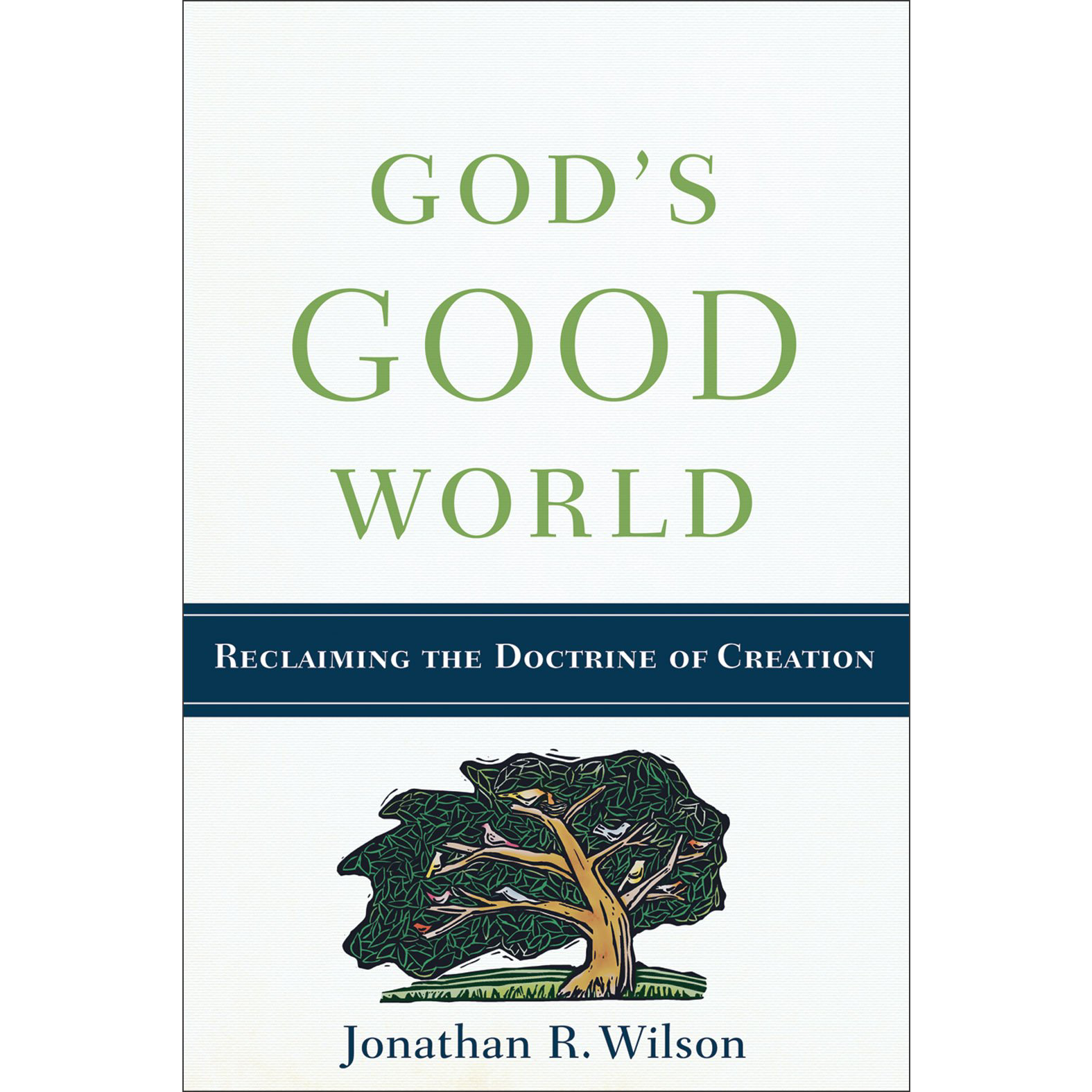
“To say that humans are creatures is to say that our identity, our meaning, our life depend on our relationship to the One who created us. This assertion runs counter to most of what we are taught. On the one hand, we are told that we are our own rulers. We have been set free from all external authority and power. We are dependent on no one but ourselves. . . . We make ourselves. We determine our own destiny. . . .”
“On the other hand, we may be told (if we are not creatures) that we have no identity. There is no such thing as constructing our own selves and determining our own destinies. We are merely products of the forces to which we have been subject and other forces that determine our lives today. Our genes, our families of origin, our traumas, our failures and successes, our particular biochemical make-up, market forces, ideologies, brain chemistry, and more converge on the aggregation of molecules that constitutes our lives. These forces determine who each of us is. We have been constructed by these forces. . . .
“One of the gravest errors we can make in our witness to the good news of Jesus Christ is to separate creation and redemption from each other. The place and meaning of creation are found in its redemption. The place and meaning of redemption are its reclaiming and healing of creation. This is the good news of the kingdom of God in Jesus Christ. Apart from redemption, creation has no purpose in the gospel. As we will see in detail later in this chapter, we recognize ‘creation’ as creation only in relation to God’s work of redemption. Likewise, we recognize ‘redemption’ as redemption only in its relation to God’s work of creation. When we sever the connection between creation and redemption, we lose both: we remove both creation and redemption from the gospel. In doing so, we may continue to perpetuate some version of the ‘good news of Jesus Christ’ that we live and proclaim, but it will be a pale version that often drifts into a loud proclamation of ‘good news,’ which upon close examination turns out to be bad news. . . .
“This commonplace denial of the interweaving of creation and redemption is deeply enshrined in beliefs and practices that regard this world merely as a container for God’s work of salvation, not as an actual participant in God’s work of salvation. It is as if this world were the stage set for God’s work of redemption. Once that work is done, the set is taken down and discarded because it is no longer needed. . . .
“We reduce the incarnation by regarding it only as a necessary step toward God’s act of redemption. In this reduction, the Word became flesh to bear our sins and live long enough as a human to teach and perform miracles that display and confirm his divinity before being crucified. In variations on this reductionist account of the incarnation, the Word becomes flesh as an instrumental act necessary to the work of redemption.
“But that understanding of the incarnation reduces the Word becoming flesh to a skeleton with some flesh hanging on it. In contrast to this deracinated image, we must retrieve, celebrate, and live the fulness of the incarnation as the climactic act of God’s love for God’s creation. The Word became flesh not as an instrument toward our salvation but as an embrace of the whole of creation in this one person — an embrace that redeems all creation. As it is, this ‘one person’ is the one by whom, through whom, and for whom all things were made. It is this very one who enters fully, deeply, passionately into the life of the creation. This is the action of love, love that began before the creation of the cosmos, gives life to the cosmos, holds the cosmos together, embraces and enfolds the cosmos into the life of God through Jesus Christ, and promises life eternal for the cosmos by weaving together creation and redemption in a new heavens and a new earth.”
—from Jonathan R. Wilson, God’s Good World: Reclaiming the Doctrine of Creation (BakerAcademic, 2013)
Related reading and listening
- When myth becomes fact — In this 1976 interview, Clyde Kilby (1902–1986) discusses C. S. Lewis’s critique of scientism and rationalism, his belief in the primacy of the imagination, and his mythic vision. (37 minutes)
- A sampling of newly published lectures — Ken Myers introduces listeners to four recently released lectures, courtesy of our Partners. The lecturers are Jennifer Frey, Gary Saul Morson, N. T. Wright, and Andrew Kern. (27 minutes)
- The inward eye, cosmic truth, and making well — Andrew Kern takes his listeners along an “interlinear” reading of a portion of St. Augustine’s Confessions that explores the differences between how God makes and how we create. (38 minutes)
- “Investigations of divine works” — Greg Wilbur explains how closely connected music is to the order of the cosmos and how it even reveals attributes of God. (56 minutes)
- A letter from Ken Myers — Ken Myers examines the cultural implications of the Incarnation and the deep-seated dualism of modernity that divorces spirituality from our material experience. (22 minutes)
- How music blesses and teaches — FROM VOL. 64 Theologian and musician Jeremy Begbie explores what we learn about time, theology, and the structure of Creation from the experience of music. (28 minutes)
- Mars Hill Audio Journal, Volume 166 — FEATURED GUESTS: William Cavanaugh, Kent Burreson, Beth Hoeltke, Jeffrey Barbeau, Jason Baxter, John Betz, and Bruce Herman
- Creation, in harmony with the Logos — Rowan Williams on the Logos and the diverse logoi that mirror it
- An icon of the whole world — Jason Baxter explains how Dante includes a panoply of characters and creatures in his Comedia, offering a prismatic view of all of Creation in its glory. (20 minutes)
- Cosmic realities in the built world — Christopher and Christine Perrin discuss the implications of architect Christopher Alexander’s (1936–2022) discovery of patterns of building that cohere with the the created cosmos and with ourselves as human creatures. (59 minutes)
- The “book” of Creation — Alan Noble explains why the modern world makes it profoundly difficult to experience Creation as revelation, and he encourages unmediated encounters with Creation that lead to meditation. (52 minutes)
- Life more abundantly — Jeanne Schindler advocates for a return to an understanding and prioritizing of sensory experience — real engagement with the real world — as foundational to learning and living. (35 minutes)
- Heaven and earth are full of His glory — Gerald R. McDermott examines the typological tradition of the Church, particularly through Jonathan Edwards’s thought, and he argues for a recovery of the Christian understanding of the universe as an “immense Trinitarian symbol.” (61 minutes)
- An invitation to a feast — Christina Bieber Lake explains how poetry is an invitation to experience the beauty and goodness of Creation as gift. (44 minutes)
- Stewarding God’s creation — FROM VOL. 116 Fred Bahnson talks about how a Christian understanding of God’s redemptive work on the earth should influence our practices of growing and sharing food. (19 minutes)
- “Earth-shaking” and “heart-breaking” beauty — FROM VOL. 151 Junius Johnson warns that the pursuit of beauty is both perilous and an experience that points to the desire for God. (25 minutes)
- Clips from five extended interviews — We are pleased to share clips from five interviews that we’ve recently produced as full-length Conversations. (30 minutes)
- Breaking out of the immanent frame — Norman Wirzba on the true character of Creation and of our creatureliness
- Good News for All Creation — Theologian Norman Wirzba helps us rethink the category of nature in terms of the Christian doctrine of creation. (66 minutes)
- Ten, seven, and the rhythm of God’s love — Joseph Cardinal Ratzinger on the meaningfulness of numbers in Creation and Scripture
- Lives of generosity — Jonathan Wilson distinguishes between two fundamental ways of viewing Creation: a true Christian account of the world and a “survival of the fittest” one. (21 minutes)
- Creation and redemption as trinitarian projects — Colin Gunton on Christ and Spirit in creation and redemption
- Reflecting the being of God in communion — Colin Gunton on the relationality at the heart of Creation
- The whole world in his Hands — Colin Gunton on the trinitarian emphasis in St. Irenaeus’s doctrine of Creation
- The recovery of an integrated ecology — In this essay, Michael Hanby unpacks the summons of Laudato si’ to an ecological way of life based on a proper understanding of creation in its fullness and integrity. (57 minutes)
- Speaking the word in love — In this lecture, D. C. Schindler examines core insights from Ferdinand Ulrich on the central vocation of man and the meaning of being. (32 minutes)
- Music, silence, and the order of Creation — In this lecture, Ken Myers explains how it is that our participation in harmonic beauty in music is a kind of participation in the life of God, in Whom all order and beauty coheres and is sustained. (61 minutes)
- The gift of liturgical time — In this lecture, Gregory Wilbur explains how liturgy and liturgical time align us to the rhythms and order of Creation, forming us as disciples. (45 minutes)
- The confident optimism in true Christian asceticism — Philosopher Étienne Gilson on the essential goodness of Creation
- Festivity and the goodness of Creation — Drawing on Josef Pieper’s ideas, Ken Myers explains why the spirit of festivity is the spirit of worship, and that “entertainment” is ultimately an artificial, contrived, and empty effort to achieve festivity. (25 minutes)
- Forms as portals to reality — Ken Myers explains the ancient classical and Christian view that music embodies an order and forms that correspond to the whole of created reality, in its transcendence and materiality. (54 minutes)
- Creation’s goodness and human faithfulness — J. Matthew Bonzo and Michael R. Stevens on Wendell Berry’s understanding of how Creation is a gift with certain givenness
- Farming and our primal vocation — Shawn and Beth Dougherty make a theological case for biomimicry, or fulfilling our original vocation of tending the earth by working according to the nature of Nature. (68 minutes)
- A theology of eating — FROM VOL. 113 Theologian Norman Wirzba examines the relationship between food and faith. (24 minutes)
- Honoring the pigness of pigs — FROM VOL. 137 Popular innovator and speaker on farming practices Joel Salatin talks about the challenges of caring for Creation within an agricultural and food system that pays little attention to the purposes and inclinations of Creation. (25 minutes)
- An account of God’s relatedness to time and space — Colin Gunton on the trinitarian conception of the divine economy in St. Irenaeus
- What does it mean to be a creature? — Canon-theologian Simon Oliver explains how and why the doctrine of Creation is cardinal and must frame all theology. (62 minutes)
- “Reading Lewis with blinders on” — Chris Armstrong explains how C. S. Lewis’s work is grounded deeply in the Christian humanist tradition. (45 minutes)
- Creation as beauty and gift — FROM VOL. 67 David Bentley Hart describes how the Christian understanding of Creation as beauty and gift, as the outward expression of the delight the Trinity has in itself, reveals a vision of reality different from the pagan or fatalist vision of reality. (12 minutes)
- The Life was the Light of men — In a lecture from 2018, Ken Myers contrasts the Enlightenment’s understanding of reason with the Christocentric conception of reason. (57 minutes)
- Discerning an alternative modernity — In a lecture from 2019, Simon Oliver presents a summary of the cultural consequences of the comprehensiveness of the work of Christ. (28 minutes)
- Lessons from Leviticus — The book of Leviticus may be assumed to be irrelevant for charting a way through the challenges of modernity. Theologian Peter J. Leithart disagrees. (22 minutes)
- A theology of active beauty — In a 2010 lecture, George Marsden examines a few ways in which the distorting effects of Enlightenment rationalism were resisted in the work of Jonathan Edwards. (64 minutes)
- Mars Hill Audio Journal, Volume 161 — FEATURED GUESTS: Andrew Wilson, Kyle Edward Williams, Andrew James Spencer, Landon Loftin, Esther Lightcap Meek, Andrew Davison
- Understanding the doctrine of participation — FROM VOL. 150Theologian and priest Andrew Davison believes that retrieving the historic doctrine of participation is vital to help Christians escape from the default philosophy of the age. (32 minutes)
- On Earth as it is in Heaven — FROM VOL. 108Hans Boersma — author of Heavenly Participation: The Weaving of a Sacramental Tapestry — explains why Christians should reject the modern separation of Heaven and Earth and recover a “sacramental ontology.” (26 minutes)
- Lilies as analogues for farming — Fred Bahnson on the wisdom of attending to patterns of Creation
- Making peace with the land — Fred Bahnson challenges us to consider how we might honor our created and redeemed relationship with the earth as God’s stewards. (48 minutes)
- Learning to see the world aright — Norman Wirzba on cultivating a Christocentric vision of Creation
- This world is now my home — Belden Lane describes several approaches to understanding how we experience the sacredness of earthly places and how we learn to see God manifest in His Creation. (48 minutes)