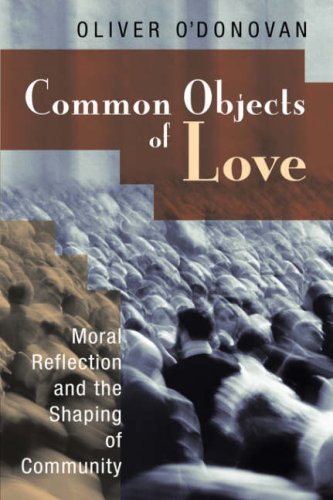
“The word ‘tradition,’ like koinonia, refers both to an action and a possession. In the first sense it is the activity by which one shares in the community, receiving and contributing. In the second sense it is the reserve of practices and communicative patterns received from the past — but only those which continue to command recognition, that is, which have been effectively communicated down to the present time. The essential thing about tradition is that it creates social continuity. It binds the communal action of the present moment to the communal actions of past moments. What we often call ‘traditionalism,’ the revival of lapsed tradition, is, properly speaking, a kind of innovation, making a new beginning out of an old model. This may or may not be sensible in any given instance, but it is not a tradition. The claim of tradition is not the claim of the past over the present, but the claim of the present to that continuity with the past which enables common action to be conceived and executed.
“The paradigm command of tradition is, ‘Honor your father and your mother, that your days may be long in the land which the Lord your God gives you.’ It appears to our eyes to be concerned with the duties of children, but this is a mistake. The duties of children are purely responsive to the duty of parents to be to their children what their parents were to them. This is a command addressed to adults, whose existence in the world is not self-posited but the fruit of an act of cultural transmission, which they have a duty to sustain. The act of transmission puts us all in the place of receiver and communicator at once. The household is envisaged as the primary unit of cultural transmission, the ‘father and the mother’ as representing every existing social practice which it is important to carry on. Only so can community sustain itself within its environment, ‘the land which the Lord your God gives you.’ No social survival in any land can be imagined without a stable cultural environment across generations. By tradition society identifies itself from one historical moment to the next, and so continues to act as itself. . . .
“The peculiar value of art to tradition lies in its capacity to elicit recognitions, reminding us of the sources of our cultural objects within the structures of natural necessity. This power of reminiscence we call ‘beauty,’ and it arises from the coincidence of natural order with artificial form. Both poles, the natural and the conventional, are essential to an art form, that the evocation of the one within the other may be experienced. Formal qualities are as important as substantive references in evoking the presence of nature in culture. A poem may allude to springtime, or a tune may imitate birdsong. But an abstract fugue evokes nature, too, by exploring the power of repetition in difference, and a sonnet by its balance of thesis development, and resolution.”
— from Oliver O’Donovan, Common Objects of Love: Moral Reflection and the Shaping of Community (Eerdmans, 2002)
This post was originally posted on September 22, 2014.
Philip Turner reflects on how Christian ethics is misplaced if it has as its central concern individual moral behavior or social justice. (28 minutes)
A flood of images — Oliver O’Donovan describes the distinctive character of publicity in modernity, which drowns us in a flood of ever-changing representations that do not serve the common good. (37 minutes)
Publicity and representative images in society — Oliver O’Donovan describes the nature of publicity as the force that mediates our communication with one another, creating common interests and then rapidly subsuming them into newer ones.(Lecture 3 of 3; 57 minutes)
How common loves shape communities — Oliver O’Donovan discusses how communities mediate love and knowledge to their members and what challenges arise as a community’s traditions are confronted by sin, error, and plurality. (Lecture 2 of 3; 49 minutes)
The “sovereign uselessness of moral reflection” — Calling on the wisdom of St. Augustine, Oliver O’Donovan reminds his listeners that all knowledge participates in the eternal Logos of God and is rooted in love, not disinterested moral judgement.(Lecture 1 of 3; 52 minutes)
Gayle Brandow Samuels examines the ways in which trees have served as anchor-points for memory and identity in American culture. (9 minutes)
City of God, City of Man — Architect Philip Bess discusses how our modern-day confusion and moral illiteracy are worked out visibly in the cities and buildings our architects create. (57 minutes)
Thinking Together — Alan Jacobs discusses some principles he’s compiled to help us think well (and charitably) in our cultural context, and he warns us to be attentive to the ways technology displaces previously fixed communities. (53 minutes)
Mars Hill Audio Journal, Volume 165 — FEATURED GUESTS: Jeffrey Bilbro, Daniel McInerny, Joseph Minich, Carl Elliott, Nadya Williams, and Don W. King
Drawing from Wendell Berry’s works, Jack Baker and Jeffrey Bilbro discuss a vision of higher education that respects a multidimensional notion of place. (23 minutes)
Real Food, Real Communities — Corby Kummer extols the virtues of the Slow Food movement, which seeks to honor, protect, and sustain traditional foods and ingredients from specific cultures and regions. (48 minutes)
Clips from five extended interviews — We are pleased to share clips from five interviews that we’ve recently produced as full-length Conversations. (30 minutes)
Shared Practices, Strong Communities — Christine Pohl reflects on why a deliberate commitment to certain shared practices is necessary for the sustaining of community. (57 minutes)
How the Church promotes the cause of freedom — Oliver O’Donovan: “We discover we are free when we are commanded by that authority which commands us according to the law of our being, disclosing the secrets of the heart.”
“The search for shared ends” — Oliver O’Donovan examines whether and to what extent there might be the possibility of a unifying Christian perspective on political doctrine or policy. (59 minutes)
Thinking coherently about politics — Ken Myers gives an introduction to political theologian Oliver O’Donovan, whose work has been instrumental in teaching many how to think about social and political life in light of the gospel of Christ. (57 minutes)
The law of faith and of love — Oliver O’Donovan compares St. Augustine’s interpretation of Psalm 119 with that of others, revealing Augustine’s more nuanced understanding of the complexities of the life of faith that the psalmist explores. (64 minutes)
“Only a real world can save us” — Oliver O’Donovan explores how the “religion” of modernity lacks a coherent world in which one may participate with full human agency and moral purpose. (Lecture 3 of 3; 61 minutes)
Christian unity and civil society — Oliver O’Donovan introduces listeners to Dutch lay theologian Hugo Grotius, arguing that the questions he tackled relate to perennial concerns about the relationship between divine and human agency, and between civil and ecclesiastical authority. (Lecture 2 of 3; 57 minutes)
The demoralizing effect of pagan Roman religion — Oliver O’Donovan examines St. Augustine’s critique of pagan Roman religion in Book II of his treatise City of God and asks his audience to consider what insights Augustine’s critique has for us today. (Lecture 1 of 3; 51 minutes)
Knowing and doing the good — Oliver O’Donovan raises several key questions and complications involved in the task of taking concrete and practical action toward a recognized moral good. (Lecture 3 of 3; 63 minutes)
Moral knowledge of reality — Oliver O’Donovan argues that admiration is the fundamental form of knowing the world, as we cannot know fully those elements of reality (“bare facts”) that contain no significance for us. (Lecture 2 of 3; 55 minutes)
Attentiveness to the world, the self, and time — Oliver O’Donovan uses the metaphor of waking to discuss the concept of moral sensibility as attention to the world, the self, and time. (Lecture 1 of 3; 60 minutes)
Cultivating the Virtue of Reverence — Paul Woodruff (1943–2023) discusses the importance of reverence as a virtue that enriches relationships, elevates civic life, and helps leaders to wield power wisely. (53 minutes)
D. C. Schindler explains how liberalism sought to make way for individuals to function together without any orientation to an explicit common good. (37 minutes)
The personal element in all knowing — Mark Mitchell connects key aspects of Michael Polanyi’s conception of knowledge with Matthew Crawford’s insistence that real knowing involves more than technique. (34 minutes)
Against hacking babies — Oliver O’Donovan raises questions about IVF and the technologically ordered motive for efficiency
Impact of “infotainment” on community — Neil Gabler and C. John Sommerville discuss how the mentalities conveyed by our experience with communications media work against the nurturing of community. (36 minutes)
Professor Christopher Shannon discusses how early twentieth-century social scientists encouraged the American idea that individual identity works against communal membership. (17 minutes)
Education that counters alienation — In this lecture, Jeanne Schindler explores how digital technologies warp not only education but our experience of being human. (30 minutes)
Historian Christopher Shannon discusses how American academic historical writing presents a grand narrative of progressivism, which it defends by subscribing to an orthodoxy of objective Reason. (21 minutes)
The gift of objective reality — Moral philosopher Oliver O’Donovan makes an argument for the consistency of the idea of law when it is conceived in a theological context. (40 minutes)
Friendship and life together — In a lecture at Providence College, Ken Myers explores how the concept of friendship, which used to be central to political philosophy, was banished from considerations of public life as the state was exalted over society. (53 minutes)
Freedom as conformity to reality — W. Bradford Littlejohn summarizes the definitions of liberty offered by Richard Bauckham and Oliver O’Donovan
The sovereignty of love — In this 2022 lecture, Oliver O’Donovan explains the historical background — and present consequences — of the assertion by Jesus of two great commands. (67 minutes)
O’Donovan, Oliver — FROM THE GUEST PAGE: Oliver O’Donovan held teaching posts at Wycliffe Hall, Oxford and Wycliffe College Toronto before becoming Regius Professor of Moral & Pastoral Theology and Canon of Christ Church at the University of Oxford in 1982.
Community, the giver of freedom — Thomas H. Naylor and William H. Willimon on why suspicion about big government shouldn’t take the form of autonomous individualism
Why kings are compelling — Historian Francis Oakley describes how the modern idea of “secular” politics is a striking departure in human history. (32 minutes)