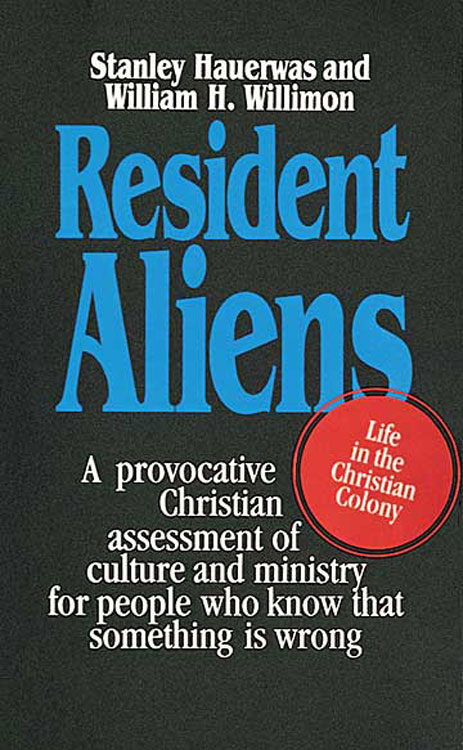
“The primary entity of democracy is the individual, the individual for whom society exists mainly to assist assertions of individuality. Society is formed to supply our needs, no matter the content of those needs. Rather than helping us to judge our needs, to have the right needs which we exercise in right ways, our society becomes a vast supermarket of desire under the assumption that if we are free enough to assert and choose whatever we want we can defer eternally the question of what needs are worth having and on what basis right choices are made. What we call ‘freedom’ becomes the tyranny of our own desires. We are kept detached, strangers to one another as we go about fulfilling our needs and asserting our rights. The individual is given a status that makes incomprehensible the Christian notion of salvation as a political, social phenomenon in the family of God. Our economics correlates to our politics. Capitalism thrives in a climate where ‘rights’ are the main political agenda. The church becomes one more consumer-oriented organization existing to encourage individual fulfillment rather than being a crucible to engender individual conversion into the Body.”
—from Stanley Hauerwas and William H. Willimon, Resident Aliens: Life in the Christian Colony (Nashville: Abingdon Press, 1989)
Related reading and listening
- Paradoxes of “nature” and “culture” — Robert Spaemann, on the destructive consequences of a merely naturalistic understanding of nature
- The primacy of the Body of Christ —
FROM VOL. 134 Philip Turner reflects on how Christian ethics is misplaced if it has as its central concern individual moral behavior or social justice. (28 minutes) - Money, status, and satisfaction —
FROM VOL. 44 David Myers and Robert Frank discuss the tenuous relationship between wealth and happiness. (22 minutes) - The vice of curiosity — Stanley Hauerwas on the warning from Paul Griffiths about desiring to own knowledge
- Shared Practices, Strong Communities — Christine Pohl reflects on why a deliberate commitment to certain shared practices is necessary for the sustaining of community. (57 minutes)
- How the Church promotes the cause of freedom — Oliver O’Donovan: “We discover we are free when we are commanded by that authority which commands us according to the law of our being, disclosing the secrets of the heart.”
- What is beyond our choosing? — D. C. Schindler on our nihilistic quest for freedom
- The danger of not defining “freedom” — Richard Bauckham insists that an adequate understanding of freedom requires recognition of God as the ground of true human freedom
- Power to the people — Nathan O. Hatch on the DIY spirit of early American Christianity
- Free for obedience — Glenn W. Olsen on Augustine’s understanding of freedom
- What Ockham severed — Jean-Charles Nault on the advent of sheer freedom
- Passing on the virtues to the next generation — Theologian and ethicist Stanley Hauerwas reflects on being a godparent and the responsibility to cultivate and talk about Christian virtue. (21 minutes)
- The Protestant project and indifference concerning God — Stanley Hauerwas on Alasdair MacIntyre’s critique of Protestant liberals
- A life well lived — In this essay, Stanley Hauerwas explains the breadth and depth of Alasdair MacIntyre’s thought, the goal of which was to help people to act intelligibly and live morally worthy lives. (40 minutes)
- The collapse of public life —
FROM VOL. 154 D. C. Schindler explains how liberalism sought to make way for individuals to function together without any orientation to an explicit common good. (37 minutes) - The profound drama of human sexuality — In this lecture, D. C. Schindler explains the cosmological significance of human sexuality and why it is paradigmatic of the relationship between nature and freedom. (32 minutes)
- Mars Hill Audio Journal, Volume 164 — FEATURED GUESTS: Dana Gioia, Brady Stiller, Robert Royal, Richard DeClue, Tiffany Schubert, and Joonas Sildre
- Liberalism’s self-destructive dynamic — T. S. Eliot on the social need to move toward something and not just away
- Countering American apathy toward history —
FROM VOL. 124 Historian John Fea discusses how American and Protestant individualism continues to influence our orientation toward the past. (22 minutes) - “Detachment as a whole way of life” —
FROM VOL. 85 Professor Christopher Shannon discusses how early twentieth-century social scientists encouraged the American idea that individual identity works against communal membership. (17 minutes) - The fraught marriage of liberty and equality — In this essay, Patrick Deneen examines Alexis de Tocqueville’s complex and insightful portrait of “democratic man” living in the context of perpetual societal tension between the excesses of liberty and equality. (39 minutes)
- Alexis de Tocqueville’s penetrating review of America —
FROM VOL. 91 Hugh Brogan and Daniel Ritchie discuss Alexis de Tocqueville’s insights into American society, government, and character. (26 minutes) - Why liberalism tends toward absolutism — In this lecture, Michael Hanby examines what causes liberalism to become dictatorial in thought and practice. (49 minutes)
- When is a market “free”? — William T. Cavanaugh argues for a richer conception of freedom than the reductionist one promoted by economist Milton Friedman. (44 minutes)
- The gift of objective reality — Moral philosopher Oliver O’Donovan makes an argument for the consistency of the idea of law when it is conceived in a theological context. (40 minutes)
- Freedom as conformity to reality — W. Bradford Littlejohn summarizes the definitions of liberty offered by Richard Bauckham and Oliver O’Donovan
- The Life was the Light of men — In a lecture from 2018, Ken Myers contrasts the Enlightenment’s understanding of reason with the Christocentric conception of reason. (57 minutes)
- The dance of law and freedom — Calvin Stapert on the experience of joyous order in Bach’s music
- Rejecting “two-tiered” Thomism —
FROM VOL. 155 David Bentley Hart on how “two-tier Thomism” deviates from historic Christian understanding of the relationship between God and Creation. (42 minutes) - Community, the giver of freedom — Thomas H. Naylor and William H. Willimon on why suspicion about big government shouldn’t take the form of autonomous individualism
- Rejecting the “big” deal — In Downsizing the U.S.A. (1997) Thomas Naylor and William Willimon argued that modern societies are guilty of worshipping bigness, and that many social and political problems are caused by problems of scale. (23 minutes)
- Light from Neither the East nor the West — John Betz distinguishes a Christian understanding of freedom from the conventional modern definitions. (41 minutes; Part 3 of 3)
- Promethean medicine? — Stanley Hauerwas on medicine and limits
- Suffering and the vocation of medicine — Stanley Hauerwas on why the elimination of suffering is an inadequate (and unrealistic) goal for medicine
- Rehabilitating authority — Authority, argues David Koyzis, is an aspect of the image of God, exercised to fulfill human vocations. (30 minutes)
- Human dignity, cosmic hierarchies — Political scientist Robert Kraynak on how Christianity opposes worldly hierarchies with hierarchies of its own
- Challenging the “gospel of democracy” — Robert Kraynak argues that assumptions many modern Christians hold about liberal democracy are rooted in some false ideas about the nature and purpose of civil government. (46 minutes)
- Freedom on Holiday: The Genealogy of a Cultural Revolution — John Betz argues that freedom for the sake of conforming to the Good has been replaced by freedom as the space to choose whatever we want. (52 minutes; Part 2 of 3)
- Is irrational freedom truly freedom? — Joseph Cardinal Ratzinger argues that freedom must be understood in the context of interplay of reason and the will
- Freedom, real and counterfeit — D. C. Schindler contrasts the classical and Christian understanding of freedom with the modern understanding of freedom, and explains how true freedom is a condition of harmony with reality. (59 minutes)
- We Hold These Freedoms: Modern, Postmodern, Christian — John Betz explores the theological grounding of real freedom and argues that human freedom cannot be understood apart from divine freedom. (36 minutes; Part 1 of 3)
- God is not Zeus; you are not Prometheus — Ron Highfield addresses those who doubt Christianity’s goodness, especially as regards modern assumptions about identity, freedom, and dignity. (24 minutes)
- Communion of saints — Jessica Hooten Wilson asserts that reading stories of holiness in the lives of “literary saints” helps to cultivate Christian character in us. (25 minutes)
- Remembering the networks of giving and receiving — O. Carter Snead on the disabling assumptions of expressive individualism in public bioethics
- Republican freedom — and ideological flexibility — Mark Noll on the novelty of America’s Christian republicanism
- Unreason destroys freedom — Joseph Cardinal Ratzinger on the relationship between freedom and truth
- The tasks, conditions, and limits of democratic politics — Excerpts from three interviews with Jean Bethke Elshtain about her concern that democracy might not be able to survive widespread distrust or the dynamics of identity politics. (37 minutes)
- How should we then die? — Stanley Hauerwas asks how the fear of death shapes the practice of medicine
- Conventional “charismatic” speech, in service of the Zeitgeist — Richard Stivers on how the rhetoric of democracy invites tyranny
- Equality and the (modern) dilemma of authority — Sociologist Richard Stivers explains the confused understanding in modern culture about equality, individualism, and authority. (16 minutes)