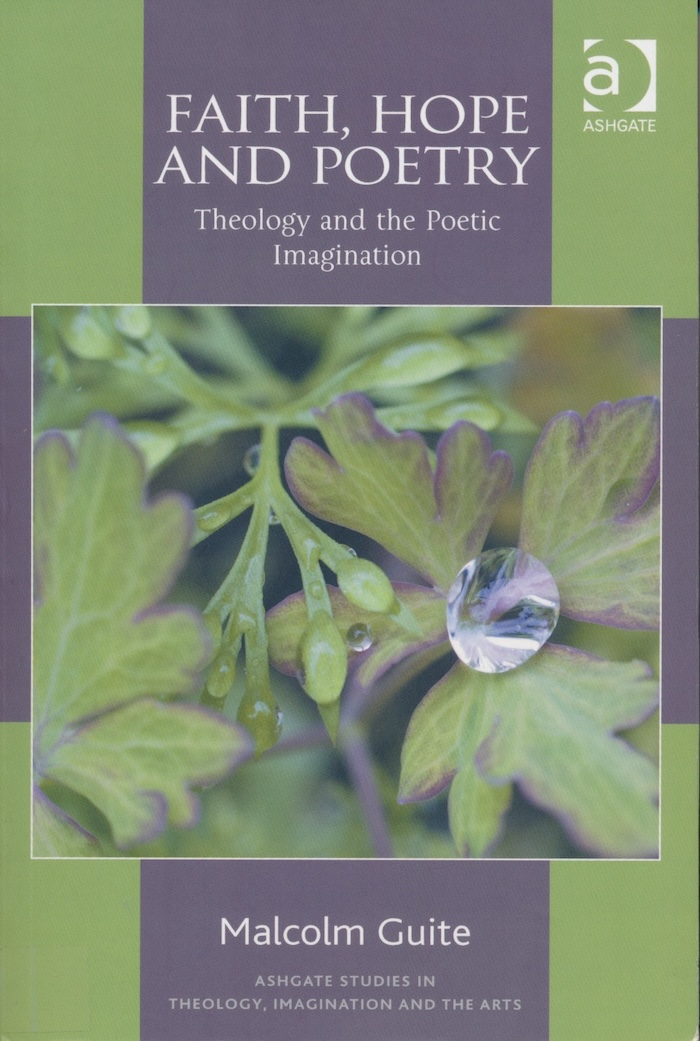
In the Introduction to his 2010 book, Faith, Hope and Poetry: Theology and the Poetic Imagination (Ashgate, 2010), Malcolm Guite makes the case for poetry “as a redress or a restoration of lost balance in vision” in Western culture.
“In order to discern why modern Western culture has lost vision, why there is an imbalance that needs to be redressed, we have to look back to the great cultural shift that occurred during the Enlightenment, ushering in a mistrust and marginalization of imaginative and poetic vision and a particular suspicion of the ambivalence or multivalent language of poetry. Instead of acknowledging, as many thinkers do now, that the way we know, the language through which we know, may be an essential and helpful part of knowledge itself, some philosophers of the Enlightenment thought that image and imagination simply clouded and obscured the pure dry knowledge that they were after. This attitude is often traced back rhetorically to Francis Bacon, who wrote that: ‘For all that concerns ornaments of speech, similitudes, treasury of eloquence, and such like emptinesses, let it be utterly dismissed.’ Nonetheless Bacon himself cannot say anything without constantly availing himself of metaphor and symbol, nor can there be any scientific discourse without it. . . . Others would trace this splitting of knowledge to Descartes’s dividing of the world between res extensa and res cogitans, a dualism from which science and philosophy are only just recovering. It is not my purpose to pursue this split to its ultimate philosophical source but rather to observe the ways in which it became current, affected the way people thought, wrote and read, and continues to affect them still. For this purpose it is better to look at more influential texts, which popularized the thought of Bacon and Descartes. The formation of the Royal Society was absolutely central to the development of English life and thought in and through the Enlightenment, and the Royal Society took a clear stand against poetry and the poetic imagination as ways of coming at truth. And here Thomas Sprat’s History of the Royal Society — really its manifesto — is a seminal text. Spratt urged his readers ‘to separate the knowledge of Nature, from the colors of Rhetoric, the devices of Fancy or the delightful deceit of Fables’.
“This advice, indeed the whole Enlightenment project that it represents, is in very sharp contrast to the wisdom of the previous age, which was rooted in the idea that fables, stories and myths were the medium that most completely embodied the deepest truths we need to know. Thus most of the wisdom of the ancient world, both Judeo-Christian and Classical, was embodied in myth, story and song. The notion of telling a fable in order to get at a truth went very deep indeed, and emerges, for example, even in the lighthearted exchange between Audrey and Touchstone the fool in As You Like It, though it should be said that Shakespeare, with a true understanding of the cross, always puts his greatest wisdom in the mouths of fools:
Audrey: I do not know what ‘poetical’ is. Is it honest in deed and word? Is it a true thing?
Touchstone: No, truly; for the truest poetry is the most fainting . . .
“Sprat’s attack was not only on story but also on the poetry of image and metaphor; he goes on to demand:
a close, naked, natural way of speaking, positive expressions, clear senses, a native easiness, bringing all things as near the mathematical plainness as they can, and preferring the language of the artisans, countrymen and merchants before that of wits and scholars.
“The new philosophers and scientists had declared war on the imagination, and the consequence of that war was a kind of cultural apartheid: the entire realm of ‘objective’ truth was to be the exclusive terrain of Reason at its narrowest — analytic, reductive, atomizing; and the faculties of Imagination and Intuition, those very faculties that alone were capable of integrating, synthesising and making sense of our atomized factual knowledge, were relegated to a purely private and ‘subjective’ truth. If it cannot be weighed and measured, these men were saying, it is not really there. How prophetic Blake, the great rebel against this division, was when he wrote:
‘What’, it will be Question’d, ‘when the Sun rises, do you not see a round disk of fire somewhat like a Guinea?’ Oh no, no, I see an Innumerable company of the Heavenly host crying, Holy, holy, holy is the Lord God Almighty.
“It was not just poetry that was under attack. This new arrangement affected everything, including the Christian faith, which was forced to choose sides in this divide, either to be relegated to something subjective, not there, essentially made up, or to become a pseudo-science, reducing the great mysteries embedded in the ancient story-telling of Scripture to quantifiable exactitudes, patient only of a literal interpretation. Theology felt itself forced to choose between an increasingly vague and amorphous liberalism, happy to keep reinventing the faith, and an increasingly strident fundamentalism, which tries to treat the vast subtle poem of Scripture as a single scientific treatise whose every word is literally and only literally true. As Coleridge brilliantly expressed it, writing in the early nineteenth century when this process was already well underway:
A hunger-bitten and idea-less philosophy naturally produces a starveling and comfortless religion. It is among the miseries of the present age that it recognizes no medium, between Literal and Metaphorical. Faith is either to be buried in the dead letter, or its name and honours usurped by a counterfeit product. . . .”
Malcolm Guite talked about Coleridge’s belief that the mind of the Creator and the minds of God’s image-bearers share an essential correspondence on Volume 144 of the Journal.
Related reading and listening
- Knowing and living our metaphysical totality — Clyde Kilby on the power of myth to bring together “the slender hints of the knowable”
- Savoring the taste of Reality — C. S. Lewis on the transporting, illuminating capacity of Myth
- When myth becomes fact — In this 1976 interview, Clyde Kilby (1902–1986) discusses C. S. Lewis’s critique of scientism and rationalism, his belief in the primacy of the imagination, and his mythic vision. (37 minutes)
- Reason and the love of truth — FROM VOL. 97 James Peters discusses historical understandings of reason and rationality and how they differ from the modern notion of rationality. (21 minutes)
- The epistemology of love — In this lecture, N. T. Wright examines the epistemology of love and how it counters the reductionism of Enlightenment and Epicurean ways of knowing. (63 minutes)
- Cultural superiority and Medieval romance literature — FROM VOL. 164 Tiffany Schubert argues that Jane Austen’s novels subtly incorporate some medieval literary conventions in ways that enable modern readers to experience a sense of wonder, romance, and the benevolence of Providence. (30 minutes)
- Theology and the imagination — Jeffrey Barbeau explains what made C. S. Lewis an effective “translator” of theology for non-theologians. (21 minutes)
- The pathos of sin — FROM VOL. 15 Poet Robert Pinsky discusses his translation of Dante’s Inferno. (9 minutes)
- Existential preparation for reading literature — FROM VOL. 128 Rod Dreher recounts how he thought he was reading Dante’s Commedia, when in reality the poem was reading him. (18 minutes)
- An icon of the whole world — Jason Baxter explains how Dante includes a panoply of characters and creatures in his Comedia, offering a prismatic view of all of Creation in its glory. (20 minutes)
- Moral reasoning and human flourishing — Tim McIntosh describes moral philosopher Alasdair MacIntyre’s intellectual conversion to a synthesis of Aristotelian ethics and Christianity, best embodied in Thomism. (44 minutes)
- The “sovereign uselessness of moral reflection” — Calling on the wisdom of St. Augustine, Oliver O’Donovan reminds his listeners that all knowledge participates in the eternal Logos of God and is rooted in love, not disinterested moral judgement.(Lecture 1 of 3; 52 minutes)
- Beyond a reasonable doubt — From a 1980 interview with Ken Myers, Mortimer J. Adler discusses his argument that belief in the existence of God is rational. (14 minutes)
- Guite, Malcolm — FROM THE GUEST PAGE: Malcolm Guite is a poet and priest who lectures widely in England and North America on theology and literature and has published poetry, theology, and literary criticism.
- An invitation to a feast — Christina Bieber Lake explains how poetry is an invitation to experience the beauty and goodness of Creation as gift. (44 minutes)
- Sacred and Profane Love: Graham Greene and the Catholic Imagination — Katy Carl discusses novelist Graham Greene’s fiction and spiritual struggles in light of the concept of the Catholic imagination. (49 minutes)
- Universities as the hosts of reciprocating speech — Robert Jenson on how the Christian understanding of Truth in a personal Word shaped the Western university
- Showing as meaning — Daniel McInerny on how the arts convey meaning
- “A man after reality” — FROM VOL. 30 Clyde Kilby discusses C. S. Lewis‘s critique of scientism and rationalism, and his belief in the primacy of the imagination. (15 minutes)
- Knowing and doing the good — Oliver O’Donovan raises several key questions and complications involved in the task of taking concrete and practical action toward a recognized moral good. (Lecture 3 of 3; 63 minutes)
- Attentiveness to the world, the self, and time — Oliver O’Donovan uses the metaphor of waking to discuss the concept of moral sensibility as attention to the world, the self, and time. (Lecture 1 of 3; 60 minutes)
- A life well lived — In this essay, Stanley Hauerwas explains the breadth and depth of Alasdair MacIntyre’s thought, the goal of which was to help people to act intelligibly and live morally worthy lives. (40 minutes)
- How the Enlightenment blinded us — Alasdair MacIntyre on the dependence of rationality on a lived tradition
- Poetry and Liturgy — Karen Dieleman explores the influence of liturgical practices on shaping the imaginations and poetry of Elizabeth Barrett Browning, Christina Rossetti, and Adelaide Proctor. (49 minutes)
- The Transformed Vision of Samuel Taylor Coleridge — Poet Malcolm Guite explores the dramatic and even prophetic parallels between the life of Samuel Taylor Coleridge and that of the titular character in his famous poem “The Rime of the Ancient Mariner.” (59 minutes)
- Politics and the good — FROM VOL. 160 D. C. Schindler argues that political order cannot be disentangled from the social, and that fundamental questions of what humans are and what the good is cannot be bracketed from politics. (30 minutes)
- The dramatic ecstasy of reason — FROM VOL. 120 D. C. Schindler argues that the Enlightenment was not wrong for giving too much to reason; it was wrong in endorsing an impoverished conception of reason. (19 minutes)
- Sacramental Poetics — Poet and Eastern Orthodox believer Scott Cairns explains how a good poem functions like an icon: it assists the process of our becoming aware of what is real, and it is generative in the ways it keeps opening up new understandings. (56 minutes)
- Poetry and piety — FROM VOL. 48 James Trott discusses insights he learned while editing A Sacrifice of Praise: An Anthology of Christian Poetry in English from Caedman to the Mid-Twentieth Century. (7 minutes)
- A poet’s relationship to time — FROM VOL. 57 Poet Wilmer Mills (1969–2011) discusses how his agricultural and cross-cultural childhood in Brazil shaped his imagination and his relationship with modernity. (11 minutes)
- The life of the city in poetry — FROM VOL. 1 Ken Myers talks with W. H. Auden’s biographer and literary executor, Edward Mendelson, about political and social themes in Auden’s poetry. (7 minutes)
- Joy & sorrow, destitution & abundance — In this poetry reading and talk, poet Christian Wiman discusses his own faith journey and how his struggles worked themselves into his poems. (40 minutes)
- Seeing Creation Anew: The Life & Poetry of Gerard Manley Hopkins — Dana Gioia examines Gerard Manley Hopkins‘s poetic genius and dedication to Christ in spite of his personal trials and difficult cultural context. (55 minutes)
- “The essence of a moment, clearly perceived” — Haiku poet Gary Hotham reads his poetry and discusses how the form of haiku reveals the connection between creatures and creation. (45 minutes)
- The joy and mystery of poetry — FROM VOL. 98 Jeanne Murray Walker discusses how she helps students approach and appreciate poetry as the mysteriously meaningful literature it is, rather than as a linguistic cage containing static meaning to be abstracted from the words of the poem. (23 minutes)
- The idiom for the revelation of mystery — Dana Gioia on the foundational place of poetry in Christian faith
- Breaking the frozen sea — Dana Gioia on how poetry enchants
- John Donne’s Passion in Life, Faith, & Verse — Poet Dana Gioia discusses the remarkable life of poet John Donne and how his spiritual and intellectual struggles created the conditions for his unique poetic voice. (53 minutes)
- Longfellow’s appeal — FROM VOL. 53 Poet and critic Dana Gioia explains why Henry Wadsworth Longfellow (1807-1882) is one of the three great American poets. (30 minutes)
- Sacramental correspondence — FROM VOL. 51 Poet Dana Gioia discusses the state of contemporary poetry and the sacramental relationship between language and reality. (15 minutes)
- Flannery at 100 — In honor of Flannery O’Connor’s 100th birthday, we have gathered here an aural feast of interviews with O’Connor scholars and aficionados discussing her life, work, and faith. (3 hours, 28 minutes)
- Ideas made incarnate — In this lecture, Karen Swallow Prior examines the power of great literature to shape lives, nourish imaginations, and develop a vision of the good life. (43 minutes)
- Wonder, being, skepticism, and reason — FROM VOL. 135 Matthew Levering talks about the long and rich tradition of reasoning about God. (23 minutes)
- The need to recollect ourselves as whole persons — In this 2016 lecture, John F. Crosby explores key personalist insights found in the thinking of John Henry Newman and Romano Guardini. (60 minutes)
- “A sign of contradiction” — In this lecture, Daniel Gibbons compares and contrasts understandings of sacramental poetics proposed by Augustine, Aquinas, and Sydney. (36 minutes)
- Knowing by heart — D. C. Schindler reflects on Plato’s idea of “conversion” in education, assuming the symbol of the heart as the center of man. (39 minutes)
- Education as a pilgrimage and a mystery — In this lecture, James Matthew Wilson gives a compelling argument for understanding the role of a literary or poetic education as an immersion of the whole being in truth and beauty. (43 minutes)
- When philosophy loses its way — FROM VOL. 52 Ralph McInerny (1929–2010) speaks about themes from his 1999 Gifford Lectures, which relate how natural theology came to be regarded as pointless, resulting in a philosophical dead end.(24 minutes)
- A prophetic “wake-up call” — In this 2024 lecture honoring the bicentennial of George MacDonald’s birth, Malcolm Guite explores MacDonald’s power to awaken readers’ spirits and effect in them a change of consciousness. (59 minutes)
- Perceiving truths that dazzle gradually — Rolland Hein on lessons from George MacDonald about the imagination as a spiritual faculty