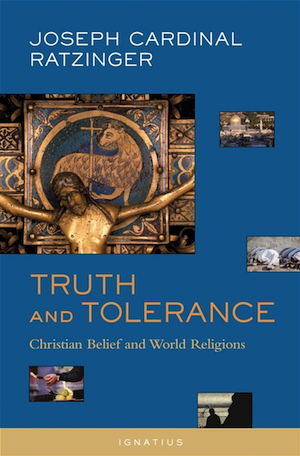
“In the consciousness of mankind today, freedom is largely regarded as the greatest good there is, after which all other good things have to take their place. In legislation, artistic freedom and freedom of speech take precedence over every other moral value. Values that conflict with freedom, that could lead to its being restricted, appear as shackles, as ‘taboos’, that is to say, as relics of archaic prohibitions and anxieties. Political action has to demonstrate that it furthers freedom. Even religion can make an impression only by depicting itself as a force for freedom for man and for mankind. In the scale of values with which man is concerned, to live a life worthy of humanity, freedom seems to be the truly fundamental value and to be the really basic human right of them all. The concept of truth, on the other hand, we greet rather with some suspicion: we recall how many opinions and systems have already laid claim to the concept of truth; how often the claim to truth in that way has been the means of limiting freedom. In addition there is the scepticism fostered by natural science regarding anything that cannot be precisely explained or demonstrated: that all seems in the final analysis to be just subjective judgment, which cannot claim to be obligatory for people in general. The modern attitude to truth shows itself most succinctly in Pilate’s words: What is truth? Anyone who claims to be serving truth with his life, and with his words and actions, must be prepared to be regarded as an enthusiast or a fanatic. For ‘Our line of sight to all above is blocked’; this quotation from Goethe’s Faust sums up the way we all feel about it.
“There is no doubt that we have reason enough, in the face of a sentimental and all-too-confident claim to truth, to ask: What is truth? Yet we have just as much reason to put the question: What is freedom? What do we actually mean when we praise freedom and set it on the highest level of our scale of values? I believe that the content generally associated with the demand for freedom is most accurately described in the words Karl Marx once used to express his dream of freedom. The state of affairs in the future Communist society will make it possible ‘to do one thing today, another tomorrow, to go shooting in the morning and fishing in the afternoon and in the evening look after the cattle, to indulge in criticism after dinner, just as the fancy takes me’. It is just in this way that the average attitude, without thinking about it, understands by ‘freedom’ the right, and the practical possibility, of doing everything we wish and not having to do anything we do not wish to do. Putting it another way, freedom would mean that our own will was the only criterion for our action and that this will would be able to want to do anything and also be able to put into practice anything it wanted. At this point the question arises, of course: How free in fact is our Will? And how rational is it? — And, is an irrational will truly a free will? Is irrational freedom truly freedom? Is it really a good thing? Does not the definition of freedom, as being able to decide to do anything and being able to do what we decide, have to be expanded to include the connection with reason, with mankind as a whole, in order to avoid becoming tyranny and unreason? And will not seeking for the common reason of all men, and thus the mutual compatibility of freedoms, be a part of the interplay of reason and the will? It is obvious that the question of truth is concealed within the question of the rationality of the will and its relation to reason.”
— from Joseph Cardinal Ratzinger, Truth and Tolerance: Christian Belief and World Religions (Ignatius Press, 2003)
Related reading and listening
When myth becomes fact — In this 1976 interview, Clyde Kilby (1902–1986) discusses C. S. Lewis’s critique of scientism and rationalism, his belief in the primacy of the imagination, and his mythic vision. (37 minutes)
James Peters discusses historical understandings of reason and rationality and how they differ from the modern notion of rationality. (21 minutes)
The inward eye, cosmic truth, and making well — Andrew Kern takes his listeners along an “interlinear” reading of a portion of St. Augustine’s Confessions that explores the differences between how God makes and how we create. (38 minutes)
James Matthew Wilson talks about how cultivating the desire to perceive the interior life of things sustains the basic human capacity for recognizing truth, pursuing wisdom, and contemplating beauty. (23 minutes)
The “sovereign uselessness of moral reflection” — Calling on the wisdom of St. Augustine, Oliver O’Donovan reminds his listeners that all knowledge participates in the eternal Logos of God and is rooted in love, not disinterested moral judgement.(Lecture 1 of 3; 52 minutes)
Beyond a reasonable doubt — From a 1980 interview with Ken Myers, Mortimer J. Adler discusses his argument that belief in the existence of God is rational. (14 minutes)
Secularization and anarchy — Joseph Cardinal Ratzinger on the necessary connection between law, ethics, and worship
Shared Practices, Strong Communities — Christine Pohl reflects on why a deliberate commitment to certain shared practices is necessary for the sustaining of community. (57 minutes)
How the Church promotes the cause of freedom — Oliver O’Donovan: “We discover we are free when we are commanded by that authority which commands us according to the law of our being, disclosing the secrets of the heart.”
The danger of not defining “freedom” — Richard Bauckham insists that an adequate understanding of freedom requires recognition of God as the ground of true human freedom
Power to the people — Nathan O. Hatch on the DIY spirit of early American Christianity
Free for obedience — Glenn W. Olsen on Augustine’s understanding of freedom
Knowing and doing the good — Oliver O’Donovan raises several key questions and complications involved in the task of taking concrete and practical action toward a recognized moral good. (Lecture 3 of 3; 63 minutes)
Attentiveness to the world, the self, and time — Oliver O’Donovan uses the metaphor of waking to discuss the concept of moral sensibility as attention to the world, the self, and time. (Lecture 1 of 3; 60 minutes)
A life well lived — In this essay, Stanley Hauerwas explains the breadth and depth of Alasdair MacIntyre’s thought, the goal of which was to help people to act intelligibly and live morally worthy lives. (40 minutes)
The Transformed Vision of Samuel Taylor Coleridge — Poet Malcolm Guite explores the dramatic and even prophetic parallels between the life of Samuel Taylor Coleridge and that of the titular character in his famous poem “The Rime of the Ancient Mariner.” (59 minutes)
D. C. Schindler argues that political order cannot be disentangled from the social, and that fundamental questions of what humans are and what the good is cannot be bracketed from politics. (30 minutes)
D. C. Schindler argues that the Enlightenment was not wrong for giving too much to reason; it was wrong in endorsing an impoverished conception of reason. (19 minutes)
The profound drama of human sexuality — In this lecture, D. C. Schindler explains the cosmological significance of human sexuality and why it is paradigmatic of the relationship between nature and freedom. (32 minutes)
Jeanne Murray Walker discusses how she helps students approach and appreciate poetry as the mysteriously meaningful literature it is, rather than as a linguistic cage containing static meaning to be abstracted from the words of the poem. (23 minutes)
Mars Hill Audio Journal, Volume 164 — FEATURED GUESTS: Dana Gioia, Brady Stiller, Robert Royal, Richard DeClue, Tiffany Schubert, and Joonas Sildre
Matthew Levering talks about the long and rich tradition of reasoning about God. (23 minutes)
The need to recollect ourselves as whole persons — In this 2016 lecture, John F. Crosby explores key personalist insights found in the thinking of John Henry Newman and Romano Guardini. (60 minutes)
Gratitude, vitalism, and the timid rationalist — In this lecture, Matthew Crawford draws a distinction between an orientation toward receiving life as gift and a timid and cramped rationalism that views man as an object to be synthetically remade. (52 minutes)
“A sign of contradiction” — In this lecture, Daniel Gibbons compares and contrasts understandings of sacramental poetics proposed by Augustine, Aquinas, and Sydney. (36 minutes)
A prophetic “wake-up call” — In this 2024 lecture honoring the bicentennial of George MacDonald’s birth, Malcolm Guite explores MacDonald’s power to awaken readers’ spirits and effect in them a change of consciousness. (59 minutes)
Eugene Peterson talks about how Jesus spent most of his time speaking normally and conversationally, and how the Spirit infused this normal speech. (14 minutes)
William Cowper: Reconciling the Heart with the Head — Daniel E. Ritchie discusses the life and work of poet William Cowper (1731–1800), comparing his commitment to understanding reality through personal knowledge, intuition, and rigorous contemplation with the thought of Michael Polanyi. (43 minutes)
Why liberalism tends toward absolutism — In this lecture, Michael Hanby examines what causes liberalism to become dictatorial in thought and practice. (49 minutes)
No neutral view of the cosmos — Ken Myers argues that Christians need to recover a “whole-earth discipleship” that enables them to think Christianly about all areas of life, including public life. (50 minutes)
When is a market “free”? — William T. Cavanaugh argues for a richer conception of freedom than the reductionist one promoted by economist Milton Friedman. (44 minutes)
Historian Christopher Shannon discusses how American academic historical writing presents a grand narrative of progressivism, which it defends by subscribing to an orthodoxy of objective Reason. (21 minutes)
The gift of objective reality — Moral philosopher Oliver O’Donovan makes an argument for the consistency of the idea of law when it is conceived in a theological context. (40 minutes)
Freedom as conformity to reality — W. Bradford Littlejohn summarizes the definitions of liberty offered by Richard Bauckham and Oliver O’Donovan