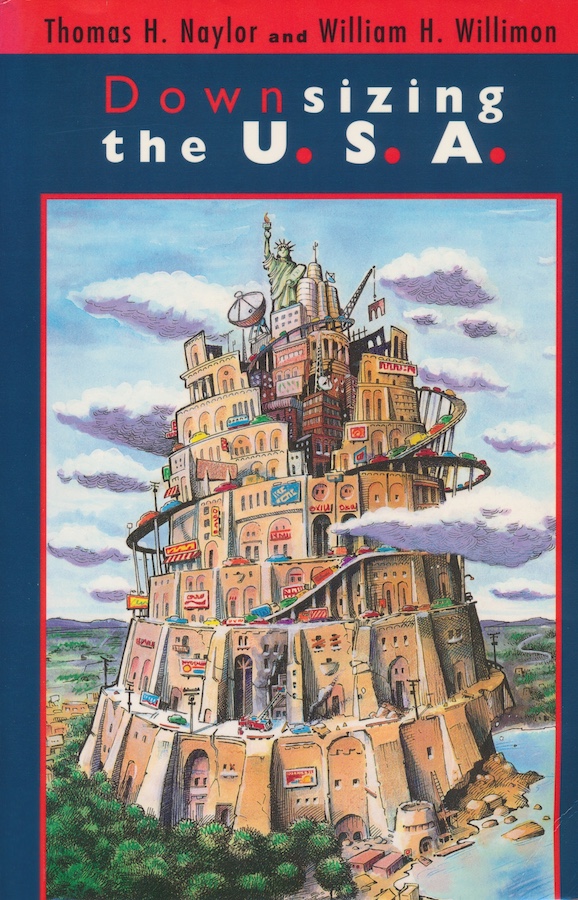
“[I]n this book, our concern for the harmful effects of large institutions arises not so much from our concern for individual freedom but rather out of our concern for the well-being of the community. Governments, as we have known them in this century, have a nasty habit of bringing order but destroying community, of forcefully yoking people together, but of destroying interconnectedness.
“While there is much that we like in Robert Nozick’s Anarchy, State, and Utopia, Nozick, like many anarchists before him, depicts society as a collection of individuals who, from time to time, out of their own self-interest come together to cooperate with one another. In an odd sense, there is a connection between modernity’s much-praised free individual and the totalitarian states which have made this century infamous.
“A great deceit fostered by modern society is that modern government treats us as ‘individuals’ — sovereign, isolated persons. Modern democracy found that by rendering all of us into ‘individuals’ — free-standing, isolated, autonomous units detached from community, tribe, and neighborhood — we were easier to manage and manipulate. The isolated individual, standing alone, disconnected from tribe, neighborhood, or family, proved to be no match for the totalitarian tendencies of the modern state.
“In his provocative 1979 essay ‘The Power of the Powerless’ portraying life in communist Czechoslovakia, Václav Havel describes life in liberal democracies such as the United States:
“It would appear that the traditional parliamentary democracies can offer no fundamental opposition to the automation of technological civilization and the industrial-consumer society, for they, too, are being dragged helplessly along by it. People are manipulated in ways that are infinitely more subtle and refined than the brutal methods used in the post-totalitarian societies. But this static complex of rigid, conceptually sloppy and politically pragmatic mass political parties run by professional apparatuses and releasing the citizen from all forms of concrete and personal responsibility; and those complex foci of capital accumulation engaged in secret manipulations and expansion; the omnipresent dictatorship of consumption, production, advertising, commerce, consumer culture, and all that flood of information: all of it, so often analysed and described, can only with great difficulty be imagined as the source of humanity’s rediscovery of itself. In his June 1978 Harvard lecture, Solzhenitsyn describes the illusory nature of freedoms not based on personal responsibility and the chronic inability of the traditional democracies, as a result, to oppose violence and totalitarianism. In a democracy, human beings may enjoy many personal freedoms and securities that are unknown to us, but in the end they do them no good, for they too are ultimately victims of the same automatism, and are incapable of defending their concerns about their own identity or preventing their superficialization or transcending concerns about their own personal survival to become proud and responsible members of the polis, making a genuine contribution to the creation of its destiny.
“We have therefore discovered the irony that true freedom is dependent upon community. I know what I want, what wants are worth having, only in community where I receive the training, acquire the habits, learn the history, and gain self-knowledge to the point whereby I can lay hold of my life and name who I am and where I am going. My ‘I’ is not an individual achievement but rather the gift, the product of a community which helps to name me, place me, value me, and tell me who I am.
“Liberal democracies have been willing to tolerate great economic inequalities in exchange for their protection of individual ‘freedom.’ Liberty may mask other forms of domination. The question is not so much, Are we free? but rather, What is the purpose, the end, of our freedom? We have thought it possible to have a society where people are given freedom to exercise their ‘rights,’ without an argument about which rights are worth having and toward what end the exercise of our various rights is moving us.
“In The Needs of Strangers, Michael Ignatieff argued that most contemporary political philosophy speaks of ‘justice’ as an individual problem. The needs of groups and communities are subordinated to sets of individual needs. Yet more than this, Ignatieff says contemporary political philosophy is worse than too individualistic. In lacking any account of the good, we are led to believe that all of our individual needs are worth meeting, that all of our desires are our rights. If I feel a desire, then that desire is elevated to the level of a need, which is further elevated to the level of an essential right.
“The societies created by this account of human beings as bundles of boundless needs to be met tend to be societies free of constraints upon the needs of individuals within them. Both liberal-capitalistic and Marxist societies tend to be imperialistic, telling members of those societies that the government can deliver all that the individuals’ hearts desire. Government exists to reward our unrealistic expectations. Thus, government has become our God.”
— from Thomas H. Naylor and William H. Willimon, Downsizing the U.S.A. (Eerdmans, 1997)
Related reading and listening
- Radical faith in the nothing — David Bentley Hart on the nihilism of worshiping mere choice
- Volume 67 excerpts — Hear excerpts from interviews with Eric Jacobsen, Allan Carlson, R. R. Reno, Terence Nichols, David Bentley Hart, J.A.C. Redford, and Scott Cairns. (34 minutes)
- Knowledge as encounter — In this extended conversation from 2013, D. C. Schindler discusses what it would mean to restore reason to its fullness from its current impoverished conception. (40 minutes)
- A call to counter-revolution — Jeanne Schindler argues that three key technological inventions — the car, central heating, and digital devices — have contributed, respectively, to the loss of “at-homeness” people experience in the city, the home, and within ourselves. (50 minutes)
- Wisdom on education, virtue, and membership — This Feature honors the life and legacy of Wendell Berry (1934–2026) with excerpts from interviews with Jeffrey Bilbro, Jack Baker, Michael Stevens, and J. Matthew Bonzo. (20 minutes)
- Fragmenting forces in modern life — FROM VOL.95 J. Matthew Bonzo and Michael R. Stevens discuss themes from their book on the life and thought of Wendell Berry. (13 minutes)
- The academy’s deconstruction of both person and community — Marion Montgomery on cultivating “a deportment of intellect governed by a continuing concern for the truth of things”
- Reality and the relations that constitute us — Reuben Slife discusses key concerns in the work of David L. Schindler (1943–2022). 31 (minutes)
- Implications of an “absent” God — David L. Schindler (1943–2022) explores the implications for a civilization that discards the reality that being is grounded in God. (66 minutes)
- Openness, welcome, listening to God — Jean Vanier on the shape of love in community
- Reflecting God’s graciousness to strangers — Christine Pohl on the character of hospitable communities
- “Your life is a miracle” — In this lecture, L. M. Sacasas questions whether Byung-Chul Han’s critique of modern life as a “burnout society” is still accurate. (40 minutes)
- Nietzsche, technology, and desire — Steven Knepper and Robert Wyllie discuss philosopher Byung-Chul Han’s thought on Nietzsche and on the effects of digital media on concepts of freedom, desire, and receptivity to others. (14 minutes)
- Paradoxes of “nature” and “culture” — Robert Spaemann, on the destructive consequences of a merely naturalistic understanding of nature
- Reason and the love of truth — FROM VOL. 97 James Peters discusses historical understandings of reason and rationality and how they differ from the modern notion of rationality. (21 minutes)
- The primacy of the Body of Christ — FROM VOL. 134 Philip Turner reflects on how Christian ethics is misplaced if it has as its central concern individual moral behavior or social justice. (28 minutes)
- How communities remember who they are — Oliver O’Donovan on the necessity of tradition in sustaining communal identity
- How common loves shape communities — Oliver O’Donovan discusses how communities mediate love and knowledge to their members and what challenges arise as a community’s traditions are confronted by sin, error, and plurality. (Lecture 2 of 3; 49 minutes)
- Money, status, and satisfaction — FROM VOL. 44 David Myers and Robert Frank discuss the tenuous relationship between wealth and happiness. (22 minutes)
- Landscape and living memory — FROM VOL. 44 Gayle Brandow Samuels examines the ways in which trees have served as anchor-points for memory and identity in American culture. (9 minutes)
- Thinking Together — Alan Jacobs discusses some principles he’s compiled to help us think well (and charitably) in our cultural context, and he warns us to be attentive to the ways technology displaces previously fixed communities. (53 minutes)
- Mars Hill Audio Journal, Volume 165 — FEATURED GUESTS: Jeffrey Bilbro, Daniel McInerny, Joseph Minich, Carl Elliott, Nadya Williams, and Don W. King
- What are students for? — FROM VOL. 140 Drawing from Wendell Berry’s works, Jack Baker and Jeffrey Bilbro discuss a vision of higher education that respects a multidimensional notion of place. (23 minutes)
- Real Food, Real Communities — Corby Kummer extols the virtues of the Slow Food movement, which seeks to honor, protect, and sustain traditional foods and ingredients from specific cultures and regions. (48 minutes)
- Clips from five extended interviews — We are pleased to share clips from five interviews that we’ve recently produced as full-length Conversations. (30 minutes)
- Shared Practices, Strong Communities — Christine Pohl reflects on why a deliberate commitment to certain shared practices is necessary for the sustaining of community. (57 minutes)
- How the Church promotes the cause of freedom — Oliver O’Donovan: “We discover we are free when we are commanded by that authority which commands us according to the law of our being, disclosing the secrets of the heart.”
- What is beyond our choosing? — D. C. Schindler on our nihilistic quest for freedom
- The danger of not defining “freedom” — Richard Bauckham insists that an adequate understanding of freedom requires recognition of God as the ground of true human freedom
- Power to the people — Nathan O. Hatch on the DIY spirit of early American Christianity
- Free for obedience — Glenn W. Olsen on Augustine’s understanding of freedom
- What Ockham severed — Jean-Charles Nault on the advent of sheer freedom
- “The search for shared ends” — Oliver O’Donovan examines whether and to what extent there might be the possibility of a unifying Christian perspective on political doctrine or policy. (59 minutes)
- Antagonism or fruitfulness? — FROM VOL. 108 Jean Porter describes how natural law justifies legal and moral authority within the life of the human person. (17 minutes)
- The collapse of public life — FROM VOL. 154 D. C. Schindler explains how liberalism sought to make way for individuals to function together without any orientation to an explicit common good. (37 minutes)
- The profound drama of human sexuality — In this lecture, D. C. Schindler explains the cosmological significance of human sexuality and why it is paradigmatic of the relationship between nature and freedom. (32 minutes)
- Mars Hill Audio Journal, Volume 164 — FEATURED GUESTS: Dana Gioia, Brady Stiller, Robert Royal, Richard DeClue, Tiffany Schubert, and Joonas Sildre
- The personal element in all knowing — Mark Mitchell connects key aspects of Michael Polanyi’s conception of knowledge with Matthew Crawford’s insistence that real knowing involves more than technique. (34 minutes)
- Impact of “infotainment” on community — Neil Gabler and C. John Sommerville discuss how the mentalities conveyed by our experience with communications media work against the nurturing of community. (36 minutes)
- The digital revolution and community — FROM VOL. 7 Ken Myers talks with Jane Metcalfe, the founder of WIRED Magazine, about technology and community. (8 minutes)
- Education that counters alienation — In this lecture, Jeanne Schindler explores how digital technologies warp not only education but our experience of being human. (30 minutes)
- Courtesy as a theological issue — FROM VOL. 37 Donald McCullough discusses his insights into the increasingly coarse nature of society and the theological foundations for courtesy. (12 minutes)
- Why liberalism tends toward absolutism — In this lecture, Michael Hanby examines what causes liberalism to become dictatorial in thought and practice. (49 minutes)
- When is a market “free”? — William T. Cavanaugh argues for a richer conception of freedom than the reductionist one promoted by economist Milton Friedman. (44 minutes)
- The historian’s communal role as storyteller — FROM VOL. 127 Historian Christopher Shannon discusses how American academic historical writing presents a grand narrative of progressivism, which it defends by subscribing to an orthodoxy of objective Reason. (21 minutes)
- The gift of objective reality — Moral philosopher Oliver O’Donovan makes an argument for the consistency of the idea of law when it is conceived in a theological context. (40 minutes)
- Friendship and life together — In a lecture at Providence College, Ken Myers explores how the concept of friendship, which used to be central to political philosophy, was banished from considerations of public life as the state was exalted over society. (53 minutes)
- Freedom as conformity to reality — W. Bradford Littlejohn summarizes the definitions of liberty offered by Richard Bauckham and Oliver O’Donovan
- The Life was the Light of men — In a lecture from 2018, Ken Myers contrasts the Enlightenment’s understanding of reason with the Christocentric conception of reason. (57 minutes)
- The dance of law and freedom — Calvin Stapert on the experience of joyous order in Bach’s music
Click on the tags below for listings of related readings or audio features.