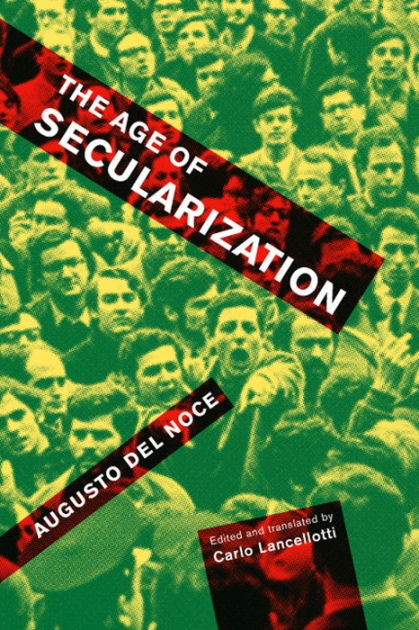
“A few days ago, I happened to read for the first time with open eyes book XII, De Scientia et Sapientia, of St Augustine’s De Trinitate. I will confess my shock and my surprise: I found in the pages written by this saint, so distant from the spatial and temporal coordinates of our age, the most perfect description of the age in which we are living. I don’t think it is naive or paradoxical at all to say that the many books about the crisis that have piled up, from Spengler to the present, lead us back to read this Augustinian text.
“I said at the start that I did not intend to discuss the concepts of traditionalism and progressivism in the abstract, but in the sense that they take today, inserted in the current historical context. Now, after we have examined the progressive view of tradition, De Trinitate offers us the criterion to look at the present situation from the standpoint of traditional values. What traditionalism may have meant in other epochs is a question that I am not going to consider now. Instead, what I am saying is that we have to look at book XII of De Trinitate to find the most precise definition of what it means today to recover tradition. What does St Augustine say? He distinguishes between the exterior man, who essentially is the subject of the human sciences, and the interior man, who is in contact with the eternal truths, which direct judgment and action. Left to its own devices, thought would just turn to seek the intelligible realities, pure contemplation. We have here the meaning of the primacy of contemplation, which is the core thesis of traditional thought. And let progressives feel free to understand traditionalism as exterior transmission of pre-cooked formulas and behaviors dictated by mere conformism. Why be polemical, after all? A characteristic of progressivism is that it cannot account for history, and this to the precise extent that it claims to speak in history’s name.
“According to St Augustine, thought left to itself would just turn to seek the intelligible realities, pure contemplation. But, on the other hand, the human soul is made to rule the body, and thus to live and act, and man in his earthly state finds himself directed towards ends that are not those of contemplation. Thus, reason, which per se is one, has two functions, and therefore two virtues, the active and the contemplative, Rachel and Leah, Martha and Mary. The pragmatic function of science was not unknown to St Augustine. But it is important to observe something else: higher and lower reason are just functions of the same reason. Forgetting this leads to the sanction of slavery, more or less hidden. These Augustinian passages would immediately lose meaning if they were used to embellish a colonial system, and unfortunately they have been used to that effect. Hence the diffidence that we see today — so common even among Catholics — against the term contemplation, almost as if it were the ideological basis for the distinction between freemen and slaves. It shows how much the habits of sociologistic thought have penetrated the common opinion. Let us just say that ‘primacy of contemplation’ means that there is a necessary, unchangeable, eternal truth shared by all spirits, superior to man and guiding his action. As such, it is the basis not for separation among social classes, but rather for spiritual unity.
“Two necessary functions for man. But man faces a choice regarding their hierarchic relationship. He can opt for the primacy of wisdom, for contemplation, for the divine ideas according to which he judges everything, and to which he submits himself in order to judge everything else by their standard. He can opt for lower reason, for sensible things, for domination above them, for exploitation of them, and this is the option for the primacy of science. Hence, the difference between science and wisdom depends on the nature of their objects. The object of wisdom is such that, because of its very intelligibility, any bad use is impossible; that of science is such that, because of its very materiality, it is constantly exposed to the danger of being prey to what St Augustine calls avaritia and cupiditas, giving these words roughly the same meaning. Indeed, science can be used well or badly. It can be subordinated to wisdom, or it can be subordinated to cupiditas. Let us translate this in modern terms: it is the question that judgments of value cannot be derived from the judgments of fact at which science has to stop. It is completely delusional to regard science as the rising value, for the simple reason that science cannot give values. ‘Now, science, any science, establishes relationships, does not give values. Relationships may well lead us to give value to some object, if they establish the conditional and causal dependence of a value from what becomes in turn a mediated value, precisely because of this connection. But the proton axion must be already given, posited, recognized as value in order to make possible any axiological judgment about what is in relationship with it.’ Who said these words? An Italian moral philosopher from a now-remote generation, of great value and yet not well known, Erminio Juvalta. He was close to positivism and initially keen on affirming a form of morality completely autonomous from metaphysics and from religion; and yet, he moved away from positivism exactly because of the affirmation that judgments of value are absolutely not derivable from science.
“But in this book St Augustine describes also the characteristics of the option to subordinate wisdom to science. So, it is not surprising that, in order to describe the dynamic by which the spirit gets attached to things to treat them as its end, he resorts to scripture, and that in this book philosophy and theology meet, and meet precisely in the discussion of original sin. The disposition by which the spirit gets attached to things to treat them as its end is the essence of cupiditas, and cupiditas is the opposite of charitas. Subordinating wisdom to science leads to the use of the whole for the sake of the individual; the domination of pure science, of science not subordinated to wisdom, leads to the pure anarchism that has been identified as one feature of today’s situation.
“Thus, the historical situation characterized by the primacy of science is perfectly predicted by St Augustine. It is a possible situation, but it cannot be interpreted as the rise of new ideals. Rather, it defines the sunset of ideals that is being demonstrated by the current process of dehumanization and that St Augustine describes as the victory of cupiditas over charitas. It is because a historical-political judgment branded the traditional ideals as dis-values that the idol of science established itself, bringing along its twin, the idol of progress. At most, one can reflect about science’s power as divertissement, in the sense that today its progress distracts from the pessimistic reflection that would be prompted by the negativist side of today’s millennialism.”
— from Augusto Del Noce, The Age of Secularization (McGill-Queen’s University Press, 2017), translated by Carlo Lancellotti.
Related reading and listening
- When myth becomes fact — In this 1976 interview, Clyde Kilby (1902–1986) discusses C. S. Lewis’s critique of scientism and rationalism, his belief in the primacy of the imagination, and his mythic vision. (37 minutes)
- The Bride of Christ — John Cavadini explores the different views of Origen and Augustine as to the nature and mission of the Church, and he calls for a recovery of the identity of the Church as the Bride of Christ. (38 minutes)
- Reason and the love of truth — FROM VOL. 97 James Peters discusses historical understandings of reason and rationality and how they differ from the modern notion of rationality. (21 minutes)
- The inward eye, cosmic truth, and making well — Andrew Kern takes his listeners along an “interlinear” reading of a portion of St. Augustine’s Confessions that explores the differences between how God makes and how we create. (38 minutes)
- Why the Department of War must be a Department of Peace — Daniel M. Bell, Jr. summarizes Augustine’s understanding of justice in warfare
- How communities remember who they are — Oliver O’Donovan on the necessity of tradition in sustaining communal identity
- How common loves shape communities — Oliver O’Donovan discusses how communities mediate love and knowledge to their members and what challenges arise as a community’s traditions are confronted by sin, error, and plurality. (Lecture 2 of 3; 49 minutes)
- The “sovereign uselessness of moral reflection” — Calling on the wisdom of St. Augustine, Oliver O’Donovan reminds his listeners that all knowledge participates in the eternal Logos of God and is rooted in love, not disinterested moral judgement.(Lecture 1 of 3; 52 minutes)
- Beyond a reasonable doubt — From a 1980 interview with Ken Myers, Mortimer J. Adler discusses his argument that belief in the existence of God is rational. (14 minutes)
- Technophiliac obsessions — FROM VOL. 141 Literary and media scholar Grant Wythoff talks about the “father of science fiction,” Hugo Gernsback. (26 minutes)
- City of God, City of Man — Architect Philip Bess discusses how our modern-day confusion and moral illiteracy are worked out visibly in the cities and buildings our architects create. (57 minutes)
- Universities as the hosts of reciprocating speech — Robert Jenson on how the Christian understanding of Truth in a personal Word shaped the Western university
- Free for obedience — Glenn W. Olsen on Augustine’s understanding of freedom
- The law of faith and of love — Oliver O’Donovan compares St. Augustine’s interpretation of Psalm 119 with that of others, revealing Augustine’s more nuanced understanding of the complexities of the life of faith that the psalmist explores. (64 minutes)
- “A man after reality” — FROM VOL. 30 Clyde Kilby discusses C. S. Lewis‘s critique of scientism and rationalism, and his belief in the primacy of the imagination. (15 minutes)
- Lives of generosity — Jonathan Wilson distinguishes between two fundamental ways of viewing Creation: a true Christian account of the world and a “survival of the fittest” one. (21 minutes)
- The demoralizing effect of pagan Roman religion — Oliver O’Donovan examines St. Augustine’s critique of pagan Roman religion in Book II of his treatise City of God and asks his audience to consider what insights Augustine’s critique has for us today. (Lecture 1 of 3; 51 minutes)
- Knowing and doing the good — Oliver O’Donovan raises several key questions and complications involved in the task of taking concrete and practical action toward a recognized moral good. (Lecture 3 of 3; 63 minutes)
- Attentiveness to the world, the self, and time — Oliver O’Donovan uses the metaphor of waking to discuss the concept of moral sensibility as attention to the world, the self, and time. (Lecture 1 of 3; 60 minutes)
- A life well lived — In this essay, Stanley Hauerwas explains the breadth and depth of Alasdair MacIntyre’s thought, the goal of which was to help people to act intelligibly and live morally worthy lives. (40 minutes)
- How the Enlightenment blinded us — Alasdair MacIntyre on the dependence of rationality on a lived tradition
- Cultivating the Virtue of Reverence — Paul Woodruff (1943–2023) discusses the importance of reverence as a virtue that enriches relationships, elevates civic life, and helps leaders to wield power wisely. (53 minutes)
- The Transformed Vision of Samuel Taylor Coleridge — Poet Malcolm Guite explores the dramatic and even prophetic parallels between the life of Samuel Taylor Coleridge and that of the titular character in his famous poem “The Rime of the Ancient Mariner.” (59 minutes)
- Politics and the good — FROM VOL. 160 D. C. Schindler argues that political order cannot be disentangled from the social, and that fundamental questions of what humans are and what the good is cannot be bracketed from politics. (30 minutes)
- The dramatic ecstasy of reason — FROM VOL. 120 D. C. Schindler argues that the Enlightenment was not wrong for giving too much to reason; it was wrong in endorsing an impoverished conception of reason. (19 minutes)
- Steward of knowledge vs. autonomous knower — FROM VOL. 66 Esther Lightcap Meek challenges the modernist view of knowledge, which prefers the figure of the autonomous knower to the figure of a steward of knowledge acquired in part from others. (15 minutes)
- Wonder, being, skepticism, and reason — FROM VOL. 135 Matthew Levering talks about the long and rich tradition of reasoning about God. (23 minutes)
- The need to recollect ourselves as whole persons — In this 2016 lecture, John F. Crosby explores key personalist insights found in the thinking of John Henry Newman and Romano Guardini. (60 minutes)
- On Eugenics in America — Christine Rosen explores early eugenics support in the early 1900s and current “participatory evolution” practices. (50 minutes)
- “Detachment as a whole way of life” — FROM VOL. 85 Professor Christopher Shannon discusses how early twentieth-century social scientists encouraged the American idea that individual identity works against communal membership. (17 minutes)
- Education as a pilgrimage and a mystery — In this lecture, James Matthew Wilson gives a compelling argument for understanding the role of a literary or poetic education as an immersion of the whole being in truth and beauty. (43 minutes)
- A prophetic “wake-up call” — In this 2024 lecture honoring the bicentennial of George MacDonald’s birth, Malcolm Guite explores MacDonald’s power to awaken readers’ spirits and effect in them a change of consciousness. (59 minutes)
- William Cowper: Reconciling the Heart with the Head — Daniel E. Ritchie discusses the life and work of poet William Cowper (1731–1800), comparing his commitment to understanding reality through personal knowledge, intuition, and rigorous contemplation with the thought of Michael Polanyi. (43 minutes)
- Confronting the supremacy of science — Augusto Del Noce on the belief that science is the only true form of knowledge
- The roots of American disorder — In this reading of an article from 2021 by Michael Hanby, the critique of Marxism in Augusto del Noce’s work is compared with texts from the American Founders. (79 minutes)
- Augusto Del Noce’s critique of modernity — FROM VOL. 128 Physicist and mathematician Carlo Lancellotti discusses the life and work of twentieth-century Italian philosopher, Augusto Del Noce. (25 minutes)
- Mars Hill Audio Journal, Volume 162 — FEATURED GUESTS: Mark Noll, R. Jared Staudt, Paul Weston, William C. Hackett, Hans Boersma, and David Paul Baird
- Play as a signal of transcendence — FROM VOL. 2
Father James V. Schall reflects upon the importance of play and contemplation in ancient political thought. (7 minutes)
- When is a market “free”? — William T. Cavanaugh argues for a richer conception of freedom than the reductionist one promoted by economist Milton Friedman. (44 minutes)
- Only a dying civilization neglects its dead — Historian Dermot Quinn discusses the work of fellow historian Christopher Dawson (1889–1970). (15 minutes)
- Christopher Dawson: Chronicler of Christendom’s Rise and Fall — Dermot Quinn discusses historian Christopher Dawson’s meta-historical perspective and his wisdom about what makes cultures healthy or unhealthy. (54 minutes)
- The historian’s communal role as storyteller — FROM VOL. 127 Historian Christopher Shannon discusses how American academic historical writing presents a grand narrative of progressivism, which it defends by subscribing to an orthodoxy of objective Reason. (21 minutes)
- Fixed certainties, fixed mysteries — FROM VOL. 42Science journalist John Horgan, author of The Undiscovered Mind: How the Human Brain Defies Replication, Medication, and Explanation, discusses the limits of neuroscience. (13 minutes)
- The Life was the Light of men — In a lecture from 2018, Ken Myers contrasts the Enlightenment’s understanding of reason with the Christocentric conception of reason. (57 minutes)
- The peril of positivism — Owen Barfield on a popular denial of the possibility of meaning
- In the image of our devices? — In light of the history of the meaning of intellectus, D. C. Schindler questions the use of the word “intelligence” to describe systems employing large language models. (18 minutes)
- On Earth as it is in Heaven — FROM VOL. 108Hans Boersma — author of Heavenly Participation: The Weaving of a Sacramental Tapestry — explains why Christians should reject the modern separation of Heaven and Earth and recover a “sacramental ontology.” (26 minutes)
- Welcoming one another — Christine Pohl describes the practice of hospitality in Church history and the particular challenges to hospitality we face in our era. (30 minutes)
- Is irrational freedom truly freedom? — Joseph Cardinal Ratzinger argues that freedom must be understood in the context of interplay of reason and the will
- Art as aestheticism, love as eroticism, politics as totalitarianism — Augusto Del Noce on the “technological mindset” and the loss of the sense of transcendence