“In [William] Cowper’s verse, the poet is a discoverer of truth, not a creator. Although he laments the lack of originality in contemporary poetry — ‘whate’er we write, we bring forth nothing new’ — Cowper’s goal is to find new language for known religious truths: ‘Twere new indeed, to see the bard all fire, / Touch’d with a coal from heav’n assume the lyre.’ As much a nature poet as Wordsworth, Cowper’s poems even give a ‘pre-intimation of immortality,’ according to [John] Newton — a phrase that may have lodged in Wordsworth’s imagination. Nevertheless, Cowper is hardly the poet to claim that his language or imagination are, in themselves, creative tools. ‘I might have preached more Sermons than ever [Archbishop] Tillotson did, and better,’ he wrote his cousin in 1786, ‘and the world has been still fast asleep. But a Volume of Verse is a fiddle that puts the Universe in motion.’ Verse puts the universe in motion, but it neither supplants nor competes with the truths of the sermon or the scientific treatise. His practice is completely opposed to that of an Enlightenment thinker like the Marquis de Laplace (1749–1827), who believed that knowing the forces and positions of all entities at a given time could theoretically produce certain knowledge of their past and future positions. Although his emphasis on beauty implies a unified vision of truth, Cowper recommends no single mode of inquiry for obtaining it. His verse in the 1780s makes use of many fields of knowledge. Even theology yields to botany, history, moral philosophy, political science, and psychology, when appropriate.
“In rejecting the Enlightenment attempt to detach the personal realm from the scientific one, Cowper’s Task emphasizes the role that intuition plays in acquiring knowledge. This intuitive, reciprocal relationship between the observer and the natural world gives fullness to the experience of ‘nature’ in the final book of that poem:
There is in souls a sympathy with sounds, And as the mind is pitch’d the ear is pleas’d With melting airs or martial, brisk or grave. Some chord in unison with what we hear Is touched within us, and the heart replies.
“Even more broadly, the poem finds truth when natural observation, morality, and beauty are reconciled in one’s inner life and outward experience.
“The accumulation of observable facts may have a connection with wisdom and truth, Cowper writes, but only under certain conditions. The detached intelligence that knows all universal forces and positions in Laplace’s theory could never achieve wisdom. True knowledge must be internalized. It must pass through serious reflection. As an example, consider this winter scene where Cowper rises from a description of a late robin to a broader reflection on observation itself:
The red-breast warbles still, but is content With slender notes and more than half supress’d. Pleased with his solitude, and flitting light From spray to spray, where’r he rests he shakes From many a twig the pendent drops of ice, That tinkle in the wither’d leaves below. Stillness accompanied with sounds so soft Charms more than silence. Meditation here May think down hours to moments. Here the heart May give an useful lesson to the head, And learning wiser grow without his books. Knowledge and wisdom, far from being one, Have oft times no connexion. Knowledge dwells In heads replete with thoughts of other men, Wisdom in minds attentive to their own.
“The mere accumulation of knowledge is trivial beside a wise apprehension of nature, Cowper maintains. The wise observer, whether poet or scientist, does more than merely locate, identify, describe, and analyze what he or she observes. Instead, he or she ‘dwells’ in observations meditatively over so long a period that hours seem to be mere moments. Only by establishing such a personal connection does the observer have the possibility of discovering a language for nature that will, over time, command broad intellectual assent.”
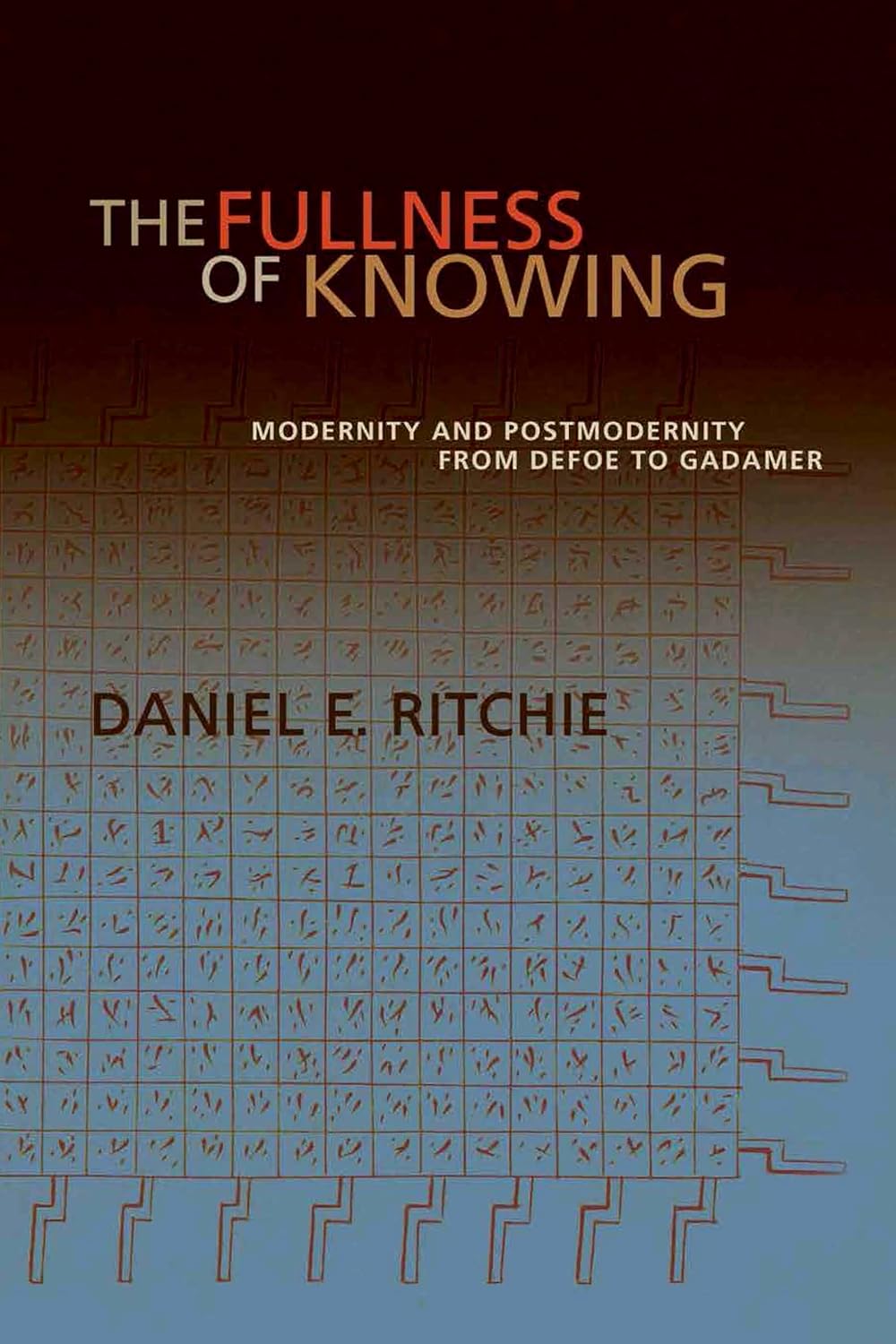
— from Daniel E. Ritchie, The Fullness of Knowing: Modernity and Postmodernity from Defoe to Gadamer (Baylor University Press, 2010)
Related reading and listening
Disengagement from the world — Nicholas Carr encourages us to consider how automation technologies impact our ability to engage with the world and whether — like a good tool — they present a more inviting world or close us off from that world. (30 minutes)
Rod Dreher recounts how he thought he was reading Dante’s Commedia, when in reality the poem was reading him. (18 minutes)
An icon of the whole world — Jason Baxter explains how Dante includes a panoply of characters and creatures in his Comedia, offering a prismatic view of all of Creation in its glory. (20 minutes)
The “sovereign uselessness of moral reflection” — Calling on the wisdom of St. Augustine, Oliver O’Donovan reminds his listeners that all knowledge participates in the eternal Logos of God and is rooted in love, not disinterested moral judgement.(Lecture 1 of 3; 52 minutes)
Beyond a reasonable doubt — From a 1980 interview with Ken Myers, Mortimer J. Adler discusses his argument that belief in the existence of God is rational. (14 minutes)
Heaven and earth are full of His glory — Gerald R. McDermott examines the typological tradition of the Church, particularly through Jonathan Edwards’s thought, and he argues for a recovery of the Christian understanding of the universe as an “immense Trinitarian symbol.” (61 minutes)
An invitation to a feast — Christina Bieber Lake explains how poetry is an invitation to experience the beauty and goodness of Creation as gift. (44 minutes)
A false dichotomy — In this conversation from 2009, Dallas Willard (1934–2013) discusses the truth of spiritual knowledge and its epistemological validity. (63 minutes)
Steven L. Porter discusses The Disappearance of Moral Knowledge, an unfinished manuscript (which he helped to complete) by the late philosopher Dallas Willard. (22 minutes)
Harbinger of disorder — Mark Mitchell on Michael Polanyi’s recognition of the dangerous dead-end of materialistic reductionism
The vice of curiosity — Stanley Hauerwas on the warning from Paul Griffiths about desiring to own knowledge
University or “utiliversity”? — In this essay, Reinhard Hütter examines in depth John Henry Newman’s The Idea of a University and argues that its insights and prescriptions are urgently relevant to the current status of higher education. (87 minutes)
Thinking Together — Alan Jacobs discusses some principles he’s compiled to help us think well (and charitably) in our cultural context, and he warns us to be attentive to the ways technology displaces previously fixed communities. (53 minutes)
Tim Clydesdale discusses the experience of freshmen year at college, suggesting that by that time students have been effectively inoculated against a love of knowledge. (21 minutes)
Pathways of the Mind: The Joy of the Essay — Alan Jacobs thinks Christians should embrace the potential in the literary form of the essay, because of the way it corresponds to the navigation and journey of a Christian life. (48 minutes)
In the Image of Our Devices — Nicholas Carr considers how automation technologies impact our ability to engage with the world. (66 minutes)
Theologian Walter Hansen and painter Bruce Herman question contemporary conceptions of meaning that confine it to the verbal or consider visual and verbal meaning to be completely exclusive. (20 minutes)
Moral knowledge of reality — Oliver O’Donovan argues that admiration is the fundamental form of knowing the world, as we cannot know fully those elements of reality (“bare facts”) that contain no significance for us. (Lecture 2 of 3; 55 minutes)
The recovery of an integrated ecology — In this essay, Michael Hanby unpacks the summons of Laudato si’ to an ecological way of life based on a proper understanding of creation in its fullness and integrity. (57 minutes)
Poetry and Liturgy — Karen Dieleman explores the influence of liturgical practices on shaping the imaginations and poetry of Elizabeth Barrett Browning, Christina Rossetti, and Adelaide Proctor. (49 minutes)
Sacramental Poetics — Poet and Eastern Orthodox believer Scott Cairns explains how a good poem functions like an icon: it assists the process of our becoming aware of what is real, and it is generative in the ways it keeps opening up new understandings. (56 minutes)
James Trott discusses insights he learned while editing A Sacrifice of Praise: An Anthology of Christian Poetry in English from Caedman to the Mid-Twentieth Century. (7 minutes)
Poet Wilmer Mills (1969–2011) discusses how his agricultural and cross-cultural childhood in Brazil shaped his imagination and his relationship with modernity. (11 minutes)
Ken Myers talks with W. H. Auden’s biographer and literary executor, Edward Mendelson, about political and social themes in Auden’s poetry. (7 minutes)
Joy & sorrow, destitution & abundance — In this poetry reading and talk, poet Christian Wiman discusses his own faith journey and how his struggles worked themselves into his poems. (40 minutes)
“The essence of a moment, clearly perceived” — Haiku poet Gary Hotham reads his poetry and discusses how the form of haiku reveals the connection between creatures and creation. (45 minutes)
Jeanne Murray Walker discusses how she helps students approach and appreciate poetry as the mysteriously meaningful literature it is, rather than as a linguistic cage containing static meaning to be abstracted from the words of the poem. (23 minutes)
Literary critic Roger Lundin situates William Blake as a descendant of the radical Protestant movement of the 17th century and as a forerunner of the late 19th and early 20th century movements that put theology and the human spirit in opposition to the natural, fragmented, fallen world. (11 minutes)
John Donne’s Passion in Life, Faith, & Verse — Poet Dana Gioia discusses the remarkable life of poet John Donne and how his spiritual and intellectual struggles created the conditions for his unique poetic voice. (53 minutes)
Poet Dana Gioia discusses the state of contemporary poetry and the sacramental relationship between language and reality. (15 minutes)
The personal element in all knowing — Mark Mitchell connects key aspects of Michael Polanyi’s conception of knowledge with Matthew Crawford’s insistence that real knowing involves more than technique. (34 minutes)
Esther Lightcap Meek challenges the modernist view of knowledge, which prefers the figure of the autonomous knower to the figure of a steward of knowledge acquired in part from others. (15 minutes)
Matthew Levering talks about the long and rich tradition of reasoning about God. (23 minutes)
The need to recollect ourselves as whole persons — In this 2016 lecture, John F. Crosby explores key personalist insights found in the thinking of John Henry Newman and Romano Guardini. (60 minutes)
“A sign of contradiction” — In this lecture, Daniel Gibbons compares and contrasts understandings of sacramental poetics proposed by Augustine, Aquinas, and Sydney. (36 minutes)
Education as a pilgrimage and a mystery — In this lecture, James Matthew Wilson gives a compelling argument for understanding the role of a literary or poetic education as an immersion of the whole being in truth and beauty. (43 minutes)
Nature’s intelligibility — In this lecture, Christopher Blum argues that scientists need to regain a full appreciation of nature’s intelligibility, as they are apt to lose sight of reality due to the reductionism produced by their theories. (31 minutes)
Submission to mathematical truth — In this lecture, Carlo Lancellotti argues that integration of the moral, cognitive, and aesthetic aspects of mathematics is needed in a robust liberal arts mathematics curriculum. (25 minutes)
“Prophet of holiness” — Timothy Larsen discusses a new edition of George MacDonald‘s Diary of An Old Soul, a slim book of poem-prayers to be read daily as a devotional aid. (30 minutes)