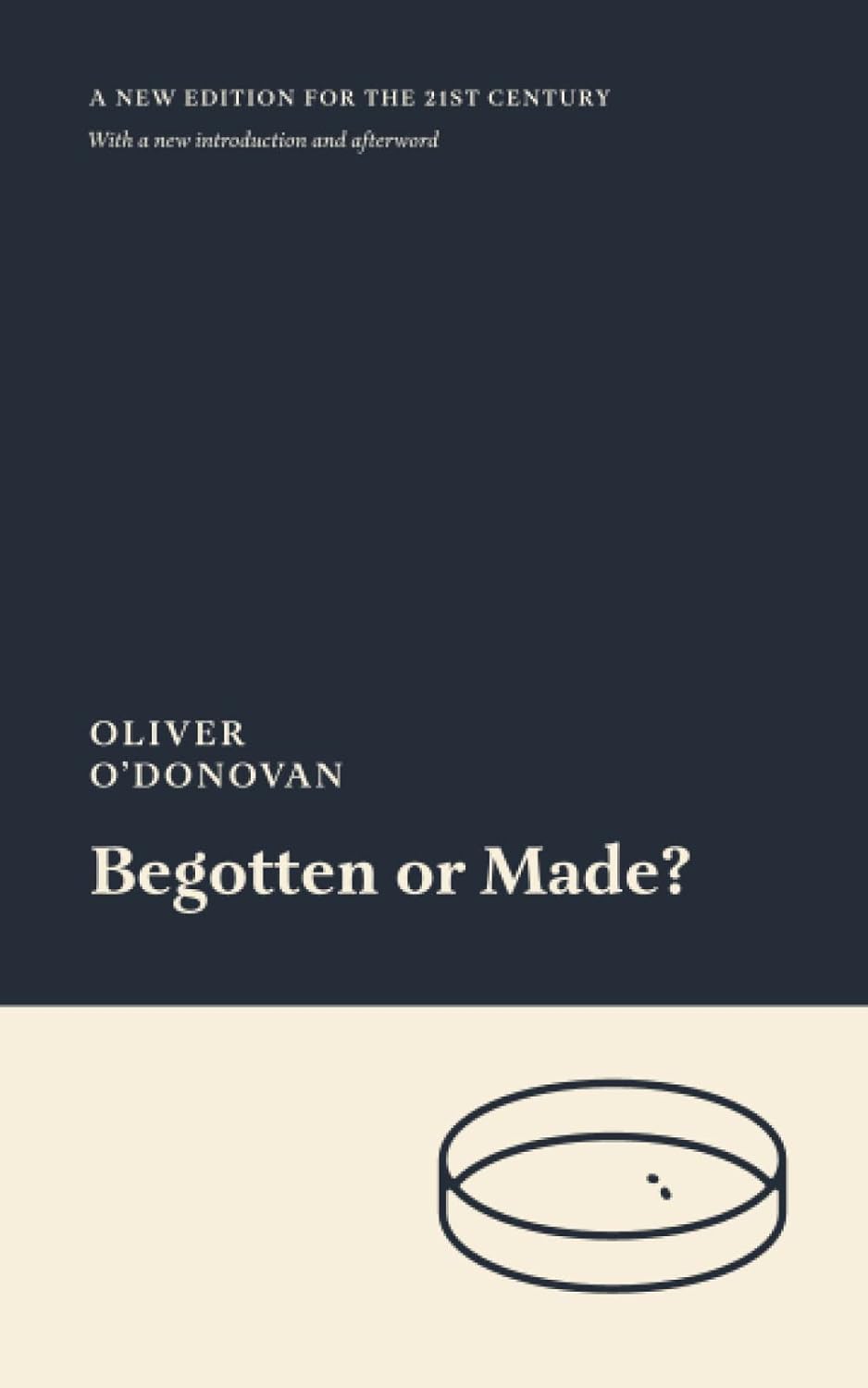
Originally published in 1984, Oliver O’Donovan’s Begotten or Made? is a collation of five lectures he gave 1983. The setting was the London Lecture Series on Contemporary Christianity, a ministry founded by the Rev. John Stott. Many of those in O’Donovan’s original audience were in the medical profession, and his introduction to the lectures acknowledges that medical practitioners are often “ready to admit both perplexity and discouragement about the moral aspects of their work. But what depresses them is not a multitude of difficult conscientious decisions, but an elusive sense that they have no decisions to make any more, that their work has been transformed by vast social changes, so that they are expected to act on the basis of presuppositions which are in tension with their traditional self-understanding but which they cannot challenge.”
That traditional self-understanding is, O’Donovan argues, profoundly Christian, and deeply suspicious about modern moral assumptions. “Medicine, with its tradition of humility before the workings of the natural order and of altruistic devotion to fostering strength and health in the weak and sick, is a kind of shrine in which banished gods still claim their secret homage, the homage of a non-manipulative approach to human nature. A theologian knows, then, that medical people still guard, however uncomfortably, a tradition which should enable them to understand him. Indeed, he should recognize that it is they, rather than he, who have been its guardians through past generations of our civilization.”
The first chapter of the book is called “Medicine and the Liberal Revolution,” and it begins with a discussion (implicitly promised in the book’s title) of the decisions made by the Council of Nicaea concerning the language appropriate to describe the relationship of the Son of God to the Father. The Council Fathers used an analogy of human begetting to stress that the second person of the Trinity had a common nature with the Father: “[T]he eternal Son of God who was not made, was of the Father’s being, not his will.” By contrast with the act of begetting is the act of making: “[T]hat which we make is unlike ourselves. . . . What we ‘make’, then, is alien from our humanity. In that it has a human maker, it has come to existence as a human project, its being at the disposal of mankind. It is not fit to take its place alongside mankind in fellowship, for it has no place beside him on which to stand: man’s will is the law of its being. That which we beget can be, and should be, our companion; but the product of our art — whatever immeasurable satisfaction and enjoyment there may be both in making it and in cherishing it — can never have the independence to be that ‘other I’, equal to us and differentiated from us, which we acknowledge in those who are begotten of human seed.”
O’Donovan regards this distinction between begetting and making as crucial in understanding the modern context for evaluating bioethical choices. “We have to consider the position of this human ‘begetting’ in a culture which has been overwhelmed by ‘making’ — that is to say, in a technological culture.” O’Donovan invokes Jacques Ellul and George Parkin Grant at this point, making it clear that “what marks this culture most importantly, is not anything that it does, but what it thinks. It is not ‘technological’ because its instruments of making are extraordinarily sophisticated (though that is evidently the case), but because it thinks of everything it does as a form of instrumental making. . . . There is no place for simply doing. The fate of a society which sees, wherever it looks, nothing but the products of human will, is that it fails, when it does see some human activity which is not a matter of construction, to recognize the significance of what it sees and to think about it appropriately. This blindness in the realm of thought is the heart of what it is to be a technological culture.
“Nevertheless, though thought comes first, there are implications in the realm of practice too. Such a society is incapable of acknowledging the inappropriateness of technical intervention in certain types of activity. When every activity is understood as making, then every situation into which we act is seen as a raw material, waiting to have something made out of it. If there is no category in thought for an action which is not artifactual, then there is no restraint in action which can preserve phenomena which are not artificial. This imperils not only, or even primarily, the ‘environment’ (as we patronizingly describe the world of things which are not human); it imperils what it is to be human, for it deprives human existence itself of certain spontaneities of being and doing, spontaneities which depend upon the reality of a world which we have not made or imagined, but which simply confronts us to evoke our love, fear, and worship. Human life, then, becomes mechanized because we cannot comprehend what it means that some human activity is ‘natural’.”
The final chapter is entitled “In a Glass Darkly.” In it, O’Donovan muses on ethical questions raised by in vitro fertilization (IVF). As is the case in earlier chapters, he is concerned to protect a clear-cut understanding of the medical profession. He observes that “childlessness itself is not a pathological condition,” and that “we should not employ medical means to compensate for nonmedical disappointments.”
“It is possible in principle for a couple to remain childless for a long time without anything being wrong with either of them. We should object to the idea that medicine may be invoked to overcome simple contingency, especially in the begetting of children, where contingency, as I shall argue shortly, plays an important role. . . .”
“The appropriate question to raise . . . is whether those who practice IVF techniques are alert to the distinction between pathological and merely contingent childlessness; and here, it would seem, there may be some ground for dissatisfaction. . . .
“[T]he element of chance is one of the factors which most distinguish the act of begetting from the act of technique. In allowing something to randomness, we confess that, though we might, from a purely technical point of view, direct events, it is beyond our competence to direct them well. We commit ourselves to divine providence because we have reached the point at which we know we must stop making, and simply be. To say ‘randomness’, of course, is not to say ‘providence’. Randomness is the inscrutable face which providence turns to us when we cannot trace its ways or guess its purpose. To accept that face is to accept that we cannot plan for the best as God plans for the best, and that we cannot read his plans before the day he declares them.”
O’Donovan points out that conception via in vitro fertilization eliminates a great deal of contingency, as does the practice of implanting more than one embryo in the womb “to increase the chance that one of them will implant.” This makes the procedure, from the administrative point of view, more efficient. But, as O’Donovan points out, “it is precisely the integration of human fertilization into the general demands of an administrative system that more than anything else confirms its status as an act of ‘making’ rather than of ‘begetting’. We pointed out in Chapter 1 that the primary characteristic of a technological society is not the things it may do with the aid of machines, but the way it thinks of everything it does is a kind of mechanical production. Once the getting is acknowledged to be under the laws of time and motion efficiency, then its absorption into the world of productive technique is complete. The laws of operation cease to be the laws of natural procreation, aided discreetly by technical assistance; they become the laws of production, which swallow up all that is natural into their own world of artifice.”
The most serious doubt that O’Donovan presents about the propriety of IVF concerns the separation of procreation from “the relational union established by the sexual bond.” That separation implies that procreation is “a chosen ‘project’ of the couple rather than a natural development of their common life. Sexual relationship, correspondingly, loses the seriousness which belongs to it because of our common need for a generation of children, and degenerates into merely a form of play.”
Begotten or Made? was out of print for many years until 2022 when the Davenant Press made it available again, with a new Introduction by Matthew Lee Anderson and a new Afterword by Oliver O’Donovan.
The use of the verb “hack” in the title of this post is an allusion to an article titled “Stop Hacking Humans,” read in a recent Friday Feature. The article was co-written by a former student of Oliver O’Donovan.
Among the related materials listed below, one Sound Thinking post stands out: Why not hatcheries?, in which objections to IVF raised in the late 1970s by bioethicist Paul Ramsey are summarized.
Related reading and listening
- War and loving our enemy-neighbor — Oliver O’Donovan on evaluating the conduct of war in light of the evangelical command of love
- A flood of images — Oliver O’Donovan describes the distinctive character of publicity in modernity, which drowns us in a flood of ever-changing representations that do not serve the common good. (37 minutes)
- How communities remember who they are — Oliver O’Donovan on the necessity of tradition in sustaining communal identity
- Publicity and representative images in society — Oliver O’Donovan describes the nature of publicity as the force that mediates our communication with one another, creating common interests and then rapidly subsuming them into newer ones.(Lecture 3 of 3; 57 minutes)
- How common loves shape communities — Oliver O’Donovan discusses how communities mediate love and knowledge to their members and what challenges arise as a community’s traditions are confronted by sin, error, and plurality. (Lecture 2 of 3; 49 minutes)
- The “sovereign uselessness of moral reflection” — Calling on the wisdom of St. Augustine, Oliver O’Donovan reminds his listeners that all knowledge participates in the eternal Logos of God and is rooted in love, not disinterested moral judgement.(Lecture 1 of 3; 52 minutes)
- How the Church promotes the cause of freedom — Oliver O’Donovan: “We discover we are free when we are commanded by that authority which commands us according to the law of our being, disclosing the secrets of the heart.”
- “The search for shared ends” — Oliver O’Donovan examines whether and to what extent there might be the possibility of a unifying Christian perspective on political doctrine or policy. (59 minutes)
- Thinking coherently about politics — Ken Myers gives an introduction to political theologian Oliver O’Donovan, whose work has been instrumental in teaching many how to think about social and political life in light of the gospel of Christ. (57 minutes)
- The law of faith and of love — Oliver O’Donovan compares St. Augustine’s interpretation of Psalm 119 with that of others, revealing Augustine’s more nuanced understanding of the complexities of the life of faith that the psalmist explores. (64 minutes)
- “Only a real world can save us” — Oliver O’Donovan explores how the “religion” of modernity lacks a coherent world in which one may participate with full human agency and moral purpose. (Lecture 3 of 3; 61 minutes)
- Christian unity and civil society — Oliver O’Donovan introduces listeners to Dutch lay theologian Hugo Grotius, arguing that the questions he tackled relate to perennial concerns about the relationship between divine and human agency, and between civil and ecclesiastical authority. (Lecture 2 of 3; 57 minutes)
- The demoralizing effect of pagan Roman religion — Oliver O’Donovan examines St. Augustine’s critique of pagan Roman religion in Book II of his treatise City of God and asks his audience to consider what insights Augustine’s critique has for us today. (Lecture 1 of 3; 51 minutes)
- Knowing and doing the good — Oliver O’Donovan raises several key questions and complications involved in the task of taking concrete and practical action toward a recognized moral good. (Lecture 3 of 3; 63 minutes)
- Moral knowledge of reality — Oliver O’Donovan argues that admiration is the fundamental form of knowing the world, as we cannot know fully those elements of reality (“bare facts”) that contain no significance for us. (Lecture 2 of 3; 55 minutes)
- Attentiveness to the world, the self, and time — Oliver O’Donovan uses the metaphor of waking to discuss the concept of moral sensibility as attention to the world, the self, and time. (Lecture 1 of 3; 60 minutes)
- Ethical issues in neurobiological interventions — William Hurlbut explores current neurobiological advancements and the ethics and dangers of biotechnology interventions that go beyond therapy. (62 minutes)
- Impact of “infotainment” on community — Neil Gabler and C. John Sommerville discuss how the mentalities conveyed by our experience with communications media work against the nurturing of community. (36 minutes)
- Humans as biological hardware — In this essay, Brad Littlejohn and Clare Morell decry how modern technology tends to hack the human person in pursuit of profit. (55 minutes)
- A richer, deeper view of human dignity — FROM VOL. 98 Moral philosopher Gilbert Meilaender examines the question of human dignity and its place within political discourse. (25 minutes)
- Privacy and a right to kill — FROM VOL. 60 Russell Hittinger explains the legal history behind the “right to privacy” and how it was used in landmark cases involving abortion and physician-assisted suicide. (33 minutes)
- The fatal polytheism of late liberalism — Oliver O’Donovan on the failure that leads to social collapse, marked by conflict, suspicion, and violence
- Insisting that political leaders are incapable of obeying Christ — Oliver O’Donovan on the unintended consequences of the First Amendment to the U.S. Constitution.
- The gift of objective reality — Moral philosopher Oliver O’Donovan makes an argument for the consistency of the idea of law when it is conceived in a theological context. (40 minutes)
- Freedom as conformity to reality — W. Bradford Littlejohn summarizes the definitions of liberty offered by Richard Bauckham and Oliver O’Donovan
- Why not hatcheries? — Ethicist Paul Ramsey (1913–1988) challenges “the unchecked employment of powers the biological revolution places in human hands.”
- The logic of “making” babies — Gilbert Meilaender on the temptation to instrumentalize our bodies
- On babies and words — Leon Kass on the re-configuring of human origins
- Medical tools and the shaping of identity — C. Ben Mitchell and Carl Elliott examine how we form judgments about bioethical questions, and how various medical capabilities form us. (27 minutes)
- The sovereignty of love — In this 2022 lecture, Oliver O’Donovan explains the historical background — and present consequences — of the assertion by Jesus of two great commands. (67 minutes)
- O’Donovan, Oliver — FROM THE GUEST PAGE: Oliver O’Donovan held teaching posts at Wycliffe Hall, Oxford and Wycliffe College Toronto before becoming Regius Professor of Moral & Pastoral Theology and Canon of Christ Church at the University of Oxford in 1982.
- Why kings are compelling — Historian Francis Oakley describes how the modern idea of “secular” politics is a striking departure in human history. (32 minutes)
- Life, liberty, and the defense of dignity — In a 2003 interview, Leon Kass discussed his book Life, Liberty, and the Defense of Dignity: The Challenge for Bioethics. The unifying theme in the book’s essays is the threat of dehumanization in one form or another. (36 minutes)
- Conscience seared with a red-hot iron — Oliver O’Donovan on the convicting role of a good conscience
- Culture in light of Easter — Oliver O’Donovan rejects a gnostic reading of redemption
- On moral authority and medicine — Continuing our time travel back to 1992, we hear two more interviews from the pilot tape for the Mars Hill Tapes, with sociologist James Davison Hunter and bioethicist Nigel Cameron. (28 minutes)
- Religion within the bounds of citizenship — In a 2006 lecture, Oliver O’Donovan argues that the conventional way of describing Western civil society creates obstacles to the participation of believers (Muslim, Christian, and other). (68 minutes)
- “Broken Bodies Redeemed” — Today’s Feature presents a reading of a 2007 article by Gilbert Meilaender that explores the significance for bioethics of the mystery of human being as body and soul. (39 minutes)
- Mars Hill Audio Journal, Volume 153 — FEATURED GUESTS:
Charles C. Camosy, O. Carter Snead, Matt Feeney, Margarita A. Mooney, Louis Markos, and Alan Jacobs
- The purpose of government and God’s eternal purpose — Philip Turner on understanding the state in light of the eschatological reality of the Church
- Politics in light of the Ascension — Oliver O’Donovan on the necessity of situating all political authority within redemptive history
- Thinking Christianly about the body — Theologian and ethicist Gilbert Meilaender discusses some of the themes he explores in two of his books: Body, Soul and Bioethics; and Bioethics: A Primer for Christians. (19 minutes)
- A foretaste of the kingdom of God — Oliver O’Donovan on the sovereignty of love
- Loving relationships in community — In conversation with moral philosopher Oliver O’Donovan, and with readings from his book, Entering into Rest, Ken Myers explores a central theme in O’Donovan’s work: that we are created to enjoy loving relationships in community. (27 minutes)
- The first virtue of citizenship: Taking the law seriously — Oliver O’Donovan reflects on how the reality of the Kingship of Christ must be affirmed as a present reality
- Reasoning about values — Revisiting a 1974 text that examined the mutual animosities of the 1960s
- “Whose kingdom shall have no end” — Oliver O’Donovan and his mentor, George B. Caird, offer lessons from the book of Revelation for thinking about politics
- The social context of freedom — Brad Littlejohn talks about the necessity of a more expansive understanding of freedom, one which recognizes that we are really only free within the social experience of shared meaning and mutual recognition. (17 minutes)
- The Kingdom of God and the kings of the earth — In a 90-minute conversation with Matthew Lee Anderson and Ken Myers, Oliver O’Donovan explains some of the central themes of his work in political theology. (91 minutes)
- Learning about the meaning of government — In a telephone conversation during COVID-19 lockdowns, Oliver O’Donovan talks about lessons we can learn about the proper role of government from our experience of pandemics and quarantine. (51 minutes)