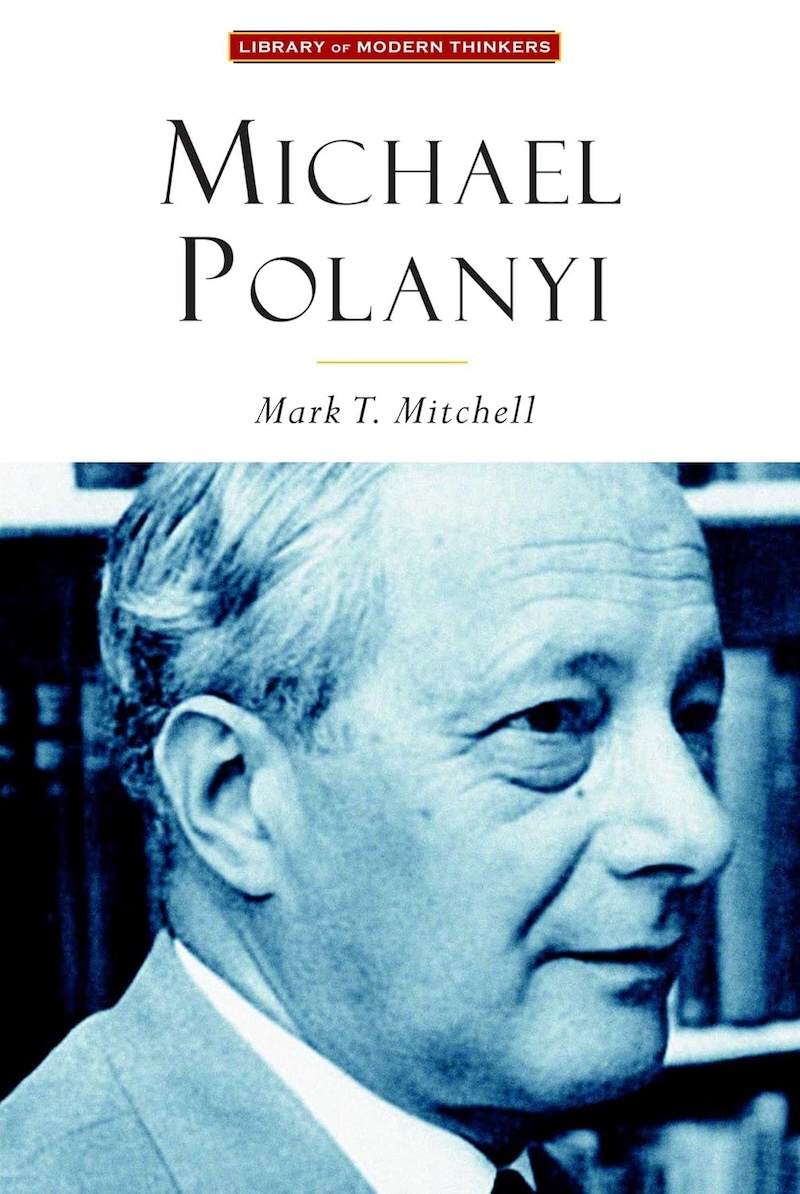
“[A]t the heart of Polanyi’s conception of knowing is his affirmation of a reality external to the knower, a reality that reveals itself unexpectedly in what Polanyi termed ‘indefinite future manifestations.’ This reality consists in both tangible and intangible elements; yet, as we saw, the intangibles are, in some respects, more real than the tangibles. The claim that intangible reality is more real, more meaningful, than tangible reality flies in the face of the materialistic reductionism that prevailed in the mid-twentieth century. An objectivist framework insisting that all knowledge must be explicitly verifiable is necessarily prejudiced in favor of a reductionist account of reality. This is clearly reflected in the analytical model of science best exemplified in Descartes’ Discourse on Method, which seeks to break all objects of inquiry into their most fundamental parts. With the tools provided by an atomistic conception of the universe, reductionism became an approach to reality that views all things as reducible to physical properties. It claims to be capable of understanding all phenomena in terms of material forces.
“Such a view of knowledge makes it impossible to make credible truth claims about such things as morality, aesthetics, or religion. These are necessarily relegated to the realm of purely subjective knowledge, but because knowledge per se must be explicit and verifiable, ‘subjective knowledge’ is really an oxymoron. Subjective knowledge, in the world of objectivism, is more properly identified as a private feeling without any truth content whatsoever. As we have seen, Polany’s goal in formulating a new account of knowing was to reintroduce the possibility of making meaningful truth claims about nonphysical reality. For Polanyi, the horrors of twentieth-century totalitarianism resulted directly from a critical framework that precludes at the outset any possibility of making meaningful moral claims. Polanyi’s theory of tacit knowing opens the door to the very ideals that had been banished by a false view of knowledge. In the absence of those ideals, the world had been violently shaken. But moral ideals, while central to human existence, are not the only ones Polanyi’s account of knowledge admits. His anti-reductionist theory of reality allows us to reconsider the very nature of nature and man’s place in it. In order to provide an alternative to reductionist accounts of reality, Polanyi worked long at developing an ontology according to which the fundamental laws of matter were given their due, but did not account for all of reality.
“Modern reductionism has its roots in the new science of the early modern period. The mechanical philosophy of Galileo tended to describe all reality in terms of matter in motion. This view found most extreme form in the materialistic reductionism suggested by the nineteenth-century French philosopher Pierre Simon Laplace. According to Laplace, a mind that could know at one time ‘all the forces by which nature is animated and the respective positions of the entities which compose it . . . would embrace in the same formula the movements of the largest bodies in the universe and those of the lightest atom: nothing would be uncertain for it, and the future, like the past, would be present to its eyes.” Theoretically the future and the past are perfectly predictable, if all reality can be reduced to matter acted upon by physical forces. Clearly, the notion of free will finds itself orphaned by such a conception — as does any meaningful conception of moral responsibility. Polanyi warns of the far-reaching effects of a reductionist conception of reality, for it is a harbinger of disorder for all intellectual pursuits. It is a ‘menace to all cultural values, including those of science, by an acceptance of a conception of man derived from a Laplacean ideal of knowledge and by the conduct of human affairs in the light of such a conception.’”
— from Mark T. Mitchell, Michael Polanyi: The Art of Knowing (ISI Books, 2006)
This post was originally published on 3/16/25.
Related reading and listening
Disengagement from the world — Nicholas Carr encourages us to consider how automation technologies impact our ability to engage with the world and whether — like a good tool — they present a more inviting world or close us off from that world. (30 minutes)
A sampling of newly published lectures — Ken Myers introduces listeners to four recently released lectures, courtesy of our Partners. The lecturers are Jennifer Frey, Gary Saul Morson, N. T. Wright, and Andrew Kern. (27 minutes)
The epistemology of love — In this lecture, N. T. Wright examines the epistemology of love and how it counters the reductionism of Enlightenment and Epicurean ways of knowing. (63 minutes)
The “sovereign uselessness of moral reflection” — Calling on the wisdom of St. Augustine, Oliver O’Donovan reminds his listeners that all knowledge participates in the eternal Logos of God and is rooted in love, not disinterested moral judgement.(Lecture 1 of 3; 52 minutes)
Beyond a reasonable doubt — From a 1980 interview with Ken Myers, Mortimer J. Adler discusses his argument that belief in the existence of God is rational. (14 minutes)
Heaven and earth are full of His glory — Gerald R. McDermott examines the typological tradition of the Church, particularly through Jonathan Edwards’s thought, and he argues for a recovery of the Christian understanding of the universe as an “immense Trinitarian symbol.” (61 minutes)
A false dichotomy — In this conversation from 2009, Dallas Willard (1934–2013) discusses the truth of spiritual knowledge and its epistemological validity. (63 minutes)
Steven L. Porter discusses The Disappearance of Moral Knowledge, an unfinished manuscript (which he helped to complete) by the late philosopher Dallas Willard. (22 minutes)
The vice of curiosity — Stanley Hauerwas on the warning from Paul Griffiths about desiring to own knowledge
University or “utiliversity”? — In this essay, Reinhard Hütter examines in depth John Henry Newman’s The Idea of a University and argues that its insights and prescriptions are urgently relevant to the current status of higher education. (87 minutes)
Thinking Together — Alan Jacobs discusses some principles he’s compiled to help us think well (and charitably) in our cultural context, and he warns us to be attentive to the ways technology displaces previously fixed communities. (53 minutes)
Tim Clydesdale discusses the experience of freshmen year at college, suggesting that by that time students have been effectively inoculated against a love of knowledge. (21 minutes)
Pathways of the Mind: The Joy of the Essay — Alan Jacobs thinks Christians should embrace the potential in the literary form of the essay, because of the way it corresponds to the navigation and journey of a Christian life. (48 minutes)
In the Image of Our Devices — Nicholas Carr considers how automation technologies impact our ability to engage with the world. (66 minutes)
Theologian Walter Hansen and painter Bruce Herman question contemporary conceptions of meaning that confine it to the verbal or consider visual and verbal meaning to be completely exclusive. (20 minutes)
Moral knowledge of reality — Oliver O’Donovan argues that admiration is the fundamental form of knowing the world, as we cannot know fully those elements of reality (“bare facts”) that contain no significance for us. (Lecture 2 of 3; 55 minutes)
The recovery of an integrated ecology — In this essay, Michael Hanby unpacks the summons of Laudato si’ to an ecological way of life based on a proper understanding of creation in its fullness and integrity. (57 minutes)
Sacramental Poetics — Poet and Eastern Orthodox believer Scott Cairns explains how a good poem functions like an icon: it assists the process of our becoming aware of what is real, and it is generative in the ways it keeps opening up new understandings. (56 minutes)
Excluding cranks and dabblers — Drusilla Scott on Michael Polanyi’s insistence that the “community of science” required authority
How discovery happens — Esther Lightcap Meek on Michael Polanyi’s account of scientific discovery
The personal element in all knowing — Mark Mitchell connects key aspects of Michael Polanyi’s conception of knowledge with Matthew Crawford’s insistence that real knowing involves more than technique. (34 minutes)
Mark Mitchell explores the consequences of four concepts that are sadly missing from most political debates today: creatureliness, gratitude, human scale, and place. (18 minutes)
Esther Lightcap Meek challenges the modernist view of knowledge, which prefers the figure of the autonomous knower to the figure of a steward of knowledge acquired in part from others. (15 minutes)
Mary Hirschfeld argues that modern economics makes some fundamental assumptions about personhood, material goods, and God that prevent the development of a truly human understanding of economic life. (20 minutes)
Historian and cultural critic Jackson Lears discusses the power of advertising to reinforce and shape cultural attitudes about material goods. (9 minutes)
The need to recollect ourselves as whole persons — In this 2016 lecture, John F. Crosby explores key personalist insights found in the thinking of John Henry Newman and Romano Guardini. (60 minutes)
“A sign of contradiction” — In this lecture, Daniel Gibbons compares and contrasts understandings of sacramental poetics proposed by Augustine, Aquinas, and Sydney. (36 minutes)
Nature’s intelligibility — In this lecture, Christopher Blum argues that scientists need to regain a full appreciation of nature’s intelligibility, as they are apt to lose sight of reality due to the reductionism produced by their theories. (31 minutes)
Submission to mathematical truth — In this lecture, Carlo Lancellotti argues that integration of the moral, cognitive, and aesthetic aspects of mathematics is needed in a robust liberal arts mathematics curriculum. (25 minutes)
James K. A. Smith advocates for a return to some pre-modern conceptualizations of the human body. (18 minutes)
Touch’d with a coal from heav’n — Daniel Ritchie finds in the poetry of William Cowper (1731–1800) an anticipation of Michael Polanyi’s epistemology
How we know the world — Daniel Ritchie argues that poet and hymnodist William Cowper was ahead of his time in critiquing the Enlightenment’s reductionist view of knowledge. (16 minutes)
William Cowper: Reconciling the Heart with the Head — Daniel E. Ritchie discusses the life and work of poet William Cowper (1731–1800), comparing his commitment to understanding reality through personal knowledge, intuition, and rigorous contemplation with the thought of Michael Polanyi. (43 minutes)
Daniel Ritchie describes how many of the figures he studies in his new book emphasize the significance of human experience, enculturation, and contingency to human knowledge. (21 minutes)
William C. Hackett discusses the relationships between philosophy and theology, and of both to the meaning embedded in myth. (29 minutes)
The ecstasy of the act of knowing — Theologian Paul Griffiths situates our creaturely knowing within the framework of the relation between God and Creation
Science journalist John Horgan, author of The Undiscovered Mind: How the Human Brain Defies Replication, Medication, and Explanation, discusses the limits of neuroscience. (13 minutes)
Mitchell, Mark T. — FROM THE GUEST PAGE: Mark T. Mitchell is Dean of Academic Affairs and Professor of Government at Patrick Henry College where he teaches political theory.
Freedom from the nature of things? — Leon Kass on the pressure exerted by the authority of science to embrace reductionistic materialism
A.I., power, control, & knowledge — Ken Myers shares some paragraphs from Langdon Winner‘s seminal book, Autonomous Technology: Technics-out-of-Control as a Theme in Political Thought (1977) and from Roger Shattuck‘s Forbidden Knowledge: From Prometheus to Pornography (1996). An interview with Shattuck is also presented. (31 minutes)