
“[T]he paths of the mind, seen honestly, are often paths set by our bodies. This is a particularly interesting fact in light of the fact that so many essays — devoted as they are to following the paths of thought — are built on memories. The cognitive scientist Antonio Damasio has argued that our memories are accompanied by what he calls ‘somatic markers’ — neural encodings of the various physical conditions (sensory, hormonal) that existed in our bodies at the moment that the remembered event happened. So to recall an event is to retrieve the whole somatic context of that event: remembering a moment of fear, we shiver; remembering excitement, we blush.
“This is a reminder of how little we control our own experiences, try though we might. And how little we control the paths we follow, whether neurally or in the great metaphorical sense of life as a pilgrimage — of a person as a viator, a wayfarer. I love the essay primarily because it is the genre par excellence of wayfaring.
“An old phrase holds that to be a Christian is to be homo viator: the human being as wayfarer, as pilgrim. Wayfarers know in a general sense where we are headed: to the City of God, what John Bunyan, that great chronicler of pilgrimage, called the Celestial City — but we aren’t altogether certain of the way. We can get lost for a time, or lose our focus and nap for too long on a soft patch of grass at the side of the road, or dally a few days at Vanity Fair. We can even become discouraged — but we don’t, ultimately and finally, give up. And we don’t think we have arrived. To presume that we have made it to our destination and to despair of arriving are both, as Jürgen Moltmann has wisely said, ways of ‘canceling the wayfaring character of hope.’
“Hope comes from knowing that there is a way — and that we didn’t make it. This is why the road’s unexpected turnings need not alarm us; this is why it’s possible even to enjoy the unpredictable, whether it comes from without or within. That is, there can be pleasure and instruction in the books we stumble across, in the serendipitous skipping from link to link across the Web — and even in our own mental vagaries, the stumbling and skipping through our neural webs.”
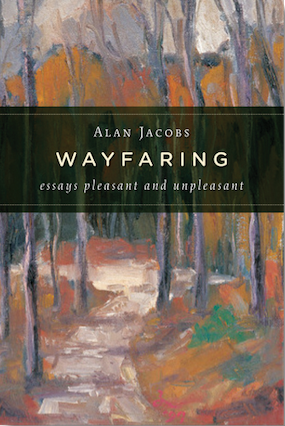
— from Alan Jacobs, Wayfaring: Essays Pleasant and Unpleasant (Eerdmans, 2010)
Click on the tags below for listings of related readings or audio features.