“In his important book, Intellectual Appetite: A Theological Grammar, Paul Griffiths provides a telling account of curiosity. Curiosity has had an interesting history. We may not be able to imagine a world without avarice, but we still think avarice is a vice. According to Griffiths, however, though we think curiosity to be a commendable virtue that scholar and student should try to develop, that has not always been the case. According to Griffiths, prior to modernity curiosity was universally thought to be a vice. It was so because curiosity was an ordering of the affections, a form of love, by which the knower sought to make that which they knew unique to themselves. The curious desired to create new knowledge in an effort to give them control over that which they knew. By dominating that which they came to know they could make what they know a private possession. ‘Curiosity is, then, in brief, appetite for the ownership of new knowledge.’
“The curious seek to know what they do not yet know. As a result, that which they come to know ravishes them by enacting what Griffiths characterizes as a ‘sequestered intimacy.’ Griffiths uses the language of ‘sequestering’ to suggest that the curious think that what they have come to know is for their exclusive use. The curious assume they are masters of what they have come to know. Because they claim what they know is peculiar to them they seek as well as create envy in those who do not know what they know.
“In a way not unlike Augustine’s understanding of the place of the spectacle for the Romans, Griffiths suggests that the curious seek spectacles to distract them from the loneliness that is the necessary result of their desire to possess what they have come to know. The desire for novelty, the desire to have knowledge that I alone can possess, produces a restlessness that ‘is inflamed rather than assuaged by the spectacles it constructs.’ Curiosity so understood is the intellectual expression of the greed correlative to an economic system built on the need to have those that make up the system always want ‘more.’
“The alternative to curiosity, according to Griffiths, is studiousness. Studiousness, like curiosity, entails an ordering of the affections and is, therefore, a form of love. But the studious do not seek to ‘sequester, own, possess, or dominate what they hope to know; they want to participate lovingly in it, to respond to it knowingly as gift rather than as potential possession, to treat it as icon rather than as spectacle.’ For the studious what they know can be loved and contemplated, but not dominated by sequestration. The studious, therefore, accept as a gift what they have come to know, which means they assume that which they know is known in common, making possible a shared life.
“The contrast between the curious and the studious will be determined, according to Griffiths, by their willingness or unwillingness to share what they know with others. Whether we are or not possessed by our possessions can only be determined to the extent we are ready to give away that which we have. Griffiths associates such a willingness to share our knowledge of Christ just to the extent that the degree to which any of us know Christ and what the gospel is, and demands, is the ‘degree to which we must share that knowledge by giving it away.’ The studious Christian, therefore, seeks in Griffiths’ words, a ‘participatory intimacy driven by wonder and riven by lament,’ which makes it impossible for them to seek ownership of what they have been given. For Christians believe that all creatures have been brought into being by God out of nothing. Accordingly, the studious recognize that only God possesses or owns any creature. Only God, therefore, has the power to sequester any being into privacy or to grant it public display. Alms, and the sharing of what we know is a form of alms giving, is rightly understood not as our giving away what is ours, but rather is making available to others what was God’s before we had a use for it.”
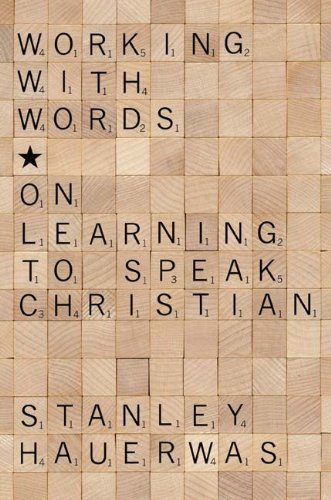
— from Stanley Hauerwas, Working with Words: On Learning to Speak Christian (Cascade, 2011)
Related reading and listening
- Disengagement from the world — Nicholas Carr encourages us to consider how automation technologies impact our ability to engage with the world and whether — like a good tool — they present a more inviting world or close us off from that world. (30 minutes)
- The “sovereign uselessness of moral reflection” — Calling on the wisdom of St. Augustine, Oliver O’Donovan reminds his listeners that all knowledge participates in the eternal Logos of God and is rooted in love, not disinterested moral judgement.(Lecture 1 of 3; 52 minutes)
- Beyond a reasonable doubt — From a 1980 interview with Ken Myers, Mortimer J. Adler discusses his argument that belief in the existence of God is rational. (14 minutes)
- Heaven and earth are full of His glory — Gerald R. McDermott examines the typological tradition of the Church, particularly through Jonathan Edwards’s thought, and he argues for a recovery of the Christian understanding of the universe as an “immense Trinitarian symbol.” (61 minutes)
- A false dichotomy — In this conversation from 2009, Dallas Willard (1934–2013) discusses the truth of spiritual knowledge and its epistemological validity. (63 minutes)
- All trees, no forest — Richard Weaver on the attenuating of knowledge
- Christian belief as real knowledge — Dallas Willard on the modern divorce between faith and knowledge
- Humility and moral knowledge — FROM VOL. 149 Steven L. Porter discusses The Disappearance of Moral Knowledge, an unfinished manuscript (which he helped to complete) by the late philosopher Dallas Willard. (22 minutes)
- Harbinger of disorder — Mark Mitchell on Michael Polanyi’s recognition of the dangerous dead-end of materialistic reductionism
- Universities as the hosts of reciprocating speech — Robert Jenson on how the Christian understanding of Truth in a personal Word shaped the Western university
- University or “utiliversity”? — In this essay, Reinhard Hütter examines in depth John Henry Newman’s The Idea of a University and argues that its insights and prescriptions are urgently relevant to the current status of higher education. (87 minutes)
- Thinking Together — Alan Jacobs discusses some principles he’s compiled to help us think well (and charitably) in our cultural context, and he warns us to be attentive to the ways technology displaces previously fixed communities. (53 minutes)
- Students as arbiters of knowledge — FROM VOL. 94 Tim Clydesdale discusses the experience of freshmen year at college, suggesting that by that time students have been effectively inoculated against a love of knowledge. (21 minutes)
- Pathways of the Mind: The Joy of the Essay — Alan Jacobs thinks Christians should embrace the potential in the literary form of the essay, because of the way it corresponds to the navigation and journey of a Christian life. (48 minutes)
- In the Image of Our Devices — Nicholas Carr considers how automation technologies impact our ability to engage with the world. (66 minutes)
- How paintings convey meaning — FROM VOL. 121 Theologian Walter Hansen and painter Bruce Herman question contemporary conceptions of meaning that confine it to the verbal or consider visual and verbal meaning to be completely exclusive. (20 minutes)
- Passing on the virtues to the next generation — Theologian and ethicist Stanley Hauerwas reflects on being a godparent and the responsibility to cultivate and talk about Christian virtue. (21 minutes)
- The Protestant project and indifference concerning God — Stanley Hauerwas on Alasdair MacIntyre’s critique of Protestant liberals
- Moral knowledge of reality — Oliver O’Donovan argues that admiration is the fundamental form of knowing the world, as we cannot know fully those elements of reality (“bare facts”) that contain no significance for us. (Lecture 2 of 3; 55 minutes)
- A life well lived — In this essay, Stanley Hauerwas explains the breadth and depth of Alasdair MacIntyre’s thought, the goal of which was to help people to act intelligibly and live morally worthy lives. (40 minutes)
- The recovery of an integrated ecology — In this essay, Michael Hanby unpacks the summons of Laudato si’ to an ecological way of life based on a proper understanding of creation in its fullness and integrity. (57 minutes)
- Sacramental Poetics — Poet and Eastern Orthodox believer Scott Cairns explains how a good poem functions like an icon: it assists the process of our becoming aware of what is real, and it is generative in the ways it keeps opening up new understandings. (56 minutes)
- The personal element in all knowing — Mark Mitchell connects key aspects of Michael Polanyi’s conception of knowledge with Matthew Crawford’s insistence that real knowing involves more than technique. (34 minutes)
- Making contact with reality — FROM VOL. 139 Esther Lightcap Meek discusses the realism of philosopher and chemist Michael Polanyi. (23 minutes)
- Knowing the world through the body — FROM VOL. 76 Professor Martin X. Moleski explains why Michael Polanyi (1891-1976) left his career in science to become a philosopher. (16 minutes)
- Steward of knowledge vs. autonomous knower — FROM VOL. 66 Esther Lightcap Meek challenges the modernist view of knowledge, which prefers the figure of the autonomous knower to the figure of a steward of knowledge acquired in part from others. (15 minutes)
- Wonder, being, skepticism, and reason — FROM VOL. 135 Matthew Levering talks about the long and rich tradition of reasoning about God. (23 minutes)
- The need to recollect ourselves as whole persons — In this 2016 lecture, John F. Crosby explores key personalist insights found in the thinking of John Henry Newman and Romano Guardini. (60 minutes)
- “A sign of contradiction” — In this lecture, Daniel Gibbons compares and contrasts understandings of sacramental poetics proposed by Augustine, Aquinas, and Sydney. (36 minutes)
- Nature’s intelligibility — In this lecture, Christopher Blum argues that scientists need to regain a full appreciation of nature’s intelligibility, as they are apt to lose sight of reality due to the reductionism produced by their theories. (31 minutes)
- Submission to mathematical truth — In this lecture, Carlo Lancellotti argues that integration of the moral, cognitive, and aesthetic aspects of mathematics is needed in a robust liberal arts mathematics curriculum. (25 minutes)
- Embodied knowledge — FROM VOL. 121 James K. A. Smith advocates for a return to some pre-modern conceptualizations of the human body. (18 minutes)
- Touch’d with a coal from heav’n — Daniel Ritchie finds in the poetry of William Cowper (1731–1800) an anticipation of Michael Polanyi’s epistemology
- How we know the world — Daniel Ritchie argues that poet and hymnodist William Cowper was ahead of his time in critiquing the Enlightenment’s reductionist view of knowledge. (16 minutes)
- William Cowper: Reconciling the Heart with the Head — Daniel E. Ritchie discusses the life and work of poet William Cowper (1731–1800), comparing his commitment to understanding reality through personal knowledge, intuition, and rigorous contemplation with the thought of Michael Polanyi. (43 minutes)
- Approaches to knowing — FROM VOL. 104 Daniel Ritchie describes how many of the figures he studies in his new book emphasize the significance of human experience, enculturation, and contingency to human knowledge. (21 minutes)
- The integration of theoretical and mythic intelligence — FROM VOL. 156 William C. Hackett discusses the relationships between philosophy and theology, and of both to the meaning embedded in myth. (29 minutes)
- The ecstasy of the act of knowing — Theologian Paul Griffiths situates our creaturely knowing within the framework of the relation between God and Creation
- Learning to live interrogatively — Matthew Lee Anderson reflects on the fact that questions can be asked about faith from a posture of doubt or from an eagerness to grow in understanding. (42 minutes)
- On The Abolition of Man — FROM VOL. 154 Michael Ward explains why The Abolition of Man is one of Lewis’s most important but also most difficult books. (36 minutes)
- A.I., power, control, & knowledge — Ken Myers shares some paragraphs from Langdon Winner‘s seminal book, Autonomous Technology: Technics-out-of-Control as a Theme in Political Thought (1977) and from Roger Shattuck‘s Forbidden Knowledge: From Prometheus to Pornography (1996). An interview with Shattuck is also presented. (31 minutes)
- Deconstructing the myths of modernity — In order to counter modernity’s fragmentation, Paul Tyson argues that we must recover a foundation of reality based on meaning and being. (35 minutes)
- Promethean medicine? — Stanley Hauerwas on medicine and limits
- Suffering and the vocation of medicine — Stanley Hauerwas on why the elimination of suffering is an inadequate (and unrealistic) goal for medicine
- Rehabilitating authority — Authority, argues David Koyzis, is an aspect of the image of God, exercised to fulfill human vocations. (30 minutes)
- Communion of saints — Jessica Hooten Wilson asserts that reading stories of holiness in the lives of “literary saints” helps to cultivate Christian character in us. (25 minutes)
- How should we then die? — Stanley Hauerwas asks how the fear of death shapes the practice of medicine
- Knowledge transformed by love — David K. Naugle on the reordered thinking of the redeemed
- Mars Hill Audio Journal, Volume 150 — FEATURED GUESTS:
David I. Smith, Eric O. Jacobsen, Matthew Crawford, Andrew Davison, Joseph E. Davis, and Rebecca Konyndyk DeYoung
- Cosmology without God — Modern science is practiced in the context of beliefs that are intrinsically metaphysical and theological, even though practitioners of science claim (and usually genuinely believe) that their disciplines are philosophically neutral. David Alcalde challenges such claims within a sub-field of astrophysics. (21 minutes)