
“The modern knower may be compared to an inebriate who, as he senses his loss of balance, endeavors to save himself by fixing tenaciously upon certain details and thus affords the familiar exhibition of positiveness and arbitrariness. With the world around him beginning to heave, he grasps at something that will come within a limited perception. So the scientist, having lost hold upon organic reality, clings the more firmly to his discovered facts, hoping that salvation lies in what can be objectively verified.
“From this comes a most important symptom of our condition, the astonishing vogue of factual information. It is naturally impossible for anyone to get along without some knowledge that he feels can be relied on. Having been told by the relativists that he cannot have truth, he now has ‘facts.’ One notes that even in everyday speech the word fact has taken the place of truth; ‘it is a fact’ is now the formula for a categorical assertion. Where fact is made the criterion, knowledge has been rendered unattainable. And the public is being taught systematically to make this fatal confusion of factual particulars with wisdom. On the radio and in magazines and newspapers appear countless games and quizzes designed to test one’s stock of facts. The acquisition of unrelated details becomes an end in itself and takes the place of the true ideal of education. So misleading is the program that one widely circulated column invites readers to test their ‘horse sense’ by answering the factual queries it propounds. The same attention to peripheral matter long ago invaded the schools, at the topmost levels, it must be confessed, where it made nonsense of literary study and almost ruined history. The supposition that facts will speak for themselves is of course another abdication of intellect. Like impressionist artists, the objectivists prostrate themselves before exterior reality on the assumption that the organizing work of the mind is deceptive.
“Plato reminded us that at any stage of an inquiry it is important to realize whether we are moving toward, or away from, first principles. The significance of the movement we are here tracing is that the former distrust of specialization has been supplanted by its opposite, a distrust of generalization. Not only has man become a specialist in practice, he is being taught that special facts represent the highest form of knowledge. Mathematical logic, with its attempt to evade universal classification, is an excellent example of the tendency. The extreme of nominalism appears when men fear, as many do today, to make even those general groupings which are requisite to ordinary activities. We are developing a phobia toward simple predication. Sensing that even expository statement is a form of argument and that argument implies the existence of truth, we shrink back by clinging to our affirmation of particulars. They seem innocuous. Any extension beyond, toward center, may involve grave duties.”
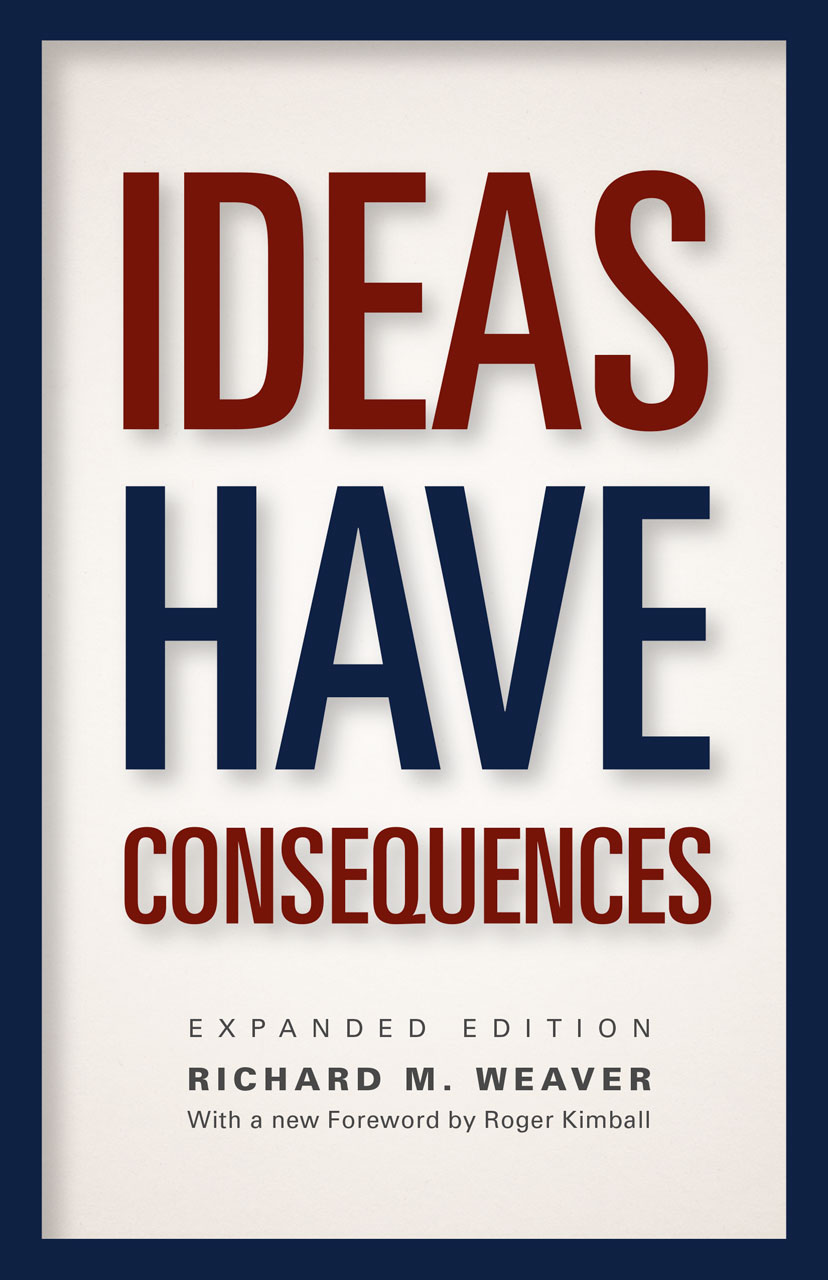
— from Richard M. Weaver, Ideas Have Consequences (University of Chicago Press, 1948)
Click on the tags below for listings of related readings or audio features.