
“There is a difference between the composer who ‘sets’ a religious text, but uses a style which is essentially unaltered by the nature of the words and their theological or liturgical context, and a composer for whom these texts are the very breath of life, and who probably cannot imagine himself working with any other kind. There are many composers who set religious texts with skilled attention to the poetical imagery and to the rhetoric and drama contained in the words. Pärt’s approach is quite different, and works outwards from the structure of the text and, simultaneously, inwards from the significance of the text as a whole (historically, spiritually, and liturgically).
“Some people may consider this approach to be an anomaly in today’s predominantly secular society. But a concentration on religious texts represents not so much a rejection of the world and ‘contemporary problems’ (which is how some critics seem to view it), but rather a profound recognition of what is most important and enduring. Of course, the music should be able to stand by itself — but what does that mean? In almost every culture except our own, the spiritual nature of music, its sacred power, is taken for granted. Even to raise the issue already presumes a specific position on the relationship between music and spirituality — one that sees them, falsely, as intrinsically separate entities. . . .
“All music emerges from silence, to which sooner or later it must return. At its simplest we may conceive of music as the relationship between sounds and the silence that surrounds them. Yet silence is an imaginary state in which all sounds are absent, akin perhaps to the infinity of time and space that surrounds us. We cannot ever hear utter silence, nor can we fully imagine such concepts as infinity and eternity. When we create music, we express life. But the source of music is silence, which is the ground of our musical being, the fundamental note of life. How we live depends on our relationship with death; how we make music depends on our relationship with silence. . . .
“[Pärt’s] aesthetic sensibility has been deeply marked by the spiritual values of the Russian Orthodox Church and its particular estimation of tradition and focus on verbal expression. More than in Western Christian liturgy, Orthodox liturgy eschews the everyday mode of speech so that some manner of singing is used for all types of utterance (except sermons). These may range by degrees from solo monotonal recitation to full choral polyphony, but there is no boundary separating portions of what is basically heightened speech from the more conventional harmonic kinds of singing. Instead, the whole service is a flux of different gradations of musical complexity, at the heart of which is the word, its meanings duly balanced according to content and liturgical significance by appropriate musical formulation.”
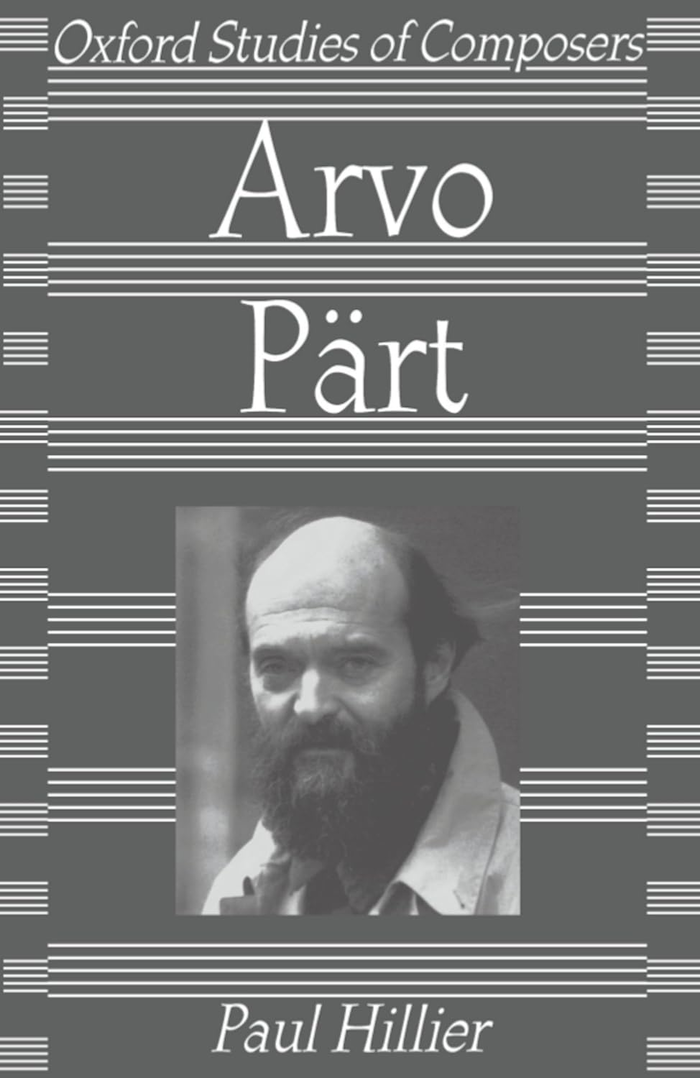
— from Paul Hillier, Arvo Pärt (Oxford University Press, 1997)
Click on the tags below for listings of related readings or audio features.