
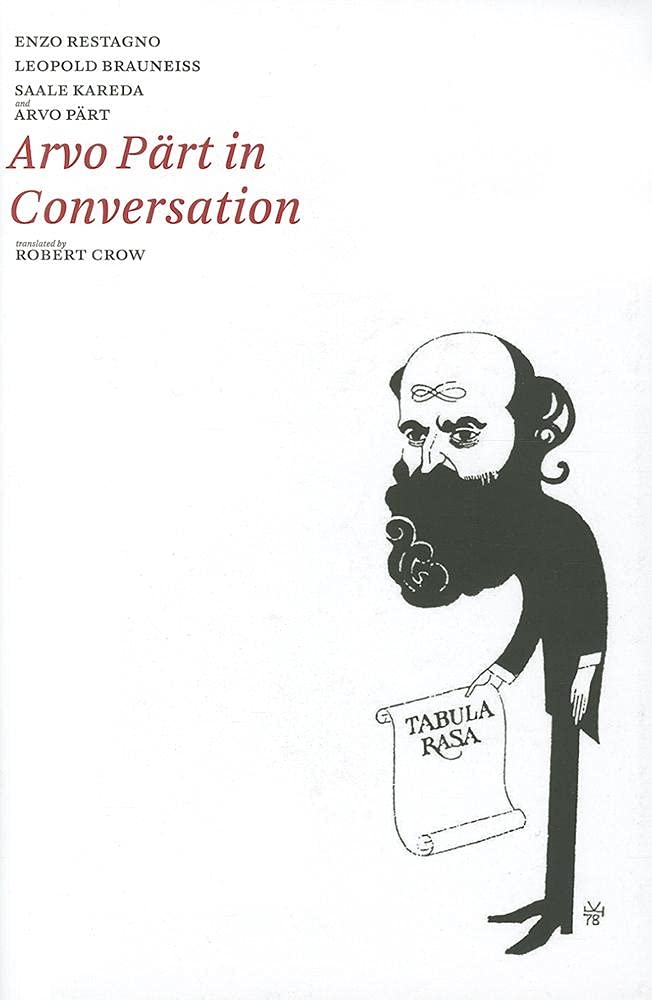
In 2003, musicologist Enzo Restagno recorded a long interview with composer Arvo Pärt about the trajectory of his life and work. During their conversation — presented in a book titled Arvo Pärt in Conversation — Restagno asked Pärt to describe the events that led him to abandon the conventional twelve-tone compositional technique common to many twentieth-century composers.
“At the time I was convinced that I just could not go on with the compositional means at my disposal. There simply wasn’t enough material to go on with, so I just stopped composing altogether. I wanted to find something that was alive and simple and not destructive. When I worked at the radio I was allowed to deal with the most elaborate and powerful electronic equipment, such as loudspeakers and tape recorders. Suddenly however I felt the need to distance myself from this luxury, because I had the feeling that I was locked in a gilded cage and was being forced in the wrong direction. If I had to work with technical equipment I always chose the most simple, for example a simple tape recorder that offered just the basics. I was no longer at all interested in the adjustment of high and low frequencies, reducing the noise level and so on. What I wanted was only a simple musical line that lived and breathed inwardly, like those in the chants of distant epochs, or such as still exist today in folk music: an absolute melody, a naked voice which is the source of everything else. I wanted to learn how to shape a melody, but I had no idea how to do it.
“All that I had to go on was a book of Gregorian chant, a Liber usualis, that I had received from a church in Tallinn. When I began to sing and to play these melodies I had the feeling that I was being given a blood transfusion. It was terribly strenuous work because it was not simply a matter of absorbing information. I had to be able to understand this music down to its very roots: how it had come into existence, what the people were like who had sung it, what they’d felt during their lives, how they’d written this music down and passed it on through the centuries until it became the source of our own music. In some way or other I succeeded in getting into contact with this music. But I never used this closeness as a quote, with the exception of one early piece that I wrote for Bologna Cathedral: Statuit ei Dominus. In Gregorian chant the succession of notes forms something like real speech, the notes offer concrete information, something that is comparable to birdsong. We do not understand them, but they understand each other. Monodic music has a certain informal content, it has arisen like a cathedral from ground that bears within it the ruins of earlier temples, probably a heathen temple that in its turn was erected in early pre-history on that site for quite specific reasons. This chain of forms, temples, and chants, each built upon the ruins of the other, is something more potent than we can imagine. In my daily work, too, I came up against tremendous difficulties. For a time I succeeded in writing a single musical line, but then I didn’t know how to go on. Should I have written just monodic music? What would have become of polyphony and harmony? What should I have done with the second and third voice? Where should a second voice come from? Tormented by these questions, I began to think about the beginnings of polyphony. It became clear to me that it was far more complex and profound than the rigid rules with which Knud Jeppesen had analysed and explained this music would have us suppose. The second voice must be something independent, like the husband and wife in a family. This relationship of independent parts can, in my opinion, already be seen in the beginnings of ancient polyphony. I tried to realise this intuition in my third symphony where I conceived the entire form of the composition through the metaphor of the building of a town: small, increasingly numerous centres that spread out until they touch each other and form a unity. The same thing happens with the harmonic progression in the piece that is evolved from a series of short cadences. Upon this idea is based the idea of polyphonic complexity. Nonetheless, my experience with the third symphony left me dissatisfied. It became clear to me that I was caught within my relationship to musical history, which was too much one of debt. And that my work somehow lacked a style of its own. But I had succeeded in building a bridge within myself between yesterday and today — a yesterday that was several centuries old — and this encouraged me to go on exploring. During those years I filled thousands of pages with exercises in which I wrote out single voiced melodies. At home there is a cupboard full of exercises like this.”
— from Arvo Pärt in Conversation (Dalkey Archive Press, 2010)
Click on the tags below for listings of related readings or audio features.