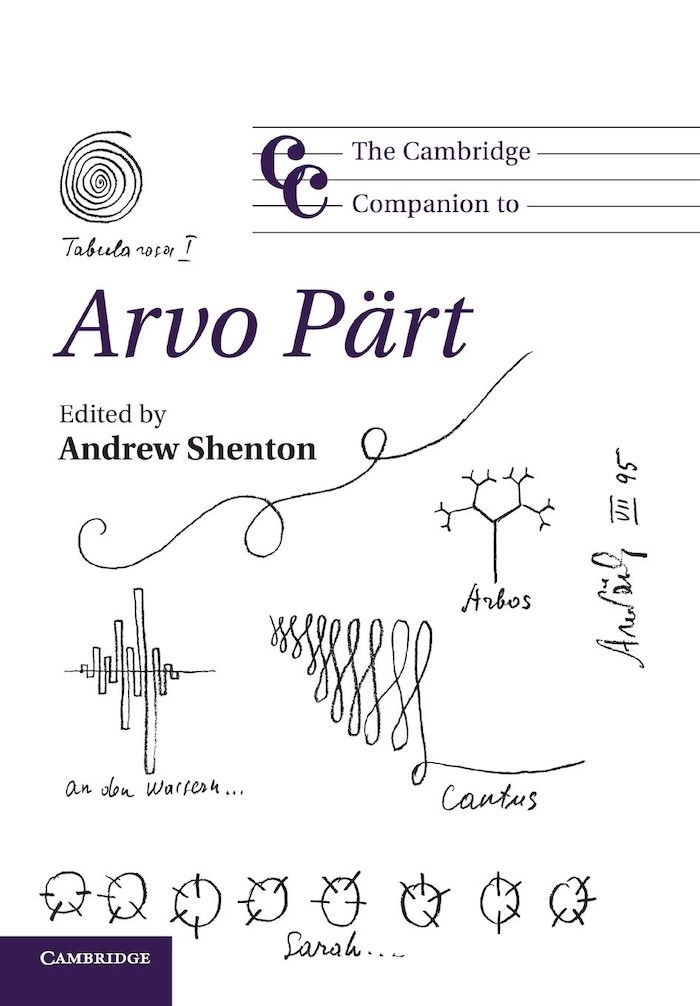
On Volume 129 of the Journal, I talked with conductor Peter Phillips about an album of music by Arvo Pärt recorded by the Tallis Scholars. The album was titled Tintinnabuli, in recognition of the technique of composition that Pärt developed. Musicologist Leopold Brauneiss discussed that technique in an essay titled “Musical archetypes: the basic elements of the titinnabuli style.”
“It could be said that, like the music of Haydn, Pärt’s music is appreciated all over the world. One reason for this rather rare phenomenon for a contemporary composer is that he found ways of (re)building the music out of very simple basic elements or patterns such as scales, which are commonly recognized. I suggest characterizing these elements or patterns as ‘archetypes’: this multilayered Greek term can literally be translated as ‘original or primal image’ (arche = beginning, source). In the twentieth century, it has been known primarily through its use in Carl Jung’s analytical psychology, where it is linked with the equally important concept of the collective unconscious. For Jung, this means a deep layer of the unconscious mind, which can be called collective inasmuch as it is ‘not a personal acquisition but is inborn’ and thus ‘not individual but universal.’ Jung calls the contents of this collective unconscious ‘archetypes.’ These ‘contents and modes of behavior that are more or less the same everywhere and in all individuals’ are by no means to be perceived as concrete images or ideas: in Jung’s understanding, the archetypes are rather ‘definite forms in the psyche which seem to be present always and everywhere.’ Elsewhere, Jung also strongly emphasizes that:
archetypes are not determined as regards their content, but only as regards their form and then only to a very limited degree. A primordial image is determined as to its content only when it has become conscious and is therefore filled out with the material of conscious experience. Its form, however, as I have explained elsewhere, might perhaps be compared to the axial system of a crystal, which, as it were, performs the crystalline structure in the mother liquid, although it has no material existence of its own. . . . The archetype in itself is empty and purely formal, nothing but a facultas performandi, a possibility of representation which is given a priori. The representations themselves are not inherited, only the forms, and in that respect they correspond in every way to the instincts, which are also determined in form only.
“The idea of the human soul possessing a ‘net-like basic pattern,’ which Arvo Pärt put forward in his acceptance speech for the Internationaler Brückepreis der Europastadt Görlitz (International Bridge Prize of the European City of Görlitz), is not too far removed from Jung’s image of a crystalline system of coordinates. Pärt’s point of origin is the empirical fact that diverse items and substances have very similar basic patterns when examined through a powerful microscope. If one were to imagine that the human soul could also be examined through a microscope lens, it could be expected that — at a certain degree of magnification — a comparable ‘net-like basic pattern’ would be detected. In his Görlitz speech Pärt notes:
Perhaps one might call it ‘human geometry,’ neatly sorted, quietly formed — but, most of all, beautiful. In this depth, we are all so similar that we could recognize ourselves in any other person. . . . I am very much tempted to see this beautiful and neat Ur-substance, this precious island in the inner seclusion of our soul, as the ‘place’ where, over 2000 years ago, we were told that the Kingdom of God would be — inside us. No matter if we are old or young, rich or poor, woman or man, colored or white, talented or less talented. And so, I keep trying to stay on the path that searches for this passionately longed-for ‘magic island,’ where all people (and for me, all sounds) can live together in love.
“Just as we strive to treat our fellow people with love and care in daily life, the composer aims at creating a world in which all sounds, despite their superficial differences, are connected with love. The parenthesis in the last sentence ‘and for me, all sounds’ shows how we are to picture the connection between life and art in the tintinnabuli style: the same ideals apply to the composer’s handling of sounds and musical figures and in our relationships with the living environment. Hence, the goal in music is to advance to the deeper layers of primal pictures and substances which could be identified as musical archetypes. Like the mental archetypes in Jung’s analytical psychology, they have to be general, supra-individual, and preexistent. The quest for the ‘magic island’ in universal human existence, which is also the place of encounter with the divine, corresponds, in music, to the quest for the universally musical: in both, the common and connective elements do not arise from a complex variety of interwoven heterogeneous elements but through the fact that outward individual differences can be reduced to homogeneous and simple basic patterns which thus can be more readily overcome.
“As with Jung’s psychic archetypes, musical archetypes are fundamentally empty forms with no contents. They only appear and become analytically graspable when musical material ‘crystallizes.’ In the tintinnabuli style, the regular crystalline structure corresponds to basic formal relationships such as mirroring, parallel motion, additions, and multiplications, all of which determine the musical processes on small and large levels. On the one hand, it is possible to explain these processes in numbers; on the other hand, they can also be illustrated graphically. The general archetypical element not only connects all tones in music; it also joins music as a whole with both the numerical world of mathematics and physical processes, as well as with the visible world of geometry and visual representation in general.”
— from Leopold Brauneiss, “Musical archetypes: the basic elements of the titinnabuli style,” in
Andrew Shenton, ed.,The Cambridge Companion to Arvo Pärt (Cambridge University Press, 2012)
Related reading and listening
- Rose without thorns — Ken Myers introduces various settings of “Ther is no rose of swych vertu,” a medieval carol that uses imagery of a rosebush to describe the Virgin Mary. (29 minutes)
- “Investigations of divine works” — Greg Wilbur explains how closely connected music is to the order of the cosmos and how it even reveals attributes of God. (56 minutes)
- The experience of a “real presence” in sacred music — FROM VOL. 126 Jonathan Arnold explores why people of no religious commitment pay money to hear specifically sacred music. (22 minutes)
- How music blesses and teaches — FROM VOL. 64 Theologian and musician Jeremy Begbie explores what we learn about time, theology, and the structure of Creation from the experience of music. (28 minutes)
- The founding of a choral ensemble — FROM VOL. 119 Founder Peter Phillips recounts the history of his choral ensemble The Tallis Scholars. (23 minutes)
- A bridge between yesterday and today — Composer Arvo Pärt describes how he came to appropriate the mysteries of polyphony
- From the heart of silence — Conductor Paul Hillier on the sources of Arvo Pärt’s distinctive musical expression
- Prayer and complexity in Arvo Pärt’s music — In honor of Estonian composer Arvo Pärt’s 90th birthday, Ken Myers talks with Peter Bouteneff, about the singular qualities of Pärt’s music. (19 minutes)
- How to illustrate music and mystery — FROM VOL. 164 Illustrator Joonas Sildre discusses his graphic biography of Estonian composer Arvo Pärt. (19 minutes)
- Mars Hill Audio Journal, Volume 164 — FEATURED GUESTS: Dana Gioia, Brady Stiller, Robert Royal, Richard DeClue, Tiffany Schubert, and Joonas Sildre
- Music, silence, and the order of Creation — In this lecture, Ken Myers explains how it is that our participation in harmonic beauty in music is a kind of participation in the life of God, in Whom all order and beauty coheres and is sustained. (61 minutes)
- Angelic voices: saying or singing? — Pope Benedict XVI on the intrinsically musical character of angelic utterance
- Seven Messianic titles, seven attributes of Christ — Ken Myers introduces listeners to four composers who each have set all seven of the O Antiphons to music. (17 minutes)
- The physical beauty of music — Music can be likened to a cathedral, says professional guitarist Gordon Kreplin, when it creates through silence and sound a meditative space into which one may enter and encounter God. (14 minutes)
- Music and the meaning of Creation — In this 2018 lecture, Ken Myers advocates for a recovery of the pre-Enlightenment idea of the intelligibility of music. (61 minutes)
- Counterpoint as a “spirited discussion” — In this essay, John Ahern explains the beauty and order of counterpoint, the accumulation of multiple melodies that come together in a harmonious whole. (20 minutes)
- The Decline of Formal Speech and Why It Matters — John McWhorter examines the reasons behind the decline in articulate speech and writing in the late 20th century, and the implications of this change across many areas of culture. (55 minutes)
- Forms as portals to reality — Ken Myers explains the ancient classical and Christian view that music embodies an order and forms that correspond to the whole of created reality, in its transcendence and materiality. (54 minutes)
- How music reflects and continues the created order — Musician, composer, and teacher Greg Wilbur explores how music reflects the created order of the cosmos. (55 minutes)
- Martyrdom and music — To mark the feast day of the Martyrdom of Polycarp, we offer an interview from 2004 with composer J. A. C. Redford and poet Scott Cairns about their work together on an oratorio based on the story of Polycarp’s death. (15 minutes)
- Melody, harmony, unity, and diversity — FROM VOL. 144Theologian Peter Bouteneff explains how Arvo Pärt’s rediscovery of the meaning of melody and harmony led to an awareness of the significance of prayer. (23 minutes)
- A contemplative musical space — FROM VOL. 129Arvo Pärt’s music, says conductor Peter Phillips, shares with that of the Renaissance an experience of timelessness within time. (22 minutes)
- Maximalist music — FROM VOL. 8Dominic Aquila explains how — unlike the minimalist composers John Cage and Philip Glass — Arvo Pärt uses purity and simplicity to point beyond the created world to the transcendent Creator. (6 minutes)
- Turn to the Lord your God — Ken Myers introduces musical settings from the book of Lamentations, traditionally sung during Holy Week. (26 minutes)
- Music without emotivism — Julian Johnson discusses how novel, historically speaking, is the idea of complete relativism in musical judgment. (33 minutes)
- Music, passion, and politics — In this interview from 2001, Carson Holloway discusses his book All Shook Up: Music, Passion, and Politics, which summarizes the dramatic chasm between the classical and modern views of political ends and of musical means. (45 minutes)
- The mysteries and glory of Christmas and its music — Ken Myers presents examples of music from five centuries that capture some sense of the astonishing fact of the Nativity of our Lord. (15 minutes)
- Mars Hill Audio Journal, Volume 154 — FEATURED GUESTS:
Felicia Wu Song, Michael Ward, Norman Wirzba, Carl Trueman, D. C. Schindler, and Kerry McCarthy
- Stabat Mater dolorosa — Ken Myers offers some thoughts on the aesthetics of sympathy, and introduces some of the musical settings of the remarkable medieval poem known as “Stabat Mater dolorosa.” (23 minutes)
- Praise my soul: the king of Heaven — Robert C. Roberts on Jung’s theology of self-exploration
- Synthesizing instinct and spirit — Jeffrey Satinover on the Gnostic resonances in the work of Carl Gustav Jung
- The Incarnation presented in music — Composer J.A.C. Redford talks about the theme of the Incarnation as musically presented in his choral symphony for Christmas entitled “Welcome All Wonders.” (23 minutes)
- Music for St. Cecilia’s Day — Ken Myers introduces several poems and related musical compositions that celebrate the heavenly gift of music and thereby honor St. Cecilia. (21 minutes)
- The Mystery Sonatas of Heinrich Biber — Baroque violinist Fiona Hughes reflects on Heinrich Biber’s 15 “Mystery Sonatas,” each of which corresponds to one of the mysteries in the life of Jesus and Mary that focused meditative devotion. (14 minutes)
- Roger Scruton: Music as an Art — Philosopher Roger Scruton explains why there are some things — music in particular and art in general — which one can’t rightly or fully perceive without making judgments. (32 minutes)
- Origins and attributes of Handel’s Messiah — Calvin Stapert explains the origins and character of Handel’s Messiah and describes the work as a Christocentric theological response to the nascent deism in the society and church in Handel’s time. (19 minutes)
- Mars Hill Audio Journal, Volume 144 — FEATURED GUESTS:
Jonathan Mcintosh, Kevin Vost, Malcolm Guite, R. David Cox, Grant Brodrecht, and Peter Bouteneff
- St. Paul’s conversion set to music — Mendelssohn biographer R. Larry Todd provides a context for appreciating Mendelssohn’s work in the context of his life and faith. (24 minutes)
- Mars Hill Audio Journal, Volume 130 — FEATURED GUESTS:
Jacob Silverman, Carson Holloway, Joseph Atkinson, Greg Peters, Antonio López, and Julian Johnson
- Mars Hill Audio Journal, Volume 129 — FEATURED GUESTS:
Nicholas Carr, Robert Pogue Harrison, R. J. Snell, Norman Wirzba, Philip Zaleski, Carol Zaleski, and Peter Phillips
- Cadences which break (or mend) the heart — George Steiner on the mystery of musical meaning
- Mars Hill Audio Journal, Volume 128 — FEATURED GUESTS:
Matthew Crawford, Carlo Lancellotti, James Turner, Rod Dreher, Mark Evan Bonds, and Jeremy Beer
- Mars Hill Audio Journal, Volume 124 — FEATURED GUESTS:
John Fea, Robert F. Rea, John C. Pinheiro, R. J. Snell, Duncan G. Stroik, Kate Tamarkin, and Fiona Hughes
- Mars Hill Audio Journal, Volume 107 — FEATURED GUESTS: Victor Lee Austin, Ellen T. Charry, Anthony Esolen, Ferdinand Schlingensiepen, Allen Verhey, and Calvin Stapert
- Robert R. Riley: “The Music of the Spheres, or the Metaphysics of Music” — Robert R. Riley contrasts two sets of assumptions about music, and introduces two 20th-century composers who rejected the metaphysics of chaos in their compositions: the Danish composer Vagn Holmboe and the American John Adams. (43 minutes)
- Mars Hill Audio Journal, Volume 94 — FEATURED GUESTS: Maggie Jackson, Mark Bauerlein, Tim Clydesdale, Andy Crouch, and Jeremy Begbie
- Mars Hill Audio Journal, Volume 88 — FEATURED GUESTS: Diana Pavlov Glyer, Michael J. Lewis, Steve Talbott, Darryl Tippens, Everett Ferguson, Alexander Lingas, and Calvin Stapert
- Mars Hill Audio Journal, Volume 80 — FEATURED GUESTS: Stephen A. McKnight, Tim Morris, Don Petcher, Vigen Guroian, Paul Valliere, and Calvin Stapert
- An ancient modern confusion — Ken Myers offers a brief primer on the heresy of Gnosticism
- Mars Hill Audio Journal, Volume 69 — FEATURED GUESTS: John McWhorter, Douglas Koopman, Daniel Ritchie, Vincent Miller, and Barrett Fisher