
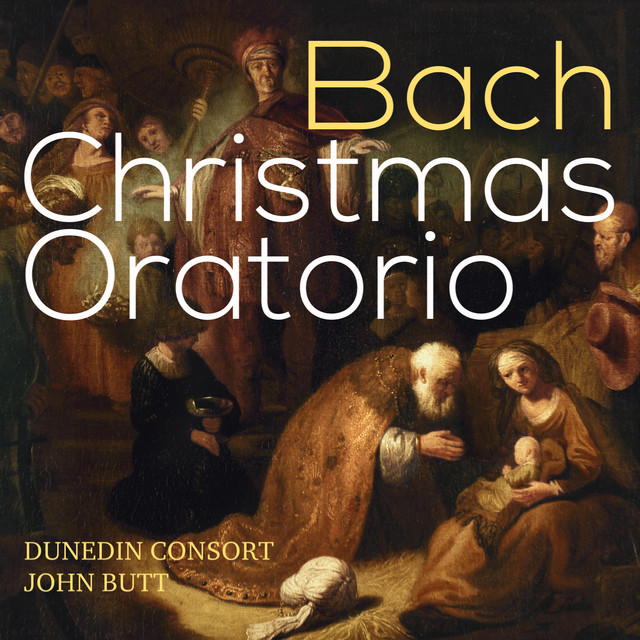
On the Friday Feature for January 2, 2026, I discussed with music historian Markus Rathey some keys to appreciating Johann Sebastian Bach’s Christmas Oratorio. This post presents a summary of that work and numerous musical examples. At the very end of the post is an embedded recording of a complete performance.
An annotated English translation of the Oratorio has been prepared by Michael Marissen and Daniel R. Melamed.
To get started, below is a video from the Netherlands Bach Society’s wonderful “All of Bach” website, in which violinist and conductor Shunske Sato presents some of the historical, liturgical, and musical background to Bach’s marvelous work for Christmas.
As do his Passion settings, Bach’s Christmas Oratorio uses a narrator: a tenor soloist sings as the Evangelist, so-named since the recitatives he sings are texts taken from the Gospels. On the performances of the Oratorio by the Netherlands Bach Society, that role is sung by tenor Daniel Johannsen. In the video below, Johannsen describes how he approaches the responsibility of singing this part.
Outline of the six movements
Known in German as Weihnachts-Oratorium, the Oratorio was performed in Leipzig during the Christmas season of 1734–5 on six separate days:
Part One — On the First Day of the Festival of Christmas (December 25th)
Part Two — On the Second Day of the Festival of Christmas (December 26th, also St. Stephen’s Day)
Part Three — On the Third Day of the Festival of Christmas (December 27th, also St. John’s Day)
Part Four — On New Year’s Day (January 1st, The Feast of the Circumcision of the Lord)
Part Five — On the Sunday after New Year’s (in 1735, January 2nd)
Part Six — On the Feast of the Epiphany (January 6th)
Each of the linked sections above includes a recording of the entire Part under discussion. A recording of the entire work is embedded at the end of this post.
Part One — Rejoicing at the birth
The first part of the Oratorio opens with a joyous chorus, with majestic trumpets and timpani urging all within earshot to vigorous celebration:
Shout, exult, arise, praise the days [of Christmas],
Glorify what the Most High [God] has done this day.
Leave off being fainthearted, banish lamentation;
Break forth into song, full of shouting and gladness.
Serve the Most High with glorious choirs;
Let us revere the name of the ruler [of the universe].
Here’s that chorus — Jauchzet, frohlocket, auf, preiset die Tage — sung by the Dunedin Consort, conducted by John Butt.
The fifth movement of Part 1 — Wie soll ich dich empfangen — presents a marveling prayer from the point of view of each believer. The text is taken from the first of ten stanzas of an Advent hymn by Paul Gerhardt, a hymn that is still included in many hymnals as “O Lord, How Shall I Meet Thee.” The original German text and a translation by Catherine Winkworth is available here. Here is a more literal translation of this stanza by Daniel R. Melamed and Michael Marissen:
How shall I receive you, And how shall I meet you,
Oh [heart’s] desire of all the world,
Oh [wisdom, Jesus, that is the] ornament of my soul?
Oh Jesus, Jesus, indeed set
The torch [of your saving word] by me,
So that whatever brings you enjoyment
May be manifest and known to me.
Listeners new to the Oratorio will probably be surprised that the tune heard in this most festive setting is the tune heard five times in the St. Matthew Passion and sung today on Good Friday as “Oh Sacred Head, sore wounded.” Because of its prominence in that Holy Week context, the melody is known as the Passion Chorale. But it shows up twice in Bach’s Christmas Oratorio, right near the beginning with a prayerful text, and then again in a more emphatic form at the very end of Part Six.
Here is that chorale as performed by the Amsterdam Baroque Choir and Orchestra, conducted by Ton Koopman.
In the seventh movement of Part One, the sopranos sing four lines from a chorale by Luther. At the end of each line, a bass soloist offers a commentary that underscores the significance of what has just been claimed.
He has come on earth poor,
Who will properly extol the love
That our savior harbors for us?
That he might have mercy on us,
Yes, who is capable of perceiving it,
How human suffering moves him?
And might make rich in heaven,
The son of the Most High comes into the world
Because its salvation pleases him so well
And equal to his beloved angels.
That he will even be born as a human being.
Lord, have mercy.
Here is that movement sung by the Choir of Trinity College, Cambridge, with bass soloist Matthew Brook, conducted by Stephen Layton.
Here is a complete performance of Part One by the Netherlands Bach Society, featuring Viola Blache, soprano, Ulrike Malotta, alto, Daniel Johannsen, tenor, Matthias Helm, bass, and Shunske Sato, violin and direction. (Turn on the subtitles to follow an English translation of the performance.)
Part Two — Angels, shepherds, and the power of music
On Volume 135 of the Journal, I interviewed Marcus Rathey about his book, Bach’s Major Vocal Works: Music, Drama, Liturgy (Yale, 2016). In that book he observes: “The recurring theme of the second part of the Christmas Oratorio is the power of music: towards the end of part two, the angels sing their praise of God in their chorus, ‘Ehre sei Gott in der Höhe’ (May honor be to God on high) and thus set a model for human music, which should mirror the sounds of the heavenly realm. The lullaby ‘Schlafe, mein Liebster’ (Sleep, my dearest) (no. 19), uses music to lull the baby Jesus to sleep; and the final chorale of part two confidently confirms that humans and angels are united in one chorus in their praise of Christ: ‘Wir singen dir in deinem Heer’ (We sing to you, amid your host).”
The lullaby-aria that Rathey mentions has long been a favorite concert work for mezzo-soprano and countertenor soloists. Bach had originally composed it as a love-song sung in Laßt uns sorgen, laßt uns wachen, a cantata written for the 11th birthday of Prince Friedrich Christian, Prince Elector of Saxony. The drama in that “secular” cantata was based on an ancient myth, The Choice of Heracles (Hercules). The choice was between Pleasure and Virtue, and the aria sung as an enticing love song in that setting was transformed into a comforting lullaby for baby Jesus in the Oratorio:
Sleep, my most beloved, enjoy your rest,
Awake after this for the flourishing of all [in faith].
Refresh our breast,
Feel our delight
[There] where we gladden our hearts.
Here is this aria sung by Anne Sofie von Otter, with the English Baroque Soloists under John Eliot Gardiner.
In his chapter on the Christmas Oratorio in Bach’s Major Vocal Works, Markus Rathey suggests that the power of music to present meaning without words is evident in the opening movement of Part Two. There we hear a purely instrumental movement — a sinfonia — in which Bach presents a musical dialogue between the strings and flutes of the orchestra (suggesting angels) and the nasal sound of oboes, a sound long associated with shepherds. As Rathey writes, “The sinfonia evokes a bucolic scene, not unlike a shepherd’s scene in a contemporary opera, but it also foreshadows the interaction between the shepherds and the angels. At the beginning, the two instrumental groups are separated. But throughout the movement, the earthly and heavenly orchestras repeatedly play together, and in the final measures they are eventually united when the oboes (shepherds) take over the musical motive from the strings (angels). The unification of celestial and mundane (earthly) choirs, which the closing chorale for part two mentions, is already realized musically in the opening movement.”
You can hear that musical dialogue (and all of Part Two) in this performance by the Netherlands Bach Society, featuring Viola Blache, soprano, Ulrike Malotta, alto, Daniel Johannsen, tenor, Matthias Helm, bass, and Shunske Sato, violin and direction. (Turn on the subtitles to follow an English translation of the performance.)
Part Three — The shepherds go to Bethlehem
The narrative focus of Part Three is the response of the shepherds to the announcement by the angels. Their wonder and joy is expressed in a duet aria sung by soprano and bass:
Lord, your compassion, your mercy
Comforts us and sets us free.
Your gracious favor and love,
Your wondrous impulses,
Make your paternal faithfulness New again [every morning].
Here Lisa Larsson and Klaus Mertens sing this duet with the Amsterdam Baroque Choir and Orchestra conducted by Ton Koopman.
Below is a complete performance of Part Three. The soloists here are Viola Blache, soprano Ulrike Malotta, alto Daniel Johannsen, and tenor Matthias Helm, bass. The Netherlands Bach Society is directed by violinist Shunske Sato.
Part Four — The Feast of the Naming and Circumcision of Jesus
In this — the shortest of the six Parts of the Oratorio — the opening chorus is followed by the words of the Evangelist: “And when eight days were passed and the child was to be circumcised, he was given the name Jesus as he had been called by the angel before he was conceived in his mother’s body.”
Perhaps the most theatrical movements in the Oratorio is the aria sometimes called the “Echo Aria.” It’s basically a duet between soprano and oboe, but each of those two have an echoing performer, often placed off-stage during live performances. Here is the text they are presenting:
Flößt, mein Heiland, flößt dein Namen
Does your name instil, my saviour, does it instil
Auch den allerkleinsten Samen
Even the tiniest seed
Jenes strengen Schreckens ein?
Of that fierce terror?
Nein, du sagst ja selber nein. (Nein!)
No, you yourself say (No!)
Sollt ich nun das Sterben scheuen?
Shall I now be afraid of death?
Nein, dein süßes Wort ist da!
No, your sweet word is there!
Oder sollt ich mich erfreuen?
Or should I rejoice?
Ja, du Heiland sprichst selbst ja. (Ja!)
Yes, you my saviour say it yourself (Yes !)
Here is soprano Lisa Larsson, echoed by Caroline Stam. I don’t know who the oboeists are, as part of Amsterdam Baroque Choir and Orchestra, conducted by Ton Koopman. If you follow the score (which includes a piano reduction of the instrumental parts), you’ll see where the echoing voice is introduced.
Here is all of Part Four. The Netherlands Bach Society is featured again with a different cast of performers than in the first three Parts. Lars Ulrik Mortensen, directs from the organ, with Carine Tinney, soprano, Marta Paklar, echoing soprano, Daniel Johannsen, tenor, and Tomáš Král, bass.
Part Five — The Wise Men meet King Herod
Markus Rathey writes of Part Five that “The entire piece revolves around the juxtaposition of light and darkness — the light of the star that guided the travelers to Bethlehem and the darkness of the plans of the king. But it is also the light of Christ and the darkness of the sinfulness of the human soul, or in the metaphor prevalent in the Christmas Oratorio, the human heart. Everything leads again to the idea of Christ dwelling in the believer’s heart.”
But, as Rathey notes, the libretto for the work is realistic: the text for the final chorale in this movement acknowledges:
Indeed such a room in my heart
Is certainly no fine royal palace
But rather a dark pit;
Yet, as soon as the rays of your mercy
Only gleam within there
It will seem filled with sunlight.
The theme of light and darkness is evident in Part Five’s first aria, in which the bass soloist sings:
Light up, too, my dark inclinations,
Light up my heart
By the clear luminosity of [your] streams [of light]!
Your word shall be the brightest candle to me
In all my [good] works;
This will not let the soul embark upon anything evil.
That aria is sung here by Peter Kooy, with Philippe Herreweghe conducting the Collegium Vocale Gent.
All of Part Five is sung below by Netherlands Bach Society, conducted by organist Lars Ulrik Mortensen. The soloists are Carine Tinney, soprano, Alex Potter, alto, Daniel Johannsen, tenor, and Tomáš Král, bass.
Part Six — The gifts of the Magi
The royal trumpets and drums return for the Feast of the Epiphany. Rathey informs his readers that “Some scholars have described the opening movement as a musical battle scene, a term that captures quite well the tumultuous texture of the instrumental parts and the battle fanfares by the trumpet. It reflects the text, which invokes God’s support and protection against the ‘snorting’ of the ‘insolent enemies.’”
The tenor aria near the end of the work reminds us that Christ’s ultimate victory does not involve a cessations of hostilities during our lifetimes:
Now you insolent enemies might horrify;
[yet] how could you arouse any fear in me?
My Treasure, my Refuge is here with me!
You do still like to feign being fierce;
just [go ahead and] threaten to bring me down completely;
but look! my Saviour dwells here.
Tenor Gerd Türk sings this aria in a performance by the Bach Collegium Japan, conducted by Masaaki Suzuki.
Part Six returns with a chorale, the Passion Chorale (we’ll hear it again during Holy Week when we listen to the St. Matthew Passion). Here the text is triumphant:
Now you [God’s chosen Christians] are well avenged
Of your band of enemies,
For Christ has shattered
What was against you.
Death, devil, sin, and hell
Are well and truly diminished;
The human family
Has its place with God [in eternity].
The Amsterdam Baroque Choir and Orchestra are conducted by Ton Koopman.
Here’s the New London Consort singing all of Part Six of the Christmas Oratorio. Philip Pickett conducting, with Catherine Bott, soprano, Michael Chance, countertenor, Paul Agnew (Evangelist), tenor, Andrew King, tenor, and Michael George, bass.
A complete performance
There are many fine recordings available of Bach’s Christmas Oratorio. The first one I ever heard, and one I go back to frequently, was recorded in 1987 at the iconic Abbey Road Studios in London. In that recording, John Eliot Gardiner directed the Monteverdi Choir and the English Baroque Soloists. Another album released at about the same time (1989) featured the Chorus and Orchestra of Collegium Vocale, Ghent, conducted by Philippe Herreweghe. The recording I listen to the most was made in 2015 by the Dunedin Consort, John Butt, conductor.
None of those recordings are available through YouTube. One of the best available on that platform is a 1997 recording with René Jacobs conducting the RIAS-Kammerchor and the Akademie für Alte Musik Berlin. The soloists are Dorothea Röschmann, soprano; Andreas Scholl, alto; Werner Güra, tenor; and Klaus Häger, bass.
Click on the tags below for listings of related readings or audio features.