
The Church fathers “do not deny to government the right to use force, and for all their aversion to violence they do not assert that killing is under all circumstances morally wrong. Their overt objection to soldiering is to the imposition of pagan rites and oaths. Their attitude to war is different from popular pagan attitudes; instead of excitement and glorying in war, they lament its tragic character and yearn for peace. Yet they are grateful for military action that secures both peace and order.
“Underlying this attitude is a twofold basis. On the one hand, they echo the biblical lament about war even while they recognize the biblical function of government in preserving peace. It is love, rather than rational laws alone, that will overcome violence and show compassion. On the other hand, they echo the natural law: Tertullian acknowledges that there is a common law of God prevailing all over the world and engraved in nature that should be our guide. Lactantius speaks of a natural law of love, rooted in our common humanity created by God, that requires brotherly compassion toward all people, rather than hatred and violence. The natural law, then, is the Creator’s law that both mandates government to defend peace and justice and commands all people to love one another. Were this law obeyed, wars would cease — which is what the just war theory itself affirms.
“Augustine, writing in north Africa shortly after A.D. 400, continues this patristic approach. He, too, recognizes a natural law as well as a biblical mandate both to governments to defend peace and order and to individuals to love their enemies. And he roundly criticizes Cicero’s ideal state for failing to render to God his right: how then could it be a just society? Men are ruled in any case by what they love, not by reason and its knowledge of natural law alone. But Augustine is also realistic about the twistedness of the human condition. It is not often the case that one side is altogether in the right and the other side altogether in the wrong. Nor is it the case that soldiers are always able to be ruled by reason or by love, for passions are excited and the best of moral rules and intentions may be violated. While he endorses just war ideals qualified by love, then, Augustine advises the Christian who goes to war to repent in advance, because the ambiguities of the situation confuse moral issues and because passions confuse the moral intention. He tells the Roman General Boniface, who was later to defend Carthage against the Vandals, that war is not a matter of choice but of necessity, forced on us by the need to control violence in a fallen world. It is waged only to restore peace, so he should preserve the spirit of a peacemaker, limiting violence to what is needed in resisting and deterring aggression, and extending mercy to the vanquished and the captive.
“Augustine’s insights guided much medieval thought. Aquinas applied both natural law and the principle of love to questions about the legitimacy of revolt against tyrannical government and about war, including military tactics like ambush. In the former case, since the use of force belongs only to lawful government, he argues that if a tyrant altogether violates the natural law on which governmental authority rests, it is legitimate only for those next in authority to use force against the tyrant and only to re-establish peace and justice for the common good.
“The sixteenth-century Spanish theologian Francisco de Vitoria develops the theory further. Examining King Philip’s wars against the American Indians, he condemns their lack of just cause. War, he insists, is not justified for religious reasons (to convert the heathen) nor for economic causes (to gain their gold) nor for political reasons (to extend the empire). The Indians, however pagan, immoral and uncivilized, are human beings with rights equal to those of all other persons. The natural law protects them against violence and injustice.
“Vitoria also asks whether the soldier who doubts the justice of a cause should fight. Ordinarily, one should trust the lawful government to do what is lawful. But if justice is seriously in doubt, and if careful inquiry does not allay those doubts, then the soldier should refuse to fight. Selective conscientious objection is the corollary of a just war ethic.
“The groundwork by now was laid. It remained for the Spanish Catholic philosopher Francisco Suarez to systematize the details in relation to the underlying concepts of justice and love, and for the Dutch Protestant jurist, Hugo Grotius, to do a similar job in the context of religious wars that ravaged seventeenth-century Europe. Since no common religious ground could be found, he appealed to the natural law with which the Creator has endowed all men in the light of reason. Grotius’s massive study, The Law of War and Peace, marks the beginning of a body of international law intended to control international conflict, to bring it under the rule of law, and ideally to eliminate war altogether.
“The Protestant Reformers meantime addressed the problem in similar terms. While Luther says little about natural law, he expounded on Aristotle’s concept of justice and extended it from just actions to just intentions. The use of the sword, he argues, is divinely entrusted to governments in order to repel injustice and keep the peace. It can, therefore, be a work of love for the common good. But only defensive war is just, including action to recover unjustly seized property from previous conflicts. This rules out religious wars, aggression and any attempt to revenge an insult. Only the highest governmental authority has the right to initiate military action, so that rebellion is always unjustified. It was on this basis that he opposed the famous Peasants’ Revolt. Yet the ruler, if wrong, should be disobeyed: selective conscientious disobedience is not revolt.
“John Calvin regarded natural law as the moral law of God and appealed to it along with the Scriptures in discussing the authority of government and its right to the selective use of force. War, he allows, is permitted for the defense of peace and justice. Justice means equity, and that requires punishing the aggressor as one does a criminal. Calvin, too, confines this function to the civil authorities, forbidding armed revolt on the grounds that private persons thereby usurp what is the sole prerogative of the highest political authority.”
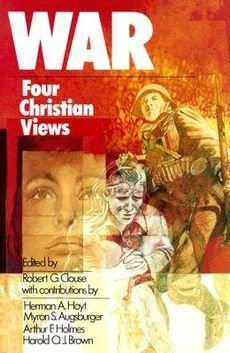
from Arthur F. Holmes, “The Just War,” in Robert G. Clouse, editor, War: Four Christian Views (InterVarsity Press, 1981)
Click on the tags below for listings of related readings or audio features.