
“To [C. S.] Lewis the story of creation in Genesis is mythical, but that does not mean it is untrue. It means rather that it is truer than history itself. The account of Adam and Eve, God and an apple symbolizes clearly a time long ago when catastrophe fell upon mankind. ‘For all I can see,’ says Lewis, ‘it might have concerned the literal eating of a fruit, but the question is of no consequence.’ Indeed, one might ask whether man and history are not actually as mysterious as myth. The great historians are quite agreed that to state the facts of history may be to leave out its essence, since history is made up both of objective, overt actions and also of the joys, agonies, and deep motives of the human soul. Christianity is the Christian creed, but it is also the glorious experience of God in the heart of a believer. We must not think we have a greater thing when we accept the ‘hypostatised abstract nouns’ of a creed as more real than the myth which incorporates them and Reality itself. Melville once remarked that the true places are never down on any map. A myth is indeed to be defined by its very power to convey essence rather than outward fact, reality rather than semblance, the genuine rather than the accidental. It is the difference between the factual announcement of a wedding and the ineluctable joys actually incorporated in the event. Corbin S. Carnell says that for Lewis ‘the great myths of the Bible as well as of pagan literature refer not to the non-historical but rather to the non-describable. The historical correlative for something like the Genesis account of the creation and fall of man may be disputed. But the theological validity of the myth rests on its uniqueness as an account of real creation (out of nothing), on its psychological insight into the rebellious will of man, and on its clear statement that man has a special dignity by virtue of his being made in God’s “image”.’ The historical correlative is less significant than the thing it signifies. All facts are misleading in proportion to their divergence from Eternal Fact.
“Perhaps Marjorie E. Wright has stated it correctly when she says that for Lewis and certain other writers Christianity itself is the great central historical embodiment of myth. ‘It is the archetypal myth of which all others are more or less distorted images.’ Christ is the great Reality which makes every other reality a jarring note and cracked vessel. The trouble is, says Lewis, that we are so inveterately given to factualizing Christian truth it is practically impossible for us to hear God when He says that one day he will give us the Morning Star and cause us to put on the splendor of the sun. It is when we begin to assent to such Scripture that ‘we may surmise that both the ancient myths and the modern poetry, so false as history, may be very near the truth as prophecy. At present we are on the outside of the world, the wrong side of the door. We discern the freshness and purity of morning, but they do not make us fresh and pure. We cannot mingle with the splendours we see. But all the leaves of the New Testament are rustling with the rumour that it will not always be so. Some day, God willing, we shall get in.’ In The Pilgrim’s Regress John was troubled about Wisdom’s remark that because no man could really come where he had come, his adventures were only figurative, but at that moment a Voice spoke to John saying: ‘Child, if you will, it is mythology.
It is but truth, not fact: an image, not the very real. But then it is My mythology. The words of Wisdom are also myth and metaphor: but since they do not know themselves for what they are, in them the hidden myth is master, where it should be servant: and it is but of man’s inventing. But this is My inventing. This is the veil under which I have chosen to appear even from the first until now. For this end I made your senses and for this end your imagination, that you might see my face and live.’ Thus it is clear that for Lewis myth, so far from being falsehood, is the best means of embodying those ultimates that transcend fact.
“Only once did myth ever become fact and that was when the Word became flesh, when God became man. ‘This is not “a religion”, nor “a philosophy”. It is the summing up and actuality of them all.’”
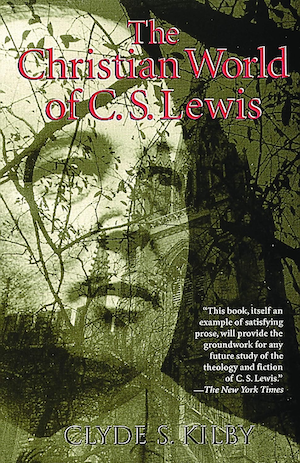
— from Clyde S. Kilby, The Christian World of C. S Lewis (Eerdmans, 1964)
Click on the tags below for listings of related readings or audio features.