
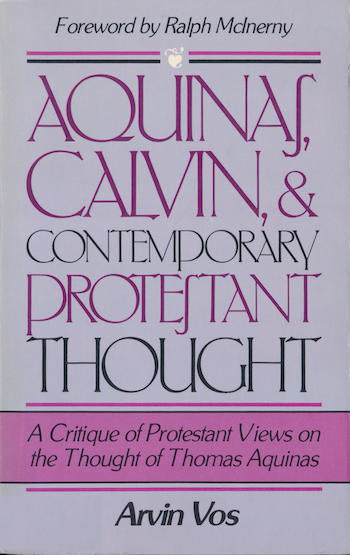
“Ignorance of Aquinas’s culture and times has contributed to misunderstandings of his use of philosophy. Contemporary Protestant opinion is still largely shaped by the rhetoric and the ideals of the sixteenth-century Reformation, which was itself deeply molded not only by a return to the gospel but also by the fourteenth- and fifteenth-century Italian Renaissance. It is well known that a recovery of past knowledge was key to the Italian Renaissance, but the process of this recovery was not unique to that era. Aquinas also lived during a period of renaissance; the treasures of the ancient world were being recovered and assimilated in the thirteenth century as well. And yet there were decisive differences between the earlier and the later movements. These differences have contributed to a number of misconceptions. I would like to look at three of them in order to get a better perspective on the problem.
“First we ought to note that Aquinas’s way of dealing with the past is very different from that found among the later Humanists, the Reformers, and ourselves. Scholars of later generations have tended to return to the ancients in order to study them for their own sake, but Aquinas sought out their ideas in order to make them live anew in his own setting. Aquinas approached Aristotle, for instance, with the intent of appropriating such truth as he could from the philosopher and incorporating it into considerations of the issues that were important in his own day. He does not simply recapitulate Aristotle; rather, he silently corrects and enriches his position. He employs Aristotelian principles in contexts and ways Aristotle never used them. In doing this Aquinas was doing something quite similar to what his contemporaries did in the areas of liturgical drama, painting, and the like, when they took Bible stories and treated them as if they were contemporaneous.
“In contrast to Aquinas and his contemporaries, who tended to study the ancients in order to put their wisdom to practical use, the later Humanists (our generation included) have tended to study the ancients for their own sake. It has been their concern to determine just what the views of the ancients were. Such an approach naturally accentuates the differences between the ancients and ourselves; indeed, contemporary scholarship tends to focus almost exclusively on how our own views differ from and go beyond those of our predecessors rather than on how their views are applicable to our concerns. For someone steeped in the Humanist perspective, Aquinas’s use of Aristotle is likely to be very perplexing. Being oriented to differences rather than agreements, when we observe Aquinas utilizing Aristotle we are inclined to think first of the historical Aristotle who held that the universe is uncreated and eternal, that man is a being who belongs to a lower changing world but in part also to a higher eternal and divine world, that there is no personal immortality, and so on. Naturally one thinking in these terms will wonder how Aquinas could have considered such a view to be compatible with his own. If he had simply adopted the historical Aristotle, there would be large chunks of undigested paganism in his theology. Only if we recognize that his way of dealing with the past is very different from our own can we see that what Aquinas attempted is not impossible.
“Moderns encountering Aquinas’s method of utilizing Aristotle for the first time are also likely to suspect that he is relying slavishly upon the past. It may well appear to such an observer that the mere fact that Aristotle said something is reason enough for Aquinas to accept it as true. This does indeed seem to have been the case with a number of Aquinas’s contemporaries; Siger of Brabant in particular, along with some other radical Aristotelians, seems to have fallen into the error of identifying philosophy exclusively with the thought of Aristotle. But Aquinas himself maintained that authority is the weakest argument in matters related to human reason (see ST, la. 1, 8 ad 2m). He states that ‘the study of philosophy is not done in order to know what men have thought, but rather to know how truth herself stands.’”
— from Arvin Vos, Aquinas, Calvin, and Contemporary Protestant Thought: A Critique of Protestant Views on the Thought of Thomas Aquinas (Christian University Press, 1985)
Click on the tags below for listings of related readings or audio features.