
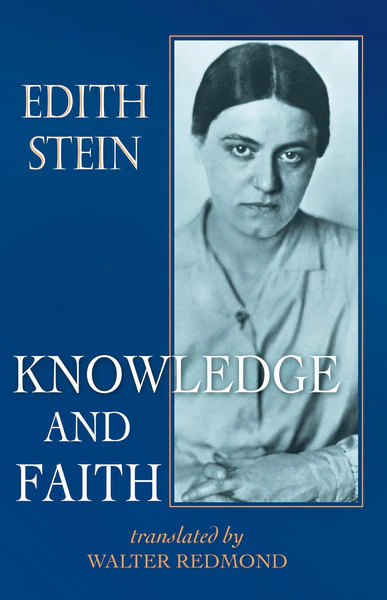
Edith Stein was canonized by John Paul II on October 11, 1998. Born in 1891 into an observant Jewish family in what is now part of Poland, Edith Stein was the youngest of 11 children and apparently her mother’s favorite. An extremely precocious child, she manifested at an early age a passion for the truth, but as she grew up, the faith of her family receded from importance. As Phyllis Zagano has noted, “She did not necessarily repudiate Judaism; more strictly she simply stopped thinking about God. By her own account, she believed in nothing from the ages of fifteen to twenty-four, but her education was a search for the truth that ended when she found her truth in Christianity. Her autobiography reports in detail her relations with her brothers and sisters, her classmates and friends, and how her intellectual quest gradually replaced these personal relationships.”
When she began her university studies, she studied history and was interested in the newly developing discipline of psychology. But her reading of Edmund Husserl’s recently published Logical Investigations introduced her to the philosophical method of phenomenology, and prompted her to transfer to the University of Göttingen to study with him. She eventually became his assistant, collating and editing many of his writings.
In 1922, Edith Stein was baptized a Roman Catholic, and in 1933 she became a Carmelite novice, taking the name Teresa Benedicta of the Cross. In the summer of 1942, she was arrested by the SS and taken to the Auschwitz concentration camp, where she was quickly executed, becoming one of many 20th century martyrs.
You can see a listing of the interviews about Edith Stein’s life and work that are currently in our catalogue here. Meanwhile, the video below (produced by the Institute of Carmelite Studies) explores some aspects of the Christian witness presented by this 20-century martyr. In this podcast conversation, Fr. Pier Giorgio Pacelli, O.C.D. and Br. John-Mary Winter, O.C.D. discuss Edith Stein’s autobiography, Life in a Jewish Family, 1891–1916 (English edition by ISC Publications, 1999), using it as a springboard to explore empathy, relational connection, growth in character and closeness with God, and what we learn from our own stories as well as those of others.
Click on the tags below for listings of related readings or audio features.