
“Human knowledge is never neutral, dispassionate, timeless or without perspective. Instead, it is always interpretive. Interpretation means that we gather the various fragments of knowledge into a more or less meaningful whole through a complex grid of intuitions, received ideas, social practice and conventions, likes and dislikes. Interpretation thus always requires personal integration of facts into a framework of meaning, and this integration requires imagination and narrative. To make meaning is to tell stories, which is why literature continues to be central for our cultural memory and outlook. While there remain important differences between knowledge in the human and natural sciences, the interpretive nature of knowledge is true for both.
“One fundamental, unquestioned or tacit assumption of science is, for example, a universe rational enough to make science possible. Such basics as measurements, computations and algebraic equations require a predetermined framework that the scientist cannot question if he or she wants to arrive at any knowledge at all. The integration of isolated facts into a meaningful whole demands our personal commitment to these tacit frameworks. Hence we may conclude with the philosopher of science Michael Polanyi that ‘two functions of the mind are jointly at work from the beginning to the end of an inquiry. One is the deliberatively active power of the imagination; the other is a spontaneous process of integration which we may call intuition.’
“In other words, the actual process of how we come to know things itself denies the bifurcation by secular reason of knowledge into public fact and private value. As Polanyi observes,
If personal participation and imagination are essentially involved in science as well as in the humanities, meanings created in the sciences stand in no more favoured relation to reality than do meanings created in the arts, in moral judgments and in religion… since the dichotomy between facts and values no longer seems to be a real distinction upon which to hang any conclusion.
From this first insight into the interpretive nature of truth follows another, namely, that all human knowing proceeds in a way we normally associate with religious knowledge, that is, as ‘a faith seeking understanding.’ All of us have some basic worldview in place, a pre-understanding of reality and a tacit self-understanding that guides our research and is enriched by it. Research in science and religion proceeds in the same way, by clarifying and modifying an existing worldview as far as possible before yielding to a different framework of meaning.
A third insight that challenges the assumptions of secularist reason has to do with the nature of authority. The postmodern critique of rationalism has helped us see that we do not arrive at conclusions independently but always rely on tradition and authority. While Western individualism is increasingly coming under attack from academics and intellectuals, our culture as a whole still operates on a thoroughly individualistic self-understanding. We approach knowledge the way teenagers approach parental authority: ‘no one tells me what to think.’ Like teenagers, we harbor the illusion of thinking in a context-free vacuum, literally making up our minds. Consequently, we lump together tradition, authority and indoctrination, equate them with coercion and reject any intrusion on the pure slate of our autonomous minds. This attitude explains not only many first-year students’ defiance toward traditional liberal arts subjects they consider useless, but also the ridiculous distinction we make between secular and religious orientations in education. According to this distinction, secular public schools are on a neutral fact-finding mission, whereas private religious institutions are obviously engaging in indoctrination.
Yet this illusion too is crumbling. As the literary critic Stanley Fish argues in his book The Trouble with Principle, ‘Just as you cannot have education without authoritative selection, so you can’t have consciousness without authoritative selection, and one you didn’t make. . . . The choice is never between indoctrination and free inquiry but between different forms of indoctrination issuing from different authorities.’ Fish’s point is that everyone thinks on the basis of some authority. That is not something we can or even should avoid; that is simply how growing in knowledge and insight works.”
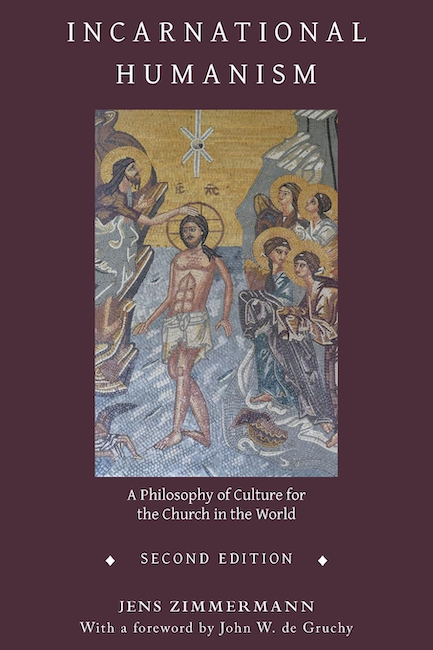
— from Jens Zimmerman, Incarnational Humanism: A Philosophy of Culture for the Church in the World, second edition (Regent College Publishing, 2024)
Click on the tags below for listings of related readings or audio features.