
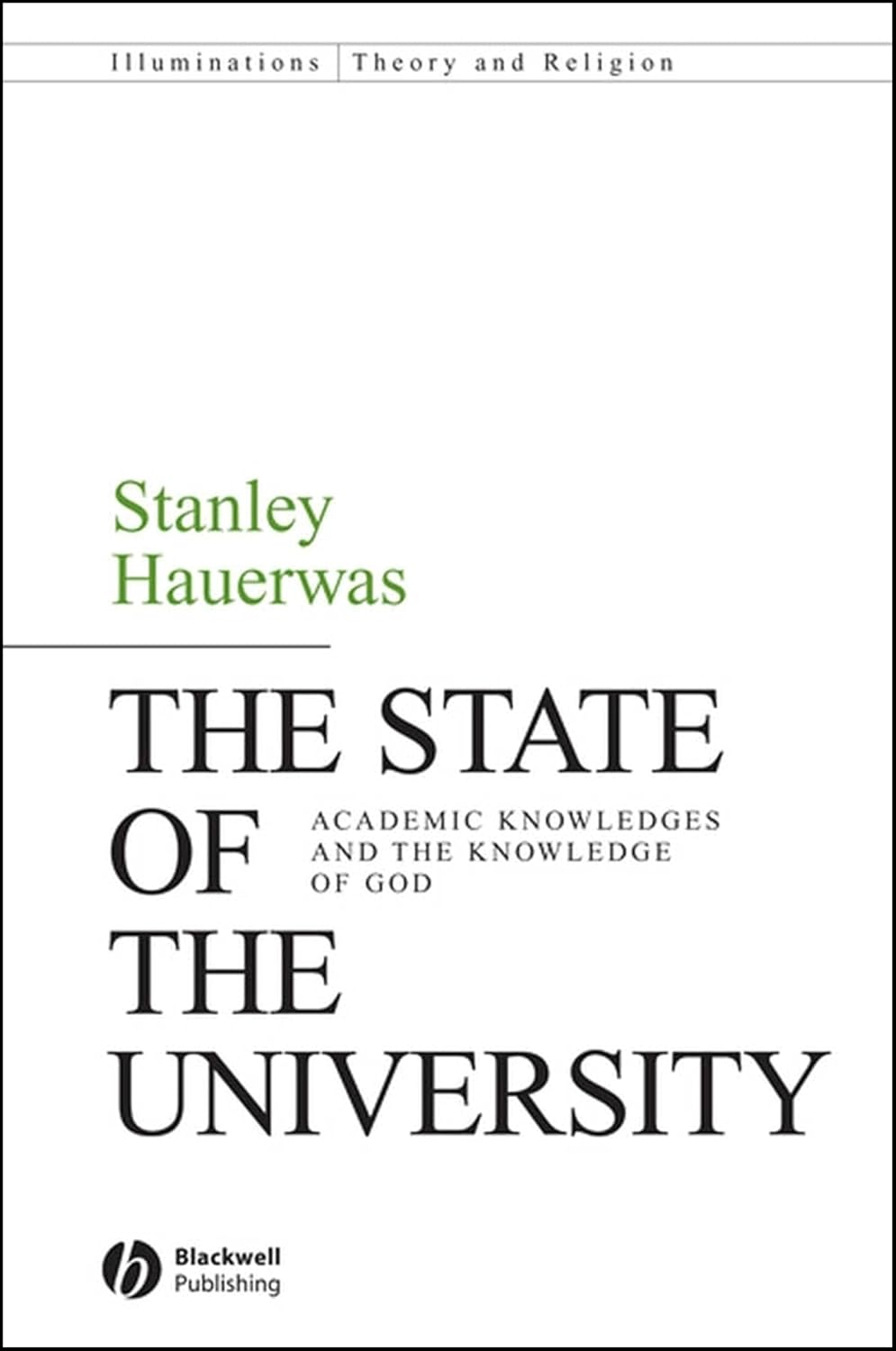
In his anthology The State of the University: Academic Knowledges and the Knowledge of God (Blackwell Publishing, 2007), Stanley Hauerwas offers some observations inspired by Luigi Giussani’s The Risk of Education. He reflects on the fact that, in the past 50 years, a large number of college-educated people have dropped out of the church.
“I think it would be a mistake not to take seriously that what many learned, or thought they were learning, in colleges and universities led them to abandon Christianity. That students took course after course in which there was no discernible connection to Christian claims about the way things are surely created the conditions that made the conclusion that Christianity is at best irrelevant, and at worse false, hard to avoid. In other words, I suspect that many people who leave their Christianity behind after they have gone to college do so because they have been created by God to desire the truth. Yet that desire has been formed by knowledges that seem to make it impossible for them to think that what Christians believe could be true. At best they assume the church may be important for spiritual or moral issues, but those spheres of life are not assumed to be about truth.
“The strategy of many Christian colleges and universities, both Catholic and Protestant, unfortunately served to underwrite the presumption that the ‘Christian’ part of education did not have to do with ‘truth.’ What made a school ‘Christian’ was not the content of the courses, but a concern for the ‘whole student.’ Student life, therefore, became the locus for any expression of Christianity. The relegation of strong religious beliefs to the ‘personal’ side of life in modern universities reflected the distinction between the private and the public imposed on the church by liberal political regimes. Christian theologians aided this development by underwriting what Douglas Sloan identifies as a two-realms theory of truth. Such a view distinguished the truths of science — which was thought to be objective and impersonal — from the truths of faith, which are then called subjective, grounded as they are in feelings, convention, or ‘common human experience.’
“These attempts to forge a ‘peace treaty’ between the Christian faith and what were assumed to be more objective modes of knowledge that were the hallmark of the university are increasingly being called into question. Unfortunately, however, the critics that are challenging the forms of knowledge that so dominate the contemporary university are not drawing on the resources of Christian theology. Indeed the challenges too often seem to make problematic whether we can know anything at all. As a result, too often the critics of modernity only underwrite the fragmentation of the university curriculums. As a result, Alasdair MacIntyre observes:
What the Catholic faith confronts today in American higher education and indeed in American education more generally is not primarily some range of alternative beliefs about the order of things, but rather a belief that there is no such thing as the order of things of which there could be a unified, if complex, understanding or even a movement toward such an understanding. There is on this contemporary view nothing to understand except what is supplied by the specialized and professionalized disciplines and subdisciplines. Higher education has become a set of assorted and heterogeneous specialized enquiries into a set of assorted and heterogeneous subject-matters, and general education is a set of introductions to these enquiries together with a teaching of the basic skills necessary for initiation into them, something to be got through in order to advance beyond it into the specialized disciplines. The undergraduate major, when taught by those whose training has led them to presuppose this view — for it is often taken for granted, rather than explicitly stated — becomes increasingly no more than a prologue to graduate school, even for those who will never go to graduate school. And graduate school becomes a place where narrowness of mind is inculcated as a condition for success within each particular discipline in terms defined by its senior practitioners.
“MacIntyre makes clear he is not against specialization — because any discipline, even philosophy, cannot do its work well without detailed investigations. Yet in modern university curriculums, every course threatens to be an introductory course, because the faculties even in their individual disciplines cannot agree what needs to be learned first to make later learning possible.”
Hauerwas goes on to point out that MacIntyre believes that Catholic universities need to “recognize the significance of philosophy for any serious education that has any pretense to inculcate in students the skills necessary for those who would love the truth. . . . Yet of equal importance, according to MacIntyre, is the study of theology. Catholic teaching rightly maintains that the natural order of things cannot be adequately understood by reason if reason is divorced form the recognition that all that is has been brought into being by God and is directed to the ends to which God orders creation. What is learned from nature about God, MacIntyre notes, will always be meager as well as subject to the human limitation and distortions resulting from our sinfulness. Yet it remains the case that ‘universities always need both the enlargement of vision and the correction of error that can be provided only from a theological standpoint, one that brings truths of Christian revelation to bear on our studies.’”
— from Stanley Hauerwas, “How Risky Is The Risk of Education? Random Reflections from the American Context,” in The State of the University: Academic Knowledges and the Knowledge of God (Blackwell Publishing, 2007)
Click on the tags below for listings of related readings or audio features.