
“God comes to us on all sides through the world; it is his Being that comes to solicit our attention. We ought to be able to meet him anywhere and recognize him everywhere. Whether we consider the ‘great world’ or the ‘little world,’ the cosmos that surrounds us or our own spirit, everything real that comes within our orbit is by the whole of itself, and first of all by virtue of its existence, the symbol and the sign of God; not an artificial sign of some kind or other, deliberately chosen and valid by convention, but a natural and, for us, a necessary symbol. It is an ontological sign which we cannot discard or emancipate ourselves from. God is not seen directly or apart from a sign; but God can be seen everywhere, through the world, however obscurely. Every creature is, in itself, a theophany. Everywhere we find traces, imprints, vestiges, enigmas; and the rays of the divinity pierce through everywhere. Everything is drenched in that unique Presence. Everything becomes transparent ‘to a pure gaze and a steady eye.’ If our knowledge, like our ignorance, troubles our contemplation, if our mind’s eye cannot see beyond the outer shell of the world, if we are open to nothing sacred — or if, on the contrary, the world seems ‘full of gods’ — that is because our sight is blurred. It is only too true; the world conceals God more than it reveals him. Things have become opaque. And yet it remains true that the Creator ‘has scattered the reflections of his divine perfections upon his creatures, and that thanks to those visible lights we are able to know, by analogy, the splendours of the inaccessible Creator.’” [quotation from Théodore de Régnon, S.J., Étude sur la Sainte Trinité, vol. 3 (1898)]
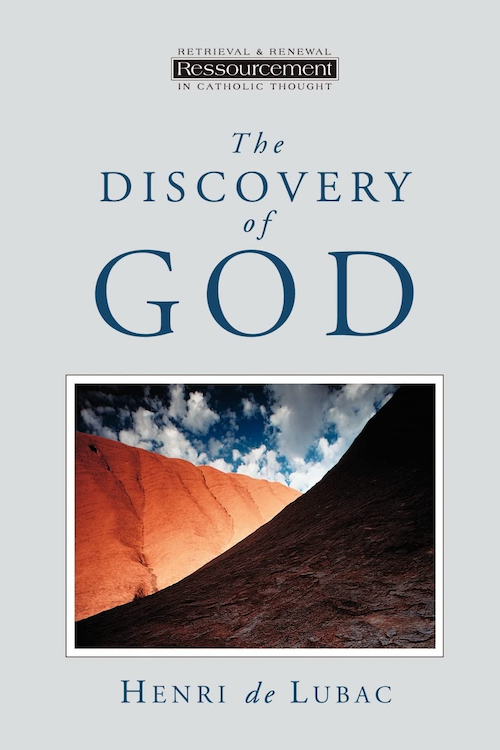
— from Henri de Lubac, The Discovery of God (Eerdmans, 1956)
Click on the tags below for listings of related readings or audio features.